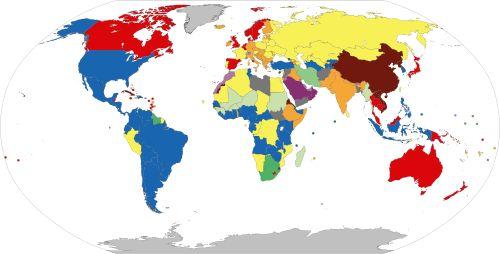
Materials covered in this trivia questions quiz
Study Hint 1
Question: In the context of elected representative democracy, what distinguishes it from a liberal democracy, according to the provided information?
Trivia Question Study Fact: Representative democracy, a common form of governance in modern Western nations, functions by electing delegates to represent the populace, differing from direct democracy where citizens vote on policies themselves. While often associated with liberal democracies and features like free elections, a representative democracy doesn't necessarily guarantee a fully established rule of law or comprehensive individual rights beyond the voting process.
Trivia Question Explanation: Representative democracies can operate with multiparty elections but may not always prioritize or fully implement a robust rule of law or broad protections for individual and minority rights beyond the electoral process.
Return to Question
Study Hint 2
Question: In the context of a parliamentary system, the head of government is considered…
Trivia Question Study Fact: In a parliamentary system, the head of government, unlike in a presidential system, gains their legitimacy and position by maintaining the confidence of the parliament. This means they must be able to command the support of a majority of the legislative body and are accountable to it, potentially facing removal through a majority vote.
Trivia Question Explanation: The head of government in a parliamentary system derives their legitimacy from the support of a majority in parliament and remains in power only as long as they maintain that confidence, making them directly accountable to the legislature.
Return to Question
Study Hint 3
Question: In the context of a parliamentary republic, how does the executive branch fundamentally differ from that of a presidential system?
Trivia Question Study Fact: A parliamentary republic distinguishes itself from a presidential system by the executive branch's accountability to the legislature, meaning the government's legitimacy and continued existence depend on maintaining the confidence of parliament. While some parliamentary republics may combine the roles of head of state and head of government, this differs from a presidential system because the executive still relies on parliamentary confidence to remain in power.
Trivia Question Explanation: Parliamentary republics are defined by the executive branch needing the support of the legislature to govern, unlike presidential systems where the executive is elected independently and does not rely on legislative confidence.
Return to Question
Study Hint 4
Question: In the context of parliamentary republics with an executive presidency, how does the executive branch’s relationship with the legislature differ from that of a conventional presidential system?
Trivia Question Study Fact: A parliamentary republic with an executive presidency blends elements of both parliamentary and presidential systems. Unlike traditional parliamentary systems, it combines the roles of head of state and head of government into a single executive president. However, this president’s legitimacy and continued tenure depend on maintaining the confidence of the legislature, distinguishing it from a purely presidential system where the executive is independent of the legislative branch.
Trivia Question Explanation: In a parliamentary republic with an executive presidency, the president’s power is fundamentally linked to the legislature’s support, meaning they must maintain the legislature’s confidence to stay in office, a key difference from presidential systems where the executive and legislature are separate and independently elected.
Return to Question
Study Hint 5
Question: In the context of a presidential system, how is the executive branch’s authority fundamentally different from that of a parliamentary system?
Trivia Question Study Fact: In a presidential system, the executive branch, led by the president, operates independently from the legislative branch, gaining its legitimacy from a separate source like a direct election by citizens. This contrasts with a parliamentary system where the executive's power is contingent on maintaining the confidence of the legislature, allowing the legislature to remove the head of government.
Trivia Question Explanation: A presidential system establishes a separation of powers, meaning the executive branch, headed by the president, gains its authority from a source separate from the legislature, such as a direct election, unlike a parliamentary system where the executive relies on the legislature’s confidence.
Return to Question
Study Hint 6
Question: In the context of a semi-presidential republic, how does the accountability of the cabinet differ from that in a presidential system?
Trivia Question Study Fact: A semi-presidential republic distinguishes itself from both parliamentary and presidential systems. Unlike a parliamentary republic, it features an executive president who is not dependent on the legislature. However, unlike a presidential system, the cabinet in a semi-presidential republic, despite being appointed by the president, is accountable to the legislature and can be removed through a vote of no confidence.
Trivia Question Explanation: In a semi-presidential republic, the cabinet, though named by the president, maintains responsibility to the legislature, meaning the legislature can force its resignation through a motion of no confidence, a feature absent in presidential systems.
Return to Question
Study Hint 7
Question: In the context of 'List of countries by system of government', a parliamentary system is considered…
Trivia Question Study Fact: The 'List of countries by system of government' categorizes sovereign states based on their legally established governmental structures as defined by their constitutions. This classification focuses solely on the *de jure* system, meaning the officially recognized system, and does not evaluate factors like democratic practices, levels of corruption, or governmental effectiveness.
Trivia Question Explanation: The list categorizes countries based on their *de jure* systems of government, which are formally established through constitutional law, rather than assessing qualities like democracy or political stability.
Return to Question
Study Hint 8
Question: In the context of Belgium, a parliamentary system is considered particularly intricate because of what defining characteristic?
Trivia Question Study Fact: Belgium operates as a parliamentary constitutional monarchy, but its governmental structure is notably complex due to its federal system and significant regional and linguistic divisions. The country is divided into three autonomous regions – Flanders, Wallonia, and the Brussels-Capital Region – and is home to Dutch, French, and German-speaking communities, resulting in a system comprised of six different governments.
Trivia Question Explanation: Belgium's parliamentary system is uniquely complex due to the high degree of autonomy granted to its regions (Flanders, Wallonia, and Brussels-Capital Region) and the presence of distinct linguistic communities, leading to a multi-layered governmental structure.
Return to Question
Study Hint 9
Question: In the context of liberal democracy, a parliamentary system is distinguished by its relationship to which other governmental structures?
Trivia Question Study Fact: Within a liberal democracy, a parliamentary system is just one of several possible constitutional forms a government can take, alongside presidential and semi-presidential systems. These systems are distinguished by how executive and legislative powers are distributed, but all operate within the broader framework of democratic principles like elections, separation of powers, and the rule of law.
Trivia Question Explanation: Liberal democracies can function with parliamentary, presidential, or semi-presidential systems, demonstrating that a parliamentary system is one option among several for organizing governmental power within a democratic framework.
Return to Question
Study Hint 10
Question: In the context of United States federal executive departments, parliamentary systems are considered…
Trivia Question Study Fact: While the United States operates under a presidential system with a head of government who is also the head of state, its federal executive departments function similarly to ministries found in parliamentary systems, serving as the administrative arms of the president. However, unlike parliamentary systems, these departments are led by an individual who simultaneously embodies both executive and symbolic national leadership.
Trivia Question Explanation: Parliamentary systems typically distribute power between a head of government (like a prime minister) and a head of state (like a monarch or president), whereas the US presidential system consolidates these roles into one individual.
Return to Question