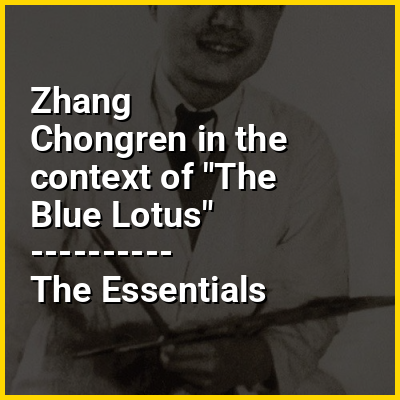
Zhang Chongren (27 September 1907 – 8 October 1998), also known as Chang Chong-jen, was a Chinese sculptor best remembered in Europe as a friend of Hergé, the Belgian cartoonist and creator of The Adventures of Tintin. The two met when Zhang was an art student in Brussels. Zhang served as the inspiration for Chang Chong-Chen, a recurring character in the Tintin stories.
The Blue Lotus (French: Le Lotus bleu) is the fifth volume of The Adventures of Tintin, the comics series by Belgian cartoonist Hergé. Commissioned by the conservative Belgian newspaper Le Vingtième Siècle for its children's supplement Le Petit Vingtième, it was serialised weekly from August 1934 to October 1935 before being published in a collected volume by Casterman in 1936. Continuing where the plot of the previous story, Cigars of the Pharaoh, left off, the story tells of young Belgian reporter Tintin and his dog Snowy, who are invited to China in the middle of the 1931 Japanese invasion, where Tintin reveals the machinations of Japanese spies and uncovers a drug-smuggling ring.
In creating The Blue Lotus, Hergé exhibited a newfound emphasis on accuracy and documentation in his portrayal of foreign societies. He was heavily influenced by his close friend Zhang Chongren, a Chinese student studying in Belgium, and the work both satirises common European misconceptions about China as well as criticising the actions of the Japanese invaders. The Blue Lotus was a commercial success in Belgium and was soon serialised in France and Switzerland, while news of the book led the Chinese political leader Chiang Kai-shek to invite Hergé to visit China. Hergé continued The Adventures of Tintin with The Broken Ear, while the series itself became a defining part of the Franco-Belgian comics tradition. In 1946, The Blue Lotus was partially re-drawn and coloured by the cartoonist and his team of assistants; during this process a number of minor plot elements were changed. The adventure introduces the recurring characters J.M. Dawson and Chang Chong-Chen. The story was adapted for a 1991 episode of the Ellipse/Nelvana animated series The Adventures of Tintin. Critical analysis of the story has been positive, with various commentators considering it to be one of Hergé's finest works.
Georges Prosper Remi (French:[ʒɔʁʒpʁɔspɛʁʁəmi]; 22 May 1907 – 3 March 1983), known by the pen name Hergé (/ɛərˈʒeɪ/air-ZHAY; French:[ɛʁʒe]), from the French pronunciation of his reversed initials RG, was a Belgian comic strip artist. He is best known for creating The Adventures of Tintin, the series of comic albums that are considered one of the most popular European comics of the 20th century. He was also responsible for two other well-known series, Quick & Flupke (1930–1940) and The Adventures of Jo, Zette and Jocko (1936–1957). His works were executed in his distinctive ligne claire drawing style.
Born to a lower-middle-class family in Etterbeek, Brussels, Hergé began his career by contributing illustrations to Scouting magazines, developing his first comic series, The Adventures of Totor, for Le Boy-Scout Belge in 1926. Working for the conservative Catholic newspaper Le Vingtième Siècle, he created The Adventures of Tintin in 1929 on the advice of its editor Norbert Wallez. Revolving around the actions of boy reporter Tintin and his dog Snowy, the series' early instalments – Tintin in the Land of the Soviets, Tintin in the Congo, and Tintin in America – were designed as conservative propaganda for children. Domestically successful, after serialisation the stories were published in book form, with Hergé continuing the series and also developing both the Quick & Flupke and Jo, Zette and Jocko series for Le Vingtième Siècle. Influenced by his friend Zhang Chongren, from 1934 Hergé placed far greater emphasis on conducting background research for his stories, resulting in increased realism from The Blue Lotus onward. Following the German occupation of Belgium in 1940, Le Vingtième Siècle was closed, but Hergé continued his series in Le Soir, a popular newspaper controlled by the Nazi administration.
The town was also once the residence of the noted painter Zhang Chongren, a friend of the Belgian cartoonist Hergé, on whom the character Chang Chong-Chen from "The Adventures of Tintin" was based.Qibao is also known for crickets (with a "Cricket House") in the Qibao Old Town area.