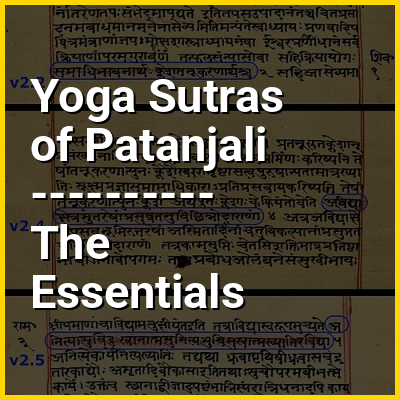
The Yoga Sutras of Patañjali (IAST: Patañjali yoga-sūtra) is a compilation "from a variety of sources" of Sanskrit sutras (aphorisms) on the practice of yoga – 195 sutras (according to Vyāsa and Krishnamacharya) and 196 sutras (according to others, including BKS Iyengar). The Yoga Sutras were compiled in India in the early centuries CE by the sage Patanjali, who collected and organized knowledge about yoga from Samkhya, Buddhism, and older Yoga traditions, and possibly another compiler who may have added the fourth chapter. He may also be the author of the Yogabhashya, a commentary on the Yoga Sutras, traditionally attributed to the legendary Vedic sage Vyasa, but possibly forming a joint work of Patanjali called the Pātañjalayogaśāstra.
The Yoga Sutras draw from three distinct traditions from the 2nd century BCE to the 1st century CE, namely Samkhya, Buddhism traditions, and "various older ascetic and religious strands of speculation." The Yoga Sutras are built on Samkhya notions of purusha and prakriti, and are often seen as complementary to it. It is closely related to Buddhism, incorporating some of its terminology. While there is "an apparent lack of unity and coherence," there is a "straightforward unity to the text," which focuses on "one-pointed awareness" (ekagrata) and "content-free awareness" (nirvikalpa samadhi); the means to acquire these, namely kriya yoga ("action yoga") and ashtanga yoga (eight-limb yoga); the results acquired from the attainment of these levels of awareness; and the final goal of yoga, namely kaivalya and liberation.