World War II casualties in the context of "Red Army"

Play Trivia Questions online!

or

Skip to study material about World War II casualties in the context of "Red Army"

Ad spacer

⭐ Core Definition: World War II casualties

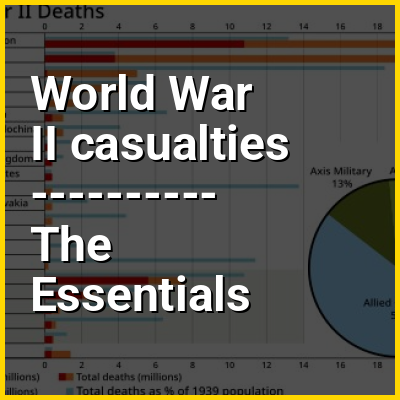
World War II was the deadliest military conflict in history. An estimated total of 70–85 million deaths were caused by the conflict, representing about 3% of the estimated global population of 2.3 billion in 1940. Deaths directly caused by the war (including military and civilian fatalities) are estimated at 50–56 million, with an additional estimated 19–28 million deaths from war-related disease and famine. Civilian deaths totaled 50–55 million. Military deaths from all causes totaled 21–25 million, including deaths in captivity of about 5 million prisoners of war. More than half of the total number of casualties are accounted for by the dead of the Republic of China and of the Soviet Union. The following tables give a detailed country-by-country count of human losses.

Recent historical scholarship has shed new light on the topic of Second World War casualties. Research in Russia since the collapse of the Soviet Union has caused a revision of estimates of Soviet World War II fatalities. According to Russian government figures, USSR losses within postwar borders now stand at 26.6 million, including 8 to 9 million due to famine and disease. In August 2009 the Polish Institute of National Remembrance (IPN) researchers estimated Poland's dead at between 5.6 and 5.8 million. Historian Rüdiger Overmans of the Military History Research Office (Germany) published a study in 2000 estimating the German military dead and missing at 5.3 million, including 900,000 men conscripted from outside of Germany's 1937 borders, in Austria, and in east-central Europe. The Red Army claimed responsibility for the majority of Wehrmacht casualties during World War II. The People's Republic of China puts its war dead at 20 million, while the Japanese government puts its casualties due to the war at 3.1 million. An estimated 7–10 million people died in the Dutch, British, French and US colonies in South and Southeast Asia, mostly from war-related famine.
↓ Menu

>>>PUT SHARE BUTTONS HERE<<<
In this Dossier

World War II casualties in the context of World War II

World War II or the Second World War (1 September 1939 – 2 September 1945) was a global conflict between two coalitions: the Allies and the Axis powers. Nearly all of the world's countries participated, with many nations mobilising all resources in pursuit of total war. Tanks and aircraft played major roles, enabling the strategic bombing of cities and delivery of the first and only nuclear weapons ever used in war. World War II is the deadliest conflict in history, causing the death of 70 to 85 million people, more than half of whom were civilians. Millions died in genocides, including the Holocaust, and by massacres, starvation, and disease. After the Allied victory, Germany, Austria, Japan, and Korea were occupied, and German and Japanese leaders were put on trial for war crimes.

The causes of World War II included unresolved tensions in the aftermath of World War I, the rise of fascism in Europe and militarism in Japan. Key events preceding the war included Japan's invasion of Manchuria in 1931, the Spanish Civil War, the outbreak of the Second Sino-Japanese War in 1937, and Germany's annexations of Austria and the Sudetenland. World War II is generally considered to have begun on 1 September 1939, when Nazi Germany, under Adolf Hitler, invaded Poland, after which the United Kingdom and France declared war on Germany. Poland was divided between Germany and the Soviet Union under the Molotov–Ribbentrop Pact. In 1940, the Soviet Union annexed the Baltic states and parts of Finland and Romania. After the fall of France in June 1940, the war continued mainly between Germany, now assisted by Fascist Italy, and the British Empire, with fighting in the Balkans, Mediterranean, and Middle East, the aerial Battle of Britain and the Blitz, and the naval Battle of the Atlantic. Through campaigns and treaties, Germany gained control of much of continental Europe and formed the Axis alliance with Italy, Japan, and other countries. In June 1941, Germany invaded the Soviet Union, opening the Eastern Front and initially making large territorial gains.

↑ Return to Menu

World War II casualties in the context of Eastern Front (World War II)

The Eastern Front, also known as the Great Patriotic War in the Soviet Union and its successor states, and the German–Soviet War in modern Germany and Ukraine, was a theatre of World War II fought between the European Axis powers and Allies, including the Soviet Union (USSR) and Poland. It encompassed Central Europe, Eastern Europe, Northeast Europe (Baltics), and Southeast Europe (Balkans), and lasted from 22 June 1941 to 9 May 1945. Of the estimated 70–85 million deaths attributed to the war, around 30 million occurred on the Eastern Front, including 9 million children. The Eastern Front was decisive in determining the outcome in the European theatre of operations in World War II and is the main cause of the defeat of Nazi Germany and the Axis nations. Historian Geoffrey Roberts noted that "more than 80 percent of all combat during the Second World War took place on the Eastern Front".

The Axis forces, led by Germany, invaded the Soviet Union in Operation Barbarossa on 22 June 1941. Despite warnings and the deployment of Axis armies on his borders, Stalin refused to believe that Hitler would invade and forbade any defensive preparations. Thus the Soviets were caught completely unprepared. They were unable to halt deep Axis advances into Russia, which came close to seizing Moscow. However, the Axis failed to capture the city, and Hitler shifted his focus to the oil fields of the Caucasus the following year. German forces advanced into the Caucasus under Fall Blau ("Case Blue"), launched on 28 June 1942. The Soviets decisively defeated the Axis at the Battle of Stalingrad—the bloodiest battle in the war and arguably in all of history—making it one of the key turning points of the front. A second great Axis defeat, at the Battle of Kursk, crippled German offensive capabilities permanently and cleared the way for Soviet offensives. Several Axis allies defected to the Allies, such as Italy, Romania and Bulgaria. The Eastern Front concluded with the capture of Berlin, followed by the signing of the German Instrument of Surrender on 8 May, ending the Eastern Front and the war in Europe.

↑ Return to Menu

World War II casualties in the context of WWII

World War II or the Second World War (1 September 1939 – 2 September 1945) was a global conflict between the Allied powers and the Axis powers. Nearly all of the world's countries participated, with many nations mobilising all resources in pursuit of total war. Tanks and aircraft played major roles, enabling the strategic bombing of cities and delivery of the first and only nuclear weapons ever used in war. World War II is the deadliest conflict in history, causing the death of 70 to 85 million people, more than half of whom were civilians. Millions died in genocides, including the Holocaust, and by massacres, starvation, and disease. After the Allied victory, Germany, Austria, Japan, and Korea were occupied, and German and Japanese leaders were put on trial for war crimes.

The causes of World War II included unresolved tensions in the aftermath of World War I, the rise of fascism in Europe and militarism in Japan. Key events preceding the war included Japan's invasion of Manchuria in 1931, the Spanish Civil War, the outbreak of the Second Sino-Japanese War in 1937, and Germany's annexations of Austria and the Sudetenland. World War II is generally considered to have begun on 1 September 1939, when Nazi Germany, under Adolf Hitler, invaded Poland, after which the United Kingdom and France declared war on Germany. Poland was divided between Germany and the Soviet Union under the Molotov–Ribbentrop Pact. In 1940, the Soviet Union annexed the Baltic states and parts of Finland and Romania. After the fall of France in June 1940, the war continued mainly between Germany, now assisted by Fascist Italy, and the British Empire, with fighting in the Balkans, Mediterranean, and Middle East, the aerial Battle of Britain and the Blitz, and the naval Battle of the Atlantic. Through campaigns and treaties, Germany gained control of much of continental Europe and formed the Axis alliance with Italy, Japan, and other countries. In June 1941, Germany invaded the Soviet Union, opening the Eastern Front and initially making large territorial gains.

↑ Return to Menu

World War II casualties in the context of German casualties in World War II

Statistics for German World War II military casualties are divergent. The wartime military casualty figures compiled by the Oberkommando der Wehrmacht (the German High Command, abbreviated as OKW) through 31 January 1945 are often cited by military historians in accounts of individual campaigns in the war. A study by German historian Rüdiger Overmans concluded that total German military deaths were much higher than those originally reported by the German High Command, amounting to 5.3 million, including 900,000 men conscripted from outside Germany's 1937 borders, in Austria and in east-central Europe. The German government reported that its records list 4.3 million dead and missing military personnel.

Air raids were a major cause of civilian deaths. Estimates of German civilians killed just by Allied strategic bombing alone have ranged from around 350,000 to 500,000.Estimates of civilian deaths due to the flight and expulsion of Germans, Soviet war crimes and the forced labor of Germans in the Soviet Union are disputed and range from 500,000 to over 2.0 million. According to the German government Suchdienste (lit.'search service') there were 300,000 German victims (including Jews) of Nazi racial, political and religious persecution. This statistic does not include 200,000 German people with disabilities who were murdered in the Action T4 and Action 14f13 euthanasia programs.

↑ Return to Menu