Munich Agreement in the context of "WWII"

Play Trivia Questions online!

or

Skip to study material about Munich Agreement in the context of "WWII"

Ad spacer

⭐ Core Definition: Munich Agreement

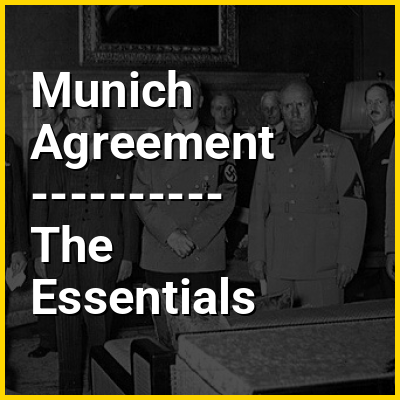
The Munich Agreement was reached in Munich on 30 September 1938, by Nazi Germany, the United Kingdom, France, and Italy. The agreement provided for the German annexation of part of Czechoslovakia called the Sudetenland, where three million people, mainly ethnic Germans, lived. The pact is known in some areas as the Munich Betrayal (Czech: Mnichovská zrada; Slovak: Mníchovská zrada), because of a previous 1924 alliance agreement and a 1925 military pact between France and the Czechoslovak Republic.

Germany had started a low-intensity undeclared war on Czechoslovakia on 17 September 1938. In reaction, Britain and France on 20 September formally requested Czechoslovakia cede the Sudetenland territory to Germany. This was followed by Polish and Hungarian territorial demands brought on 21 and 22 September, respectively. Meanwhile, German forces conquered parts of the Cheb District and Jeseník District, where battles included use of German artillery, Czechoslovak tanks, and armored vehicles. Lightly armed German infantry briefly overran other border counties before being repelled. Poland grouped its army units near its common border with Czechoslovakia and conducted an unsuccessful probing offensive on 23 September. Hungary moved its troops towards the border with Czechoslovakia, without attacking. The Soviet Union announced its willingness to come to Czechoslovakia's assistance, provided the Red Army would be able to cross Polish and Romanian territory; both countries refused.
↓ Menu

>>>PUT SHARE BUTTONS HERE<<<
In this Dossier

Munich Agreement in the context of World War II

World War II or the Second World War (1 September 1939 – 2 September 1945) was a global conflict between two coalitions: the Allies and the Axis powers. Nearly all of the world's countries participated, with many nations mobilising all resources in pursuit of total war. Tanks and aircraft played major roles, enabling the strategic bombing of cities and delivery of the first and only nuclear weapons ever used in war. World War II is the deadliest conflict in history, causing the death of 70 to 85 million people, more than half of whom were civilians. Millions died in genocides, including the Holocaust, and by massacres, starvation, and disease. After the Allied victory, Germany, Austria, Japan, and Korea were occupied, and German and Japanese leaders were put on trial for war crimes.

The causes of World War II included unresolved tensions in the aftermath of World War I, the rise of fascism in Europe and militarism in Japan. Key events preceding the war included Japan's invasion of Manchuria in 1931, the Spanish Civil War, the outbreak of the Second Sino-Japanese War in 1937, and Germany's annexations of Austria and the Sudetenland. World War II is generally considered to have begun on 1 September 1939, when Nazi Germany, under Adolf Hitler, invaded Poland, after which the United Kingdom and France declared war on Germany. Poland was divided between Germany and the Soviet Union under the Molotov–Ribbentrop Pact. In 1940, the Soviet Union annexed the Baltic states and parts of Finland and Romania. After the fall of France in June 1940, the war continued mainly between Germany, now assisted by Fascist Italy, and the British Empire, with fighting in the Balkans, Mediterranean, and Middle East, the aerial Battle of Britain and the Blitz, and the naval Battle of the Atlantic. Through campaigns and treaties, Germany gained control of much of continental Europe and formed the Axis alliance with Italy, Japan, and other countries. In June 1941, Germany invaded the Soviet Union, opening the Eastern Front and initially making large territorial gains.

↑ Return to Menu

Munich Agreement in the context of Molotov–Ribbentrop Pact

The Molotov–Ribbentrop Pact, officially the Treaty of Non-Aggression between Germany and the Union of Soviet Socialist Republics, and also known as the Hitler–Stalin Pact, the Berlin–Moscow Pact and the Nazi–Soviet Pact, was a non-aggression pact between Nazi Germany and the Soviet Union, with a secret protocol establishing Soviet and German spheres of influence across Eastern Europe. The pact was signed in Moscow on 24 August 1939 (backdated 23 August 1939) by Soviet Foreign Minister Vyacheslav Molotov and German Foreign Minister Joachim von Ribbentrop.

Tripartite discussions between the Soviet Union, the United Kingdom and France had broken down after the Soviet Union was excluded from the Munich Agreement in September 1938. Joseph Stalin, the General Secretary of the Communist Party of the Soviet Union, had indicated that the USSR was willing to support Czechoslovakia militarily if France did so as well. Subsequently, rapprochement between Soviet Union and Nazi Germany began in early 1939. Later that year the Soviet-German pact was agreed, committing both sides to neither aid nor ally itself with an enemy of the other for the following 10 years. Under the Secret Additional Protocol of 23 August 1939, Germany and the Soviet Union agreed to partition Poland; Latvia, Estonia, Finland and Bessarabia were allotted to the Soviet sphere, while Lithuania – apart from the Vilnius region, whose "interests" were recognized – lay in the German sphere (Lithuania – including the Vilnius region, but excluding a strip of land – was only transferred to the Soviet sphere by the 28 September 1939 Boundary and Friendship Treaty). In the west, rumored existence of the Secret Protocol was proven only when it was made public during the Nuremberg trials.

↑ Return to Menu

Munich Agreement in the context of First Czechoslovak Republic

The First Czechoslovak Republic, often colloquially referred to as the First Republic, was the first Czechoslovak state that existed from 1918 to 1938, a union of ethnic Czechs and Slovaks. The country was commonly called Czechoslovakia, a compound of Czech and Slovak; which gradually became the most widely used name for its successor states. It was composed of former territories of Austria-Hungary, inheriting different systems of administration from the formerly Austrian (Bohemia, Moravia, a small part of Silesia) and Hungarian territories (mostly Upper Hungary and Carpathian Ruthenia).

After 1933, Czechoslovakia remained the only de facto functioning democracy in Central Europe, organized as a parliamentary republic. Under pressure from its Sudeten German minority, supported by neighbouring Nazi Germany, Czechoslovakia was forced to cede its Sudetenland region to Germany on 1 October 1938 as part of the Munich Agreement. It also ceded southern parts of Slovakia and Carpathian Ruthenia to Hungary and the Trans-Olza region in Silesia to Poland. This, in effect, ended the First Czechoslovak Republic. It was replaced by the Second Czechoslovak Republic, which lasted less than half a year before Germany occupied the rest of Czechoslovakia in March 1939.

↑ Return to Menu

Munich Agreement in the context of Sudetenland

The Sudetenland (/sˈdtənlænd/ soo-DAY-tən-land, German: [zuˈdeːtn̩ˌlant]; Czech and Slovak: Sudety) is a German name for the northern, southern, and western areas of former Czechoslovakia which were inhabited primarily by Sudeten Germans. These German speakers had predominated in the border districts of Bohemia, Moravia, and Czech Silesia since the Middle Ages.

The word "Sudetenland" did not come into being until the early part of the 20th century and did not come to prominence until almost two decades into the century, after World War I, when Austria-Hungary disintegrated and the Sudeten Germans found themselves living in the new country of Czechoslovakia. The Sudeten crisis of 1938 was provoked by the Pan-Germanist demands of Nazi Germany that the Sudetenland be annexed to Germany, which happened after the later Munich Agreement. Part of the borderland was invaded and annexed by Poland. Afterwards, the formerly unrecognized Sudetenland became an administrative division of Germany. When Czechoslovakia was reconstituted after World War II, the Sudeten Germans were expelled and the region today is inhabited almost exclusively by Czech speakers.

↑ Return to Menu

Munich Agreement in the context of Czechoslovakia

Czechoslovakia (/ˌɛkslˈvæki.ə, ˈɛkə-, -slə-, -ˈvɑː-/ CHEK-oh-sloh-VAK-ee-ə, CHEK-ə-, -⁠slə-, -⁠VAH-; Czech and Slovak: Československo, Česko-Slovensko) was a landlocked country in Central Europe created in 1918 when it declared its independence from Austria-Hungary. In 1938, after the Munich Agreement, the Sudetenland became part of Nazi Germany. Between 1939 and 1945, the state ceased to exist, as Slovakia proclaimed its independence and Carpathian Ruthenia became part of Hungary, while the German Protectorate of Bohemia and Moravia was proclaimed in the remainder of the Czech Lands. In 1939, after the outbreak of World War II, former Czechoslovak president Edvard Beneš formed a government-in-exile and sought recognition from the Allies.

After World War II, Czechoslovakia was re-established under its pre-1938 borders, with the exception of Carpathian Ruthenia, which became part of the Ukrainian SSR (a republic of the Soviet Union). The Communist Party seized power in a coup in 1948. From 1948 to 1989, Czechoslovakia was part of the Eastern Bloc with a planned economy. Its economic status was formalized in membership of Comecon from 1949 and its defense status in the Warsaw Pact of 1955. A period of political liberalization in 1968, the Prague Spring, ended when the Soviet Union, assisted by other Warsaw Pact countries, invaded Czechoslovakia. In 1989, as Marxist–Leninist governments and communism were ending all over Central and Eastern Europe, Czechoslovaks peacefully deposed their communist government during the Velvet Revolution, which began on 17 November 1989 and ended 11 days later on 28 November when all of the top Communist leaders and Communist party itself resigned. On 31 December 1992, Czechoslovakia split peacefully into the two sovereign states of the Czech Republic and Slovakia.

↑ Return to Menu

Munich Agreement in the context of Occupation of Czechoslovakia (1938–1945)

The military occupation of Czechoslovakia by Nazi Germany began with the German annexation of the Sudetenland in 1938, continued with the creation of the Protectorate of Bohemia and Moravia, and by the end of 1944 extended to all parts of Czechoslovakia.

Following the Anschluss of Austria in March 1938 and the Munich Agreement in September of that same year, Adolf Hitler annexed the Sudetenland from Czechoslovakia on 1 October, giving Germany control of the extensive Czechoslovak border fortifications in this area. The incorporation of the Sudetenland into Germany left the rest of Czechoslovakia ("Rest-Tschechei" ) with a largely indefensible northwestern border. Also a Polish-majority borderland region of Trans-Olza which was annexed by Czechoslovakia in 1919, was occupied and annexed by Poland following the two-decade long territorial dispute. Finally the First Vienna Award gave to Hungary the southern territories of Slovakia and Carpathian Ruthenia, mostly inhabited by Hungarians.

↑ Return to Menu

Munich Agreement in the context of Sudeten Germans

German Bohemians (German: Deutschböhmen und Deutschmährer [ˈdɔʏtʃˌbøːmən] ; Czech: čeští Němci a moravští Němci, lit.'German Bohemians and German Moravians'), later known as Sudeten Germans (German: Sudetendeutsche [zuˈdeːtn̩ˌdɔʏtʃə] ; Czech: sudetští Němci), were ethnic Germans living in the Czech lands of the Bohemian Crown, which later became an integral part of Czechoslovakia. Before 1945, over three million German Bohemians constituted about 23% of the population of the whole country and about 29.5% of the population of Bohemia and Moravia. Ethnic Germans migrated into the Kingdom of Bohemia, an electoral territory of the Holy Roman Empire, from the 11th century, mostly in the border regions of what was later called the "Sudetenland", which was named after the Sudeten Mountains.

The process of German expansion was known as Ostsiedlung ("Settling of the East"). The name "Sudeten Germans" was adopted during rising nationalism after the fall of Austria-Hungary in the aftermath of First World War. After the Munich Agreement (1938), the so-called Sudetenland became part of Germany.

↑ Return to Menu