Wisconsin Territory in the context of "Sauk County, Wisconsin"

Play Trivia Questions online!

or

Skip to study material about Wisconsin Territory in the context of "Sauk County, Wisconsin"


⭐ Core Definition: Wisconsin Territory

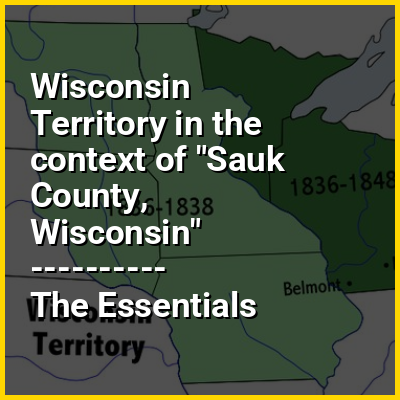
The Territory of Wisconsin was an organized and incorporated territory of the United States that existed from July 3, 1836, until May 29, 1848, when an eastern portion of the territory was admitted to the Union as the State of Wisconsin. Belmont was initially chosen as the capital of the territory. In 1837, the territorial legislature met in Burlington, just north of the Skunk River on the Mississippi, which became part of the Iowa Territory in 1838. In that year, 1838, the territorial capital of Wisconsin was moved to Madison.

↓ Menu

👉 Wisconsin Territory in the context of Sauk County, Wisconsin

Sauk County is a county in Wisconsin. It is named after a large village of the Sauk people. As of the 2020 census, the population was 65,763. Its county seat and largest city is Baraboo. The county was created in 1840 from Wisconsin Territory and organized in 1844. Sauk County comprises the Baraboo, WI Micropolitan Statistical Area and is included in the Greater Madison area.

↓ Explore More Topics
In this Dossier

Wisconsin Territory in the context of Dred Scott decision

Dred Scott v. Sandford, 60 U.S. (19 How.) 393 (1857), was a landmark decision of the United States Supreme Court that held the United States Constitution did not extend American citizenship to people of black African descent, and therefore they could not enjoy the rights and privileges the Constitution conferred upon American citizens. The decision is widely considered the worst in the Supreme Court's history, widely denounced for its overt racism, judicial activism, and poor legal reasoning. It de jure nationalized slavery, and thus played a crucial role in the events that led to the American Civil War four years later. Legal scholar Bernard Schwartz said that it "stands first in any list of the worst Supreme Court decisions." Chief Justice Charles Evans Hughes called it the Court's "greatest self-inflicted wound".

The decision involved the case of Dred Scott, an enslaved black man whose owners had taken him from Missouri, a slave-holding state, into Illinois and the Wisconsin Territory, where slavery was illegal. When his owners later brought him back to Missouri, Scott sued for his freedom and claimed that because he had been taken into "free" U.S. territory, he had automatically been freed and was legally no longer a slave. Scott sued first in Missouri state court, which ruled that he was still a slave under its law. He then sued in U.S. federal court, which ruled against him by deciding that it had to apply Missouri law to the case. He then appealed to the U.S. Supreme Court.

↑ Return to Menu

Wisconsin Territory in the context of Dred Scott

Dred Scott (c. 1799 – September 17, 1858) was an enslaved African-American man who, along with his wife, Harriet, unsuccessfully sued for the freedom of themselves and their two daughters, Eliza and Lizzie, in the Dred Scott v. Sandford case of 1857, popularly known as the "Dred Scott decision". The Scotts claimed that they should be granted freedom because Dred had lived in Illinois and the Wisconsin Territory for four years, where slavery was illegal, and laws in those jurisdictions said that slave holders gave up their rights to slaves if they stayed for an extended period.

In a landmark case, the United States Supreme Court decided 7–2 against Scott, finding that neither he nor any other person of African ancestry could claim citizenship in the United States, and therefore Scott could not bring suit in federal court under diversity of citizenship rules. Scott's temporary residence in free territory outside Missouri did not bring about his emancipation, because the Missouri Compromise, which made that territory free by prohibiting slavery north of the 36°30′ parallel, was unconstitutional because it "deprives citizens of their [slave] property without due process of law".

↑ Return to Menu

Wisconsin Territory in the context of List of counties in Wisconsin

There are 72 counties in the US state of Wisconsin. The land that eventually became Wisconsin was transferred from British to American control with the 1783 signing of the Treaty of Paris. It was an unorganized part of the Northwest Territory until 1802 when all of the land from St. Louis north to the Canadian border was organized as St. Clair County. When Illinois was admitted to the union in 1818, Wisconsin became part of the Territory of Michigan and divided into two counties: Brown County in the northeast along Lake Michigan and Crawford County in the southwest along the Mississippi River. Iowa County was formed in 1829 from the Crawford County land south of the Wisconsin River. Brown County's southern portion was used to form Milwaukee County in 1834. The state of Wisconsin was created from Wisconsin Territory on May 29, 1848, with 28 counties.

The most populous county in the state is Milwaukee County at 924,740 people at the 2024 Census estimate. The county with the least population is Menominee County with 4,286 residents; the Menominee Indian Reservation is co-extensive with the county. Pepin County is the smallest in area, with 231.98 square miles (600.8 km); Marathon is the largest, having 1,544.91 square miles (4,001.3 km).

↑ Return to Menu