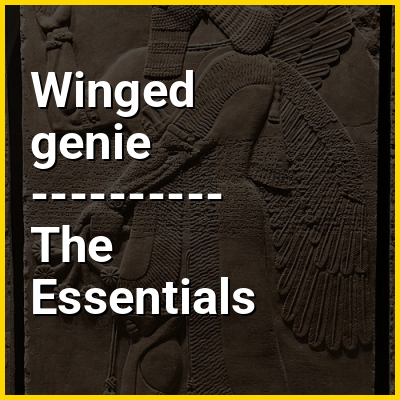
Winged genie is the conventional term for a recurring motif in the iconography of Assyrian sculpture.Winged genies are usually bearded male figures sporting birds' wings. The Genii are a reappearing trait in ancient Assyrian art, and are displayed most prominently in palaces or places of royalty. The two most notable places where the genies existed were Ashurnasirpal II’s palace Kalhu, and Sargon II’s palace Dur-Sharrukin.
HINT:
In this Dossier
- ⭐ Core Definition: Winged genie
- Winged genie in the context of Assyrian sculpture
- Winged genie in the context of Bucket and cone
Winged genie in the context of Assyrian sculpture
Assyrian sculpture is the sculpture of the ancient Assyrian states, especially the Neo-Assyrian Empire of 911 to 612 BC, which was centered around the city of Assur in Mesopotamia (modern-day Iraq) which at its height, ruled over all of Mesopotamia, the Levant and Egypt, as well as portions of Anatolia, Arabia and modern-day Iran and Armenia. It forms a phase of the art of Mesopotamia, differing in particular because of its much greater use of stone and gypsum alabaster for large sculpture.
Much the best-known works are the huge lamassu guarding entrance ways, and Assyrian palace reliefs on thin slabs of alabaster, which were originally painted, at least in part, and fixed on the wall all round the main rooms of palaces. Most of these are in museums in Europe or America, following a hectic period of excavations from 1842 to 1855, which took Assyrian art from being almost completely unknown to being the subject of several best-selling books, and imitated in political cartoons.
View the full Wikipedia page for Assyrian sculptureWinged genie in the context of Bucket and cone
Bucket and cone refer to twin attributes that are frequently held in the hands of winged genies depicted in the art of Mesopotamia, and within the context of Ancient Mesopotamian religion. The iconography is particularly frequent in art from the Neo-Assyrian Empire (911–605 BCE), and especially Assyrian palace reliefs from this period. In some instances, only the bucket is held and the other hand is held up in what may be a blessing gesture. To a lesser degree such images were also depicted in images from the Neo-Sumerian Empire, Old Assyrian Empire, Babylonian Empire, and Middle Assyrian Empire.
View the full Wikipedia page for Bucket and cone