Wilmington, Delaware in the context of "Delaware Colony"

Play Trivia Questions online!

or

Skip to study material about Wilmington, Delaware in the context of "Delaware Colony"

Ad spacer

⭐ Core Definition: Wilmington, Delaware

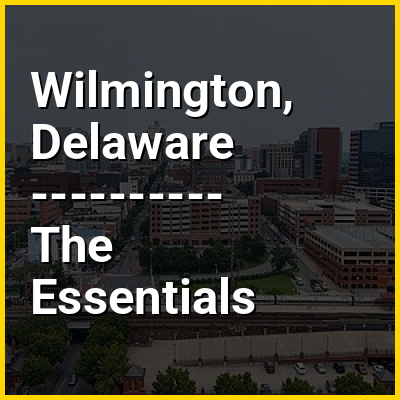
Wilmington is the most populous city in the U.S. state of Delaware. It lies at the confluence of the Christina River and Brandywine Creek, near where the Christina flows into the Delaware River. The population was 70,898 at the 2020 census. It is the county seat of New Castle County and one of the major cities near the Delaware Valley metropolitan area.

Wilmington was founded by Swedish settlers in 1638 as Christinaham or spelled Kristinehamn, which was planned to be the capital of New Sweden. The city was built on the site of Fort Christina, which was the first Swedish settlement in North America. Control of the area shifted before it was formally incorporated as the Village of Willingtown in 1731, then later granted Borough Charter within the Delaware Colony as Wilmington in 1739, named after Spencer Compton, 1st Earl of Wilmington. Throughout the 18th and 19th centuries, Wilmington developed as an industrial hub with industries in shipbuilding, milling, and later chemical manufacturing, largely influenced by DuPont. Its modern economy is focused on national banking and finance institutions.
↓ Menu

>>>PUT SHARE BUTTONS HERE<<<

πŸ‘‰ Wilmington, Delaware in the context of Delaware Colony

The Lower Counties on the Delaware, was a semi-autonomous region of the proprietary Province of Pennsylvania and a de facto British colony in North America. Although not royally sanctioned, Delaware consisted of the three counties on the west bank of the Delaware River Bay.

In the early 17th century, the area was inhabited by Lenape and possibly Assateague Indian tribes. The first European settlers were Swedes, who established the colony of New Sweden at Fort Christina in present-day Wilmington, Delaware, in 1638. The Dutch captured the colony in 1655 and annexed it to New Netherland to the north. England subsequently took control of it from the Dutch in 1664. In 1682, William Penn, the Quaker proprietor of the Province of Pennsylvania to the north leased the three lower counties on the Delaware River from James, the Duke of York, who went on to become King James II.

↓ Explore More Topics
In this Dossier

Wilmington, Delaware in the context of Philadelphia metropolitan area

The Philadelphia metropolitan area, also referred to as the Delaware Valley or Greater Philadelphia, is a major metropolitan area in the Northeastern United States that centers on Philadelphia, the sixth-most populous city in the United States. This area spans up to four states: southeastern Pennsylvania, southern New Jersey, northern Delaware, and the northern Eastern Shore of Maryland, though it is sometimes considered a tri-state region if northeastern Maryland is excluded. With a core metropolitan statistical area population of 6.245 million residents and a combined statistical area population of 7.379 million as of the 2020 census, it is the ninth-largest metropolitan area in the United States in 2024 and the 68th-largest metropolitan region in the world.

In addition to Philadelphia, other major population centers in the Philadelphia metro area include Reading, Upper Darby Township, and Chester in Pennsylvania; Atlantic City, Camden, Vineland, and Cherry Hill in South Jersey; and Wilmington and Dover in Delaware. As of 2023, the Philadelphia metro area's gross domestic product (GDP) exceeds US$557 billion, making it the nation's 11th-largest metropolitan economy.

↑ Return to Menu

Wilmington, Delaware in the context of Northeast Corridor

The Northeast Corridor (NEC) is an electrified railroad line in the Northeast megalopolis of the United States. Owned primarily by Amtrak, it runs from Boston in the north to Washington, D.C., in the south, with major stops in Providence, New Haven, Stamford, New York City, Newark, Trenton, Philadelphia, Wilmington, and Baltimore. The NEC is roughly paralleled by Interstate 95 for most of its length. Carrying more than 2,200 trains a day, it is the busiest passenger rail line in the United States by ridership and service frequency.

The corridor is used by many Amtrak trains, including the high-speed Acela (formerly Acela Express), intercity trains, and several long-distance trains. Most of the corridor also has frequent commuter rail service, operated by the MBTA (Keolis), CT Rail, Metro-North Railroad, Long Island Rail Road, New Jersey Transit, SEPTA, and MARC. While large through freights have not run on the NEC since the early 1980s, some sections still carry smaller local freights operated by CSX, Norfolk Southern, CSAO, Providence and Worcester, New York and Atlantic, and Canadian Pacific. CSX and NS partly own their routes.

↑ Return to Menu

Wilmington, Delaware in the context of South Jersey

South Jersey, also known as Southern New Jersey, comprises the southern portion of the U.S. state of New Jersey. It is located between Pennsylvania and the lower Delaware River to its west, the Atlantic Ocean to its east, Delaware to its south, and Central Jersey or North Jersey to its north, depending on the definition of North Jersey.

South Jersey is part of the Philadelphia metropolitan area, or Delaware Valley, the seventh-largest metropolitan region in the nation with 6.288 million residents in the core metropolitan statistical area and 7.366 million residents in the combined statistical area of Camden, Philadelphia and Wilmington, as of 2020. South Jersey is known for containing the unique ecoregion known as the Pine Barrens, which remains largely undisturbed despite its location within the Northeastern megalopolis. The South Jersey Pine Barrens are the largest remaining example of the Atlantic coastal pine barrens ecosystem.

↑ Return to Menu

Wilmington, Delaware in the context of Delaware

Delaware (/ˈdΙ›lΙ™wΙ›Ι™r/ DEL-Ι™-wair) is a state in the Mid-Atlantic and South Atlantic regions of the United States. It borders Maryland to its south and west, Pennsylvania to its north, New Jersey to its northeast, and the Atlantic Ocean to its east. The state's name derives from the adjacent Delaware Bay, which in turn was named after Thomas West, 3rd Baron De La Warr, an English nobleman and the Colony of Virginia's first colonial-era governor.

Delaware occupies the northeastern portion of the Delmarva Peninsula, and some islands and territory within the Delaware River. It is the second-smallest and sixth-least populous state, but also the sixth-most densely populated. Delaware's most populous city is Wilmington, and the state's capital is Dover, the second-most populous city in Delaware. The state is divided into three counties, the fewest number of counties of any of the 50 U.S. states; from north to south, the three counties are: New Castle County, Kent County, and Sussex County. The southern two counties, Kent and Sussex, have historically been predominantly agrarian economies. New Castle is more urbanized and is considered part of the Philadelphia metropolitan area. Delaware is considered part of the Southern United States by the U.S. Census Bureau, but the state's geography, culture, and history are a hybrid of the Mid-Atlantic, Northeastern, and Southern regions of the country.

↑ Return to Menu

Wilmington, Delaware in the context of Cape May Point, New Jersey

Cape May Point is a borough located at the tip of the Cape May Peninsula in Cape May County, in the U.S. state of New Jersey. The borough, and all of Cape May County, is part of the Ocean City metropolitan statistical area, and is part of the Philadelphia-Wilmington-Camden, PA-NJ-DE-MD combined statistical area, also known as the Delaware Valley or Philadelphia metropolitan area. As of the 2020 United States census, the borough's population was 305, an increase of 14 (+4.8%) from the 2010 census count of 291, which in turn reflected an increase of 50 (+20.7%) from the 241 counted in the 2000 census. The summer population can reach 4,500.

The Cape May Light is located in Lower Township, but is also a point of identity for Cape May Point as it uses the lighthouse as a logo for municipal-owned vehicles. Mayors of the two municipalities previously had a conflict over in which municipality it was located.

↑ Return to Menu

Wilmington, Delaware in the context of Chester, Pennsylvania

Chester is a city in Delaware County, Pennsylvania, United States. It is part of the Philadelphia metropolitan area and located on the western bank of the Delaware River between Philadelphia and Wilmington, Delaware. The population of Chester was 32,605 at the 2020 census.

Incorporated in 1682, Chester is the oldest city in Pennsylvania and was the location of William Penn's first arrival in the Province of Pennsylvania. It was the county seat for Chester County from 1682 to 1788 and of Delaware County from 1789 to 1851.

↑ Return to Menu

Wilmington, Delaware in the context of Dover, Delaware

Dover (/ˈdoʊvΙ™r/ DOH-vΙ™r) is the capital and the second-most populous city of the U.S. state of Delaware, after Wilmington. It is also the county seat of Kent County and the principal city of the Dover metropolitan statistical area, which encompasses all of Kent County and is part of the Philadelphia–Wilmington–Camden, PA–NJ–DE–MD, combined statistical area. It is located on the St. Jones River in the Delaware River coastal plain. It was named by William Penn for Dover in Kent, England (for which Kent County is named). As of 2020, its population was 39,403.

↑ Return to Menu