William Henry Harrison in the context of "Vice President of the United States"

Play Trivia Questions online!

or

Skip to study material about William Henry Harrison in the context of "Vice President of the United States"


⭐ Core Definition: William Henry Harrison

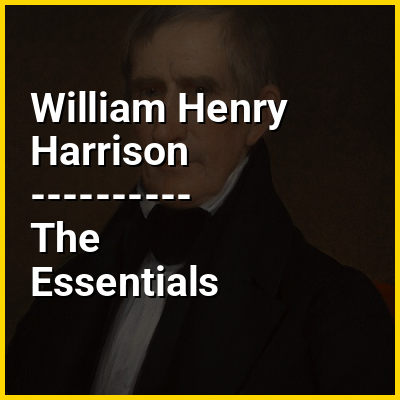
William Henry Harrison (February 9, 1773 – April 4, 1841) was the ninth president of the United States, serving from March 4 to April 4, 1841, the shortest presidency in U.S. history. He was also the first U.S. president to die in office, causing a brief constitutional crisis, since presidential succession was not then fully defined in the U.S. Constitution. Harrison was the last president born as a British subject in the Thirteen Colonies. He was a member of the Harrison family of Virginia, and a son of Benjamin Harrison V, who was a U.S. Founding Father. His own son John Scott Harrison was the father of Benjamin Harrison, the 23rd U.S. president.

Harrison was born in Charles City County, Virginia. In 1794, he participated in the Battle of Fallen Timbers, an American military victory that ended the Northwest Indian War. In 1811, he led a military force against Tecumseh's confederacy at the Battle of Tippecanoe, for which he earned the nickname "Old Tippecanoe". He was promoted to major general in the Army during the War of 1812, and led American infantry and cavalry to victory at the Battle of the Thames in Upper Canada.
↓ Menu

In this Dossier

William Henry Harrison in the context of Whig Party (United States)

The Whig Party was a mid-19th century political party in the United States. Alongside the Democratic Party, it was one of two major parties from the late 1830s until the early 1850s and part of the Second Party System. As well as four Whig presidents (William Henry Harrison, John Tyler, Zachary Taylor, and Millard Fillmore), other prominent members included Henry Clay, Daniel Webster, Rufus Choate, William Seward, John J. Crittenden, and John Quincy Adams (whose presidency ended prior to the formation of the Whig Party). The Whig base of support was amongst entrepreneurs, professionals, Protestant Christians (particularly Evangelicals), the urban middle class, and nativists.

The party was hostile towards the ideology of "manifest destiny", territorial expansion into Texas and the Southwest, and the Mexican–American War. It disliked presidential power, as exhibited by Andrew Jackson and James K. Polk, and preferred congressional dominance in lawmaking. Members advocated modernization, meritocracy, the rule of law, protections against majority rule, and vigilance against executive tyranny. They favored an economic program known as the American System, which called for a protective tariff, federal subsidies for the construction of infrastructure, and support for a national bank. The party was active in both the Northern and Southern United States and did not take a firm stance on slavery, but Northern Whigs tended to be less supportive than their Democratic counterparts.

↑ Return to Menu

William Henry Harrison in the context of List of presidents of the United States by time in office

The length of a full four-year term of office for a president of the United States usually amounts to 1,461 days (three common years of 365 days plus one leap year of 366 days). The listed number of days is calculated as the difference between dates, which counts the number of calendar days except the first day (day zero). If the first day were included, all numbers would be one day more, except Grover Cleveland would have two more days, as he served two full nonconsecutive terms.

Of the individuals elected president, four died of natural causes while in office (William Henry Harrison, Zachary Taylor, Warren G. Harding, and Franklin D. Roosevelt), four were assassinated (Abraham Lincoln, James A. Garfield, William McKinley, and John F. Kennedy), and one resigned from office (Richard Nixon).

↑ Return to Menu

William Henry Harrison in the context of Vice president of the United States

The vice president of the United States (VPOTUS, or informally, veep) is the second-highest ranking office in the executive branch of the U.S. federal government, after the president of the United States, and ranks first in the presidential line of succession. The vice president is also an officer in the legislative branch, as the president of the Senate. In this capacity, the vice president is empowered to preside over the United States Senate, but may not vote except to cast a tie-breaking vote. The vice president is elected at the same time as the president to a four-year term of office by the people of the United States through the Electoral College, but the electoral votes are cast separately for these two offices. Following the passage in 1967 of the Twenty-fifth Amendment to the US Constitution, a vacancy in the office of vice president may be filled by presidential nomination and confirmation by a majority vote in both houses of Congress. This was based on the Tyler Precedent set in 1841 when John Tyler became the first vice president to take over for a deceased president following the death of William Henry Harrison.

The modern vice presidency is a position of significant power and is widely seen as an integral part of a president's administration. The presidential candidate selects the candidate for the vice presidency as their running mate in the lead-up to the presidential election. While the exact nature of the role varies in each administration, since the vice president's service in office is by election, the president cannot dismiss the vice president, and the personal working-relationship with the president varies, most modern vice presidents serve as a key presidential advisor, governing partner, and representative of the president. The vice president is also a statutory member of the United States Cabinet and United States National Security Council and thus plays a significant role in executive government and national security matters. As the vice president's role within the executive branch has expanded, the legislative branch role has contracted; for example, vice presidents now preside over the Senate only infrequently.

↑ Return to Menu

William Henry Harrison in the context of Thurlow Weed

Edward Thurlow Weed (November 15, 1797 – November 22, 1882) was an American printer, newspaper publisher, and Whig and Republican politician. He was the principal political advisor to prominent New York politician William H. Seward and was instrumental in the presidential nominations of William Henry Harrison (1840), Zachary Taylor (1848), and John C. Frémont (1856).

Born in Cairo, New York, Weed apprenticed as a printer under William Williams and served with him in the War of 1812 before winning election to the New York State Assembly. He met Seward in the assembly, and they formed a close political alliance that lasted for several decades. Weed and Seward became leaders of the New York Anti-Masonic Party, and Weed established the Albany Evening Journal as the party's main newspaper. Weed supported the American System of Henry Clay and helped establish the Whig Party in the 1830s. He helped Seward win election as Governor of New York and supported the successful presidential candidacies of Harrison and Taylor.

↑ Return to Menu

William Henry Harrison in the context of Fort Vincennes

During the 18th and early 19th centuries, the French, British and U.S. forces built and occupied a number of forts at Vincennes, Indiana. These outposts commanded a strategic position on the Wabash River. The names of the installations were changed by the various ruling parties, and the forts were considered strategic in the French and Indian War, the American Revolutionary War, the Northwest Indian War and the War of 1812. The last fort was abandoned in 1816.

The settlement around the forts was best known as the territorial capital of the Northwest Territory (later, the Indiana Territory). The best known event was Gen. William Henry Harrison's mustering of forces at Vincennes just prior to his campaign against the Indian capital at Prophetstown in Tippecanoe, culminating in the Battle of Tippecanoe in 1811. This battle was one of the factors that contributed to the start of the War of 1812.

↑ Return to Menu

William Henry Harrison in the context of John Tyler

John Tyler (March 29, 1790 – January 18, 1862) was the tenth president of the United States, serving from 1841 to 1845, after briefly holding office as the tenth vice president in 1841. He was elected vice president on the 1840 Whig ticket with President William Henry Harrison, succeeding to the presidency following Harrison's death 31 days after assuming office. Tyler was a stalwart supporter and advocate of states' rights, including regarding slavery, and he adopted nationalistic policies as president only when they did not infringe on the states' powers. His unexpected rise to the presidency posed a threat to the presidential ambitions of Henry Clay and other Whig politicians and left Tyler estranged from both of the nation's major political parties at the time.

Tyler was born into a prominent slaveholding Virginia family. He became a national figure at a time of political upheaval. In the 1820s, the Democratic-Republican Party, at the time the nation's only political party, split into several factions. Initially a Jacksonian Democrat, Tyler opposed President Andrew Jackson during the nullification crisis as he saw Jackson's actions as infringing on states' rights and criticized Jackson's expansion of executive power during Jackson's veto on banks. This led Tyler to ally with the southern faction of the Whig Party. He served as a Virginia state legislator and governor, U.S. representative, and U.S. senator. Tyler was a regional Whig vice-presidential nominee in the 1836 presidential election, which Democrat Martin Van Buren won. He was the sole nominee on the 1840 Whig presidential ticket as William Henry Harrison's running mate. Under the campaign slogan "Tippecanoe and Tyler Too", the Harrison–Tyler ticket defeated Van Buren.

↑ Return to Menu

William Henry Harrison in the context of Daniel Webster

Daniel Webster (January 18, 1782 – October 24, 1852) was an American lawyer and statesman who represented New Hampshire and Massachusetts in the U.S. Congress and served as the 14th and 19th U.S. secretary of state under presidents William Henry Harrison, John Tyler, and Millard Fillmore. Webster was one of the most prominent American lawyers of the 19th century, arguing over 200 cases before the United States Supreme Court in his career. During his life, Webster had been a member of the Federalist Party, the National Republican Party, and the Whig Party. He was among the three members of the Great Triumvirate along with Henry Clay and John C. Calhoun.

Born in Salisbury, New Hampshire, in 1782, Webster established a successful legal practice in Portsmouth, New Hampshire, after graduating from Dartmouth College and serving a legal apprenticeship. A prominent opponent of the War of 1812, he won election to the United States House of Representatives, where he served as a leader of the Federalist Party. Webster left office after two terms and moved to Boston, Massachusetts. He became a leading attorney before the U.S. Supreme Court, winning cases such as Dartmouth College v. Woodward, McCulloch v. Maryland, and Gibbons v. Ogden.

↑ Return to Menu

William Henry Harrison in the context of John J. Crittenden

John Jordan Crittenden (September 10, 1787 – July 26, 1863) was an American statesman and politician from the U.S. state of Kentucky. He represented the state in the U.S. House of Representatives and the U.S. Senate and twice served as United States Attorney General in the administrations of William Henry Harrison, John Tyler, and Millard Fillmore. He was also the 17th governor of Kentucky and served in the state legislature. Although frequently mentioned as a potential candidate for the U.S. presidency, he never consented to run for the office.

During his early political career, Crittenden served in the Kentucky House of Representatives and was chosen as speaker on several occasions. With the advent of the Second Party System, he allied with the National Republican (later Whig) Party and was a fervent supporter of, and eventually a protege of Henry Clay and opponent of Democrats Andrew Jackson and Martin Van Buren.

↑ Return to Menu

William Henry Harrison in the context of John Bell (Tennessee politician)

John Bell (February 18, 1796 – September 10, 1869) was an American politician, attorney, and planter who was a candidate for President of the United States in the election of 1860.

One of Tennessee's most prominent antebellum politicians, Bell served in the House of Representatives from 1827 to 1841, and in the Senate from 1847 to 1859. He was Speaker of the House for the 23rd Congress (1834–1835), and briefly served as Secretary of War during the administration of William Henry Harrison (1841). In 1860, he ran for president as the candidate of the Constitutional Union Party, a third party which took a neutral stance on the issue of slavery. He won the electoral votes of three states by a slim margin.

↑ Return to Menu