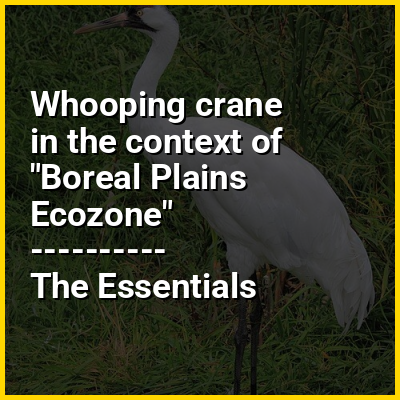
Whooping crane in the context of "Boreal Plains Ecozone"

Play Trivia Questions online!

or

Skip to study material about Whooping crane in the context of "Boreal Plains Ecozone"


👉 Whooping crane in the context of Boreal Plains Ecozone

The Boreal Plains Ecozone, as defined by the Commission for Environmental Cooperation (CEC), is a terrestrial ecozone in the western Canadian provinces of Manitoba, Saskatchewan and Alberta. It also has minor extensions into northeastern British Columbia and south-central Northwest Territories. The region extends over 779,471 km, of which 58,981 km is conserved (7.6 percent).

Wood Buffalo National Park, the largest national park in Canada, and Whooping Crane Summer Range, the only nesting and breeding area for the critically endangered whooping crane, are both located in the northern portion of this ecozone.

↓ Explore More Topics
In this Dossier

Whooping crane in the context of Wood Buffalo National Park

Wood Buffalo National Park is the largest national park of Canada at 44,741 km (17,275 sq mi). It is in northeastern Alberta and the southern Northwest Territories. Larger in area than Switzerland, it is the second-largest national park in the world. The park was established in 1922 to protect the world's largest herd of free-roaming wood bison. They became hybridized after the introduction of plains bison. The population is currently estimated at 3,000. It is one of two known nesting sites of whooping cranes.

The park ranges in elevation from 183 m (600 ft) at the Little Buffalo River to 945 m (3,100 ft) in the Caribou Mountains. The park headquarters is in Fort Smith, with a smaller satellite office in Fort Chipewyan, Alberta. The park contains one of the world's largest fresh-water deltas, the Peace-Athabasca Delta, formed by the Peace, Athabasca and Birch rivers.

↑ Return to Menu