West Antarctic Ice Sheet in the context of Antarctic Ice Sheet


West Antarctic Ice Sheet in the context of Antarctic Ice Sheet

⭐ Core Definition: West Antarctic Ice Sheet

78°44′03″S 133°16′41″W / 78.73417°S 133.27806°W / -78.73417; -133.27806

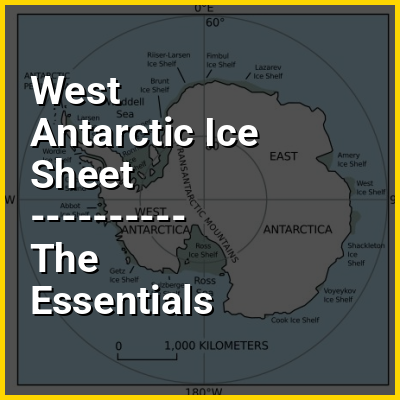
The West Antarctic Ice Sheet (WAIS) is the segment of the continental ice sheet that covers West Antarctica, the portion of Antarctica on the side of the Transantarctic Mountains that lies in the Western Hemisphere. It is classified as a marine-based ice sheet, meaning that its bed lies well below sea level and its edges flow into floating ice shelves. The WAIS is bounded by the Ross Ice Shelf, the Ronne Ice Shelf, and outlet glaciers that drain into the Amundsen Sea.

↓ Menu
HINT:

In this Dossier

West Antarctic Ice Sheet in the context of Antarctic ice sheet

The Antarctic ice sheet is a continental glacier covering 98% of the Antarctic continent, with an area of 14 million square kilometres (5.4 million square miles) and an average thickness of over 2 kilometres (1.2 mi). It is the largest of Earth's two current ice sheets, containing 26.5 million cubic kilometres (6,400,000 cubic miles) of ice, which is equivalent to 61% of all fresh water on Earth. Its surface is nearly continuous, and the only ice-free areas on the continent are the dry valleys, nunataks of the Antarctic mountain ranges, and sparse coastal bedrock. It is often subdivided into the Antarctic Peninsula (AP), the East Antarctic Ice Sheet (EAIS), and the West Antarctic Ice Sheet (WAIS), due to the large differences in glacier mass balance, ice flow, and topography between the three regions.

Because the East Antarctic Ice Sheet is over 10 times larger than the West Antarctic Ice Sheet and located at a higher elevation, it is less vulnerable to climate change than the WAIS. In the 20th century, EAIS had been one of the only places on Earth which displayed limited cooling instead of warming, even as the WAIS warmed by over 0.1 °C/decade from 1950s to 2000, with an average warming trend of >0.05 °C/decade since 1957 across the whole continent. As of early 2020s, there is still net mass gain over the EAIS (due to increased precipitation freezing on top of the ice sheet), yet the ice loss from the WAIS glaciers such as Thwaites and Pine Island Glacier is far greater.

View the full Wikipedia page for Antarctic ice sheet
↑ Return to Menu

West Antarctic Ice Sheet in the context of Tipping points in the climate system

In climate science, a tipping point is a critical threshold that, when crossed, leads to large, accelerating and often irreversible changes in the climate system. If tipping points are crossed, they are likely to have severe impacts on human society and may accelerate global warming. Tipping behavior is found across the climate system, for example in ice sheets, mountain glaciers, circulation patterns in the ocean, in ecosystems, and the atmosphere. Examples of tipping points include thawing permafrost, which will release methane, a powerful greenhouse gas, or melting ice sheets and glaciers reducing Earth's albedo, which would warm the planet faster. Thawing permafrost is a threat multiplier because it holds roughly twice as much carbon as the amount currently circulating in the atmosphere.

Tipping points are often, but not necessarily, abrupt. For example, with average global warming somewhere between 0.8 °C (1.4 °F) and 3 °C (5.4 °F), the Greenland ice sheet passes a tipping point and is doomed, but its melt would take place over millennia. Tipping points are possible at today's global warming of just over 1 °C (1.8 °F) above preindustrial times, and highly probable above 2 °C (3.6 °F) of global warming. It is possible that some tipping points are close to being crossed or have already been crossed, like those of the West Antarctic and Greenland ice sheets, the Amazon rainforest and warm-water coral reefs. A 2022 study published in Science found that exceeding 1.5 °C of global warming could trigger multiple tipping points, including the collapse of major ice sheets, abrupt thawing of permafrost, and coral reef die-off, with potential for cascading system effects.

View the full Wikipedia page for Tipping points in the climate system
↑ Return to Menu

West Antarctic Ice Sheet in the context of West Antarctica

79°S 100°W / 79°S 100°W / -79; -100

West Antarctica, or Lesser Antarctica, one of the two major regions of Antarctica, is the part of that continent that lies within the Western Hemisphere, and includes the Antarctic Peninsula. It is separated from East Antarctica by the Transantarctic Mountains and is covered by the West Antarctic Ice Sheet. It lies between the Ross Sea (partly covered by the Ross Ice Shelf), and the Weddell Sea (largely covered by the Filchner-Ronne Ice Shelf). It may be considered a giant peninsula, stretching from the South Pole towards the tip of South America.

View the full Wikipedia page for West Antarctica
↑ Return to Menu

West Antarctic Ice Sheet in the context of East Antarctic Ice Sheet

80°S 60°E / 80°S 60°E / -80; 60

The East Antarctic Ice Sheet (EAIS) lies between 45° west and 168° east longitudinally. It was first formed around 34 million years ago, and it is the largest ice sheet on the entire planet, with far greater volume than the Greenland ice sheet or the West Antarctic Ice Sheet (WAIS), from which it is separated by the Transantarctic Mountains. The ice sheet is around 2.2 km (1.4 mi) thick on average and is 4,897 m (16,066 ft) at its thickest point. It is also home to the geographic South Pole, South Magnetic Pole and the Amundsen–Scott South Pole Station.

View the full Wikipedia page for East Antarctic Ice Sheet
↑ Return to Menu

West Antarctic Ice Sheet in the context of Thwaites Glacier

Thwaites Glacier is an unusually broad and vast Antarctic glacier located east of Mount Murphy, on the Walgreen Coast of Marie Byrd Land. It was initially sighted by polar researchers in 1940, mapped in 1959–1966 and officially named in 1967, after the late American glaciologist Fredrik T. Thwaites. The glacier flows into Pine Island Bay, part of the Amundsen Sea, at surface speeds which exceed 2 kilometres (1.2 mi) per year near its grounding line. Its fastest-flowing grounded ice is centered between 50 and 100 kilometres (31 and 62 mi) east of Mount Murphy. Like many other parts of the cryosphere, it has been adversely affected by climate change, and provides one of the more notable examples of the retreat of glaciers since 1850.

Thwaites Glacier is closely monitored for its potential to elevate sea levels. Since the 1980s, Thwaites and Pine Island Glacier have been described as part of the "weak underbelly" of the West Antarctic Ice Sheet, in part because they seem vulnerable to irreversible retreat and collapse even under relatively little warming, but mainly because if they go, the entire ice sheet is likely to eventually follow. This hypothesis is based on both theoretical studies of the stability of marine ice sheets and observations of large changes on these two glaciers. In recent years, the flow of both of these glaciers has accelerated, their surfaces have lowered, and their grounding lines have retreated. They are believed very likely to eventually collapse even without any further warming. The outsized danger Thwaites poses has led to some reporters nicknaming it the Doomsday Glacier, although this nickname is controversial among scientists.

View the full Wikipedia page for Thwaites Glacier
↑ Return to Menu

West Antarctic Ice Sheet in the context of Pine Island Glacier

Pine Island Glacier (PIG) is a large ice stream, and the fastest melting glacier in Antarctica. responsible for about 13% of Antarctica's ice loss. The glacier flows west-northwest along the south side of the Hudson Mountains into Pine Island Bay, part of the Amundsen Sea. The area drained by Pine Island Glacier comprises about 10% of the West Antarctic Ice Sheet. Satellite measurements have shown that the Pine Island Glacier Basin has a greater net contribution of ice to the sea than any other ice drainage basin in the world and this has increased due to recent acceleration of the ice stream. In recent years, the flow of the glacier has accelerated and the grounding line has retreated.

Since 2015, the calving of very large icebergs from the Pine Island Glacier has become a roughly annual event. The largest such iceberg, Iceberg B-46, had an initial size of 226 square kilometres (87 sq mi).

View the full Wikipedia page for Pine Island Glacier
↑ Return to Menu

West Antarctic Ice Sheet in the context of Amundsen Sea

The Amundsen Sea is an arm of the Southern Ocean off Marie Byrd Land in western Antarctica. It lies between Cape Flying Fish (the northwestern tip of Thurston Island) to the east and Cape Dart on Siple Island to the west. Cape Flying Fish marks the boundary between the Amundsen Sea and the Bellingshausen Sea. West of Cape Dart there is no named marginal sea of the Southern Ocean between the Amundsen and Ross Seas. The Norwegian expedition of 1928–1929 under Captain Nils Larsen named the body of water for the Norwegian polar explorer Roald Amundsen while exploring this area in February 1929.

The sea is mostly ice-covered, and the Thwaites Ice Tongue protrudes into it. The ice sheet which drains into the Amundsen Sea averages about 3 km (1.9 mi) in thickness; roughly the size of the state of Texas, this area is known as the Amundsen Sea Embayment (ASE); it forms one of the three major ice-drainage basins of the West Antarctic Ice Sheet.

View the full Wikipedia page for Amundsen Sea
↑ Return to Menu