Wax tablet in the context of "Blank slate"

Play Trivia Questions online!

or

Skip to study material about Wax tablet in the context of "Blank slate"

Ad spacer

⭐ Core Definition: Wax tablet

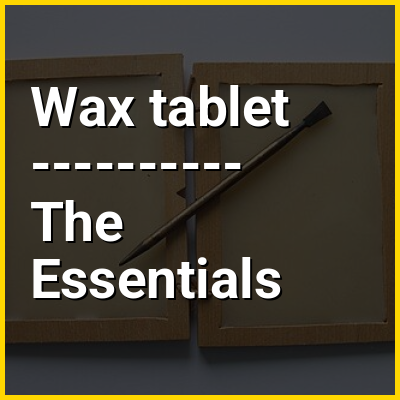
A wax tablet is a tablet made of wood and covered with a layer of wax, often linked loosely to a cover tablet, as a "double-leaved" diptych. It was used as a reusable and portable writing surface in antiquity and throughout the Middle Ages. Cicero's letters make passing reference to the use of cerae, and some examples of wax-tablets have been preserved in waterlogged deposits in the Roman fort at Vindolanda on Hadrian's Wall. Medieval wax tablet books are on display in several European museums.

Writing on the wax surface was performed with a pointed instrument, a stylus. A straight-edged spatula-like implement (often placed on the opposite end of the stylus tip) would be used as an eraser. The modern expression of "a clean slate" equates to the Latin expression "tabula rasa".
↓ Menu

>>>PUT SHARE BUTTONS HERE<<<

👉 Wax tablet in the context of Blank slate

Tabula rasa (/ˈtæbjələ ˈrɑːsə, -zə, ˈr-/; Latin for "blank slate") is the idea of individuals being born empty of any built-in mental content, so that all knowledge comes from later perceptions or sensory experiences. Proponents typically form the extreme "nurture" side of the nature versus nurture debate, arguing that humans are born without any "natural" psychological traits and that all aspects of one's personality, social and emotional behaviour, knowledge, or sapience are later imprinted by one's environment onto the mind as one would onto a wax tablet. This idea is the central view posited in the theory of knowledge known as empiricism. Empiricists disagree with the doctrines of innatism or rationalism, which hold that the mind is born already in possession of specific knowledge or rational capacity.

↓ Explore More Topics
In this Dossier

Wax tablet in the context of Diptych

A diptych (/ˈdɪptɪk/, DIP-tick) is any object with two flat plates which form a pair, often attached by a hinge. For example, the standard notebook and school exercise book of the ancient world was a diptych consisting of a pair of such plates that contained a recessed space filled with wax. Writing was accomplished by scratching the wax surface with a stylus. When the notes were no longer needed, the wax could be slightly heated and then smoothed to allow reuse. Ordinary versions had wooden frames, but more luxurious diptychs were crafted with more expensive materials.

↑ Return to Menu

Wax tablet in the context of Vision (spirituality)

A vision is something seen in a dream, trance, or religious ecstasy, especially a supernatural appearance that usually conveys a revelation. Visions generally have more clarity than dreams, but traditionally fewer psychological connotations. Visions are known to emerge from spiritual traditions and could provide a lens into human nature and reality. Prophecy is often associated with visions.

↑ Return to Menu

Wax tablet in the context of Stylus

A stylus is a writing utensil or tool for scribing or marking into softer materials. Different styluses were used to write in cuneiform by pressing into wet clay, and to scribe or carve into a wax tablet. Very hard styluses are also used to engrave metal, and the slate and stylus system is used to punch out dots to write in Braille.

Styluses are held in the hand and thus are usually a narrow elongated shape, similar to a modern ballpoint pen. Many styluses are heavily curved to be held more easily.

↑ Return to Menu