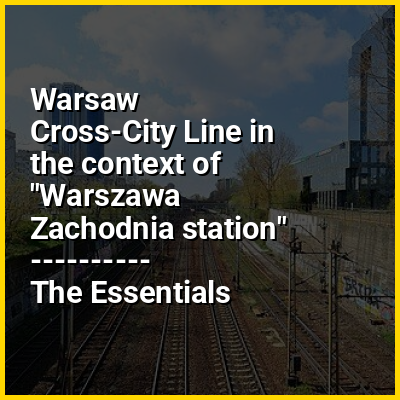
Warsaw Cross-City Line in the context of "Warszawa Zachodnia station"

Play Trivia Questions online!

or

Skip to study material about Warsaw Cross-City Line in the context of "Warszawa Zachodnia station"


👉 Warsaw Cross-City Line in the context of Warszawa Zachodnia station

Warszawa Zachodnia station, in English Warsaw West, is a railway and long-distance bus station in Warsaw, Poland on the border of Ochota and Wola districts. The railway station is the westernmost terminus of the Warsaw Cross-City Line. It serves trains from PKP Intercity, Polregio, Koleje Mazowieckie, Szybka Kolej Miejska and Warszawska Kolej Dojazdowa as well as international trains passing through Warsaw. It is one of the busiest railway stations in Poland, with over 800 daily trains.

Despite being one of the chief railway stations on the line towards Warszawa Centralna (Warsaw Central), there has been limited development of the station since its construction in 1936. However, the station is undergoing an extensive modernization between 2020 and 2024.

↓ Explore More Topics
In this Dossier

Warsaw Cross-City Line in the context of Warszawa Śródmieście railway station

Warszawa Śródmieście railway station (Polish pronunciation: [ɕrudˈmjɛɕt͡ɕɛ]) is a railway station in Warsaw, Poland, in the district of Śródmieście. The station serves the suburban (southern) tracks of the Warsaw Cross-City Line and is used by regional trains run by Koleje Mazowieckie (KM) and Szybka Kolej Miejska (SKM). There are two side platforms and one island platform serving two tracks, all located in a tunnel.

It was built on the principle of the Spanish solution, whereas the centre platform would be using for the arriving passengers only and the side platforms for departing passengers only. The separation was enforced by access controls to the centre platform (discontinued in 1960s), location of ticket offices next to side platforms only, and opening trains' doors on the centre platform side first and on the side platform side with a delay. The separation was in operation until the 1980s.

↑ Return to Menu