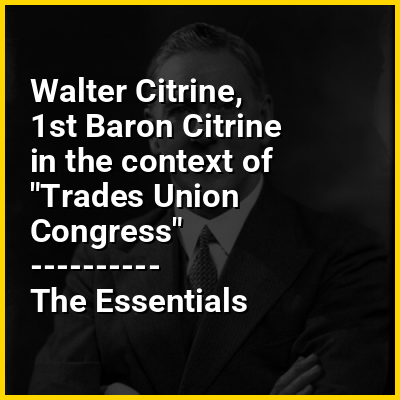
Walter Citrine, 1st Baron Citrine in the context of "Trades Union Congress"

Play Trivia Questions online!

or

Skip to study material about Walter Citrine, 1st Baron Citrine in the context of "Trades Union Congress"

Ad spacer

⭐ Core Definition: Walter Citrine, 1st Baron Citrine

Walter McLennan Citrine, 1st Baron Citrine, GBE, PC (22 August 1887 – 22 January 1983) was one of the leading British and international trade unionists of the twentieth century and a notable public figure. Yet, apart from his renowned guide to the conduct of meetings, ABC of Chairmanship, he has been little spoken of in the history of the labour movement. More recently, labour historians have begun to re-assess Citrine's role.

By redefining the role of the Trades Union Congress (TUC), whose general secretary he was from 1926 until 1946, he helped create a far more coherent and effective union force. This, in turn, transformed the Labour Party into a substantial social democratic force for government from 1939. Citrine was also president of the then influential International Federation of Trade Unions (IFTU) from 1928 until 1945. He was also joint secretary of the key TUC/ Labour Party National Joint Council from 1931 and a director of the UK Daily Herald newspaper until 1946 which was then a mass circulation Labour paper with considerable influence. In these important roles, Citrine was highly influential in the industrial and political wings of the labour movement. His prominent involvement helped secure its recovery after the deep crisis and crushing defeat which followed the fall of the British Labour government in 1931. In particular, he played a key role from the mid-1930s in reshaping Labour's foreign policy, especially as regards re-armament and through the all-party Anti-Nazi Council in which he worked with Winston Churchill.
↓ Menu

>>>PUT SHARE BUTTONS HERE<<<
In this Dossier

Walter Citrine, 1st Baron Citrine in the context of Main motion

In parliamentary procedure, a motion is a formal proposal by a member of a deliberative assembly that the assembly take a particular action. These may include legislative motions, budgetary motions, supplementary budgetary motions, and petitionary motions.

The possible motions in a deliberative assembly are determined by a pre-agreed volume detailing the correct parliamentary procedure, such as Robert's Rules of Order; The Standard Code of Parliamentary Procedure; or Lord Citrine's The ABC of Chairmanship. Motions are used in conducting business in almost all legislative bodies worldwide, and are used in meetings of many church vestries, corporate boards, and fraternal organizations.

↑ Return to Menu

Walter Citrine, 1st Baron Citrine in the context of The ABC of Chairmanship

A.B.C. of Chairmanship by Walter Citrine is considered by many in the Labour and Union movements of the UK to be the definitive book on how meetings should be run and how committees should be managed. It originated as notes for Electrical Trades Union (ETU) activists in the Merseyside area of the UK – they had Liverpool, Birkenhead and Bootle branches – in the 1910s by Citrine who was then chairman of their district committee.

Union meetings were then important places where the terms of employment in the trade were keenly discussed by union activists, news of employment opportunities were shared and some general social life ensued in the pub where they usually met. It was to guide these activist electricians – a very intelligent but sometimes fractious community who tended to be critical of their ETU headquarters officials in Manchester – that Citrine devised the notes, based on parliamentary rules of debate, to ensure the efficient and orderly conduct of the business. So well received were they that the ETU adopted them nationally in its Rule Book in 1914. Over the years, they were revised and adapted to changing circumstances in a union which grew vastly during World War 1.

↑ Return to Menu