Walls of Old San Juan in the context of "Castillo San Felipe del Morro"

Play Trivia Questions online!

or

Skip to study material about Walls of Old San Juan in the context of "Castillo San Felipe del Morro"

Ad spacer

⭐ Core Definition: Walls of Old San Juan

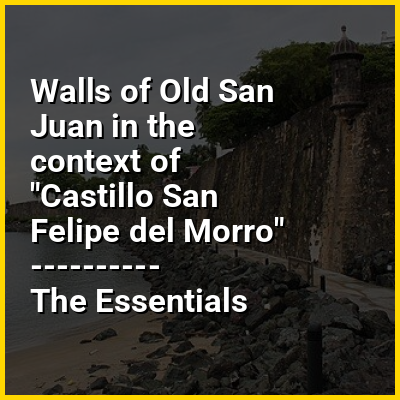
The Walls of Old San Juan (Spanish: Murallas del Viejo San Juan) is a defensive city wall that surrounds the western end of the San Juan Islet, site of the historic district of San Juan, Puerto Rico. This defensive wall system was built between the 16th and 18th centuries to protect the city and the Bay of San Juan, a highly strategic point in the Caribbean. These walls, along with the defensive fortresses in Old San Juan (La Fortaleza, El Morro and San Cristóbal), form part of the UNESCO World Heritage Site-designated San Juan National Historic Site as they are characteristic examples of the historic methods of construction used in military architecture which adapted European designs and techniques to the special conditions of the Caribbean port cities.

San Juan remains the only walled city under the United States jurisdiction, with walled cities like Boston, Charleston and New Orleans no longer having walls after the 18th century, although St. Augustine, Florida, still retains several wall remnants. Examples of other North American walled cities that retain their ramparts are Quebec City in Canada and Campeche in Mexico. The bartizans (garitas) found along the walls are considered emblematic of the city of San Juan and a symbol of historic heritage preservation in Puerto Rico.
↓ Menu

>>>PUT SHARE BUTTONS HERE<<<

👉 Walls of Old San Juan in the context of Castillo San Felipe del Morro

Castillo San Felipe del Morro (English: Promontory Castle of Saint Philip), most commonly known as El Morro (The Promontory), is a large fortress and citadel in the Old San Juan historic quarter of San Juan, the capital municipality of Puerto Rico. Commissioned by King Charles I of Spain in 1539, it was first built as a fortified tower in honor of King Philip II, who oversaw its expansion into a hornwork bastion fort by 1595. Over the next 200 years, especially in the reign of King Charles III, El Morro continued to be developed to reach its current form in 1787. Rising 43 metres (140 ft) from the Atlantic shoreline with 5.5 to 7.6 metres (18 to 25 ft) thick walls, the six-leveled edifice stands on a steep, rocky headland promontory on San Juan Islet guarding the entry to San Juan Bay, the harbor of Old San Juan. El Morro, alongside La Fortaleza, San Cristóbal, El Cañuelo, and other forts part of the Walls of Old San Juan, protected strategically and militarily important Puerto Rico, or La Llave de las Indias (The Key to the Indies), from invasion by competing world powers during the Age of Discovery and Sail. It was designated a World Heritage Site by UNESCO in 1983.

↓ Explore More Topics
In this Dossier

Walls of Old San Juan in the context of Castillo San Cristóbal (San Juan)

Castillo San Cristóbal (English: Saint Christopher Castle) is a fortress in the Old San Juan historic quarter of San Juan, the capital municipality of Puerto Rico, known for being the largest fortification built by the Spanish in the New World. Dating back to defense expansions following attacks by the English in 1598 and Dutch in 1625, it was first constructed in 1634 as the Caballero de San Miguel (Saint Michael Cavalier) and the Garita del Diablo ("devil’s sentry box"). Over the next 150 years, especially in the reign of King Charles III of Spain, it continued to be developed into a bastion fort with outer ravelins and batteries to reach its largest size in 1783. Rising 150 ft from the Atlantic shoreline, the three-level edifice stands on a hill at the northern coastline of San Juan Islet, guarding the land entry to Old San Juan. Alongside El Morro, La Fortaleza, and other forts part of the Walls of Old San Juan, it protected strategically and militarily important Puerto Rico, or La Llave de las Indias (The Key to the Indies), from invasion by competing world powers during the Age of Sail. It was designated a World Heritage Site by UNESCO in 1983.

↑ Return to Menu

Walls of Old San Juan in the context of La Fortaleza

La Fortaleza (English: "the fortress"), officially the Palacio de Santa Catalina ("Saint Catherine's Palace"), is the official residence and workplace of the governor of Puerto Rico. Located in the historic quarter of Old San Juan in the capital municipality of San Juan, it has served as the governor’s residence since the 16th century, making it the oldest executive mansion in continuous use in the New World. Built as a medieval fortress from 1533 to 1540 by orders of King Charles I of Spain, and remodeled to its present Neoclassical style in 1846 by orders of Governor Rafael Arístegui y Vélez, it was the first fortification erected by the Spanish on San Juan Islet to defend San Juan Bay, the harbor of Old San Juan. Alongside El Morro, San Cristóbal, and other forts part of the Walls of Old San Juan, it protected strategically and militarily important Puerto Rico, or La Llave de las Indias (The Key to the Indies), from invasion by competing world powers and harassment by privateers and pirates during the Age of Discovery and Sail. It was designated a World Heritage Site in 1983.

Situated in the western end of San Juan Islet in the Old San Juan historic quarter, La Fortaleza, seat of the executive branch, is about 1 mile (1.6 km) from the Capitol of Puerto Rico, seat of the legislative branch, in the center of the Islet in the Puerta de Tierra historic district, and 2 miles (3.2 km) from the Supreme Court Building, seat of the judicial branch, in the eastern end of the Islet in Puerta de Tierra.

↑ Return to Menu

Walls of Old San Juan in the context of Capitol of Puerto Rico

The Capitol of Puerto Rico (Spanish: Capitolio de Puerto Rico), also known as Casa de las Leyes (House of Laws), and most commonly referred to as El Capitolio (The Capitol), is the seat of the Legislative Assembly of Puerto Rico, a bicameral legislature composed of a Senate and a House of Representatives responsible for the legislative branch of the government in the archipelago and island. Located in San Juan Islet immediately outside the city walls of the Old San Juan historic quarter in the capital municipality of San Juan, the ocean and bayfront, Neoclassical Beaux-Arts style, entirely white marble-cladded edifice was built by architect Rafael Carmoega between 1921 and 1929 to resemble the Pantheon in Rome, using as inspiration the Low Memorial Library in New York City. It was added to the U.S. National Register of Historic Places in 1977.

Situated in the center of San Juan Islet in the Puerta de Tierra historic district overlooking the Atlantic Ocean in the north and San Juan Bay in the south from an elevated point, the Capitol of Puerto Rico is about 1 mile (1.6 km) from both the La Fortaleza, seat of the executive branch, in the Old San Juan historic quarter in the western end of the Islet, and the Supreme Court Building, seat of the judicial branch, in the eastern end of the Islet in Puerta de Tierra. The Court and Capitol are directly connected via Luis Muñoz Rivera Avenue in the north and Juan Ponce de León Avenue in the south, both of which are directly linked to La Fortaleza via San Francisco Street in the north and Fortaleza Street in the south.

↑ Return to Menu