Wake Island in the context of "United States Minor Outlying Islands"

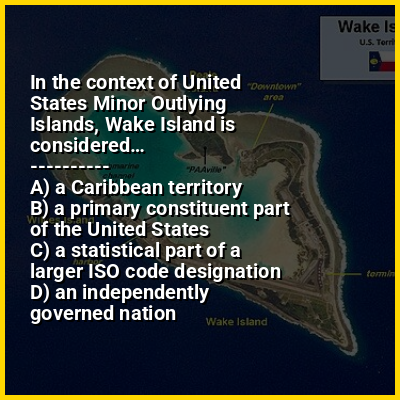
⭐ In the context of United States Minor Outlying Islands, Wake Island is considered…

Ad spacer

⭐ Core Definition: Wake Island

Wake Island (Marshallese: Ānen Kio, lit. 'island of the kio flower'), also known as Wake Atoll (Chamorro: Islan Wake), is a coral atoll in the Micronesia subregion of the Pacific Ocean. The atoll is composed of three islets – Wake, Wilkes, and Peale Islands – surrounding a lagoon encircled by a coral reef. The nearest inhabited island is Utirik Atoll in the Marshall Islands, located 592 miles (953 kilometers) to the southeast.

The island may have been found by prehistoric Austronesian mariners before its first recorded discovery by Ɓlvaro de MendaƱa de Neira in 1568. Ships continued visiting the area in the following centuries, but the island remained undeveloped until the United States claimed it in 1899. Significant development of the island did not begin until 1935 when Pan American Airways constructed an airfield and hotel, establishing Wake Island as a stopover for trans-Pacific flying boat routes. In December 1941 at the opening of the Pacific Theatre of World War II Japan seized the island, which remained under Japanese occupation until the end of the war in September 1945. In 1972, Pan American Airways ceased using the island for trans-Pacific layovers, instead using Boeing 747 aircraft, which could cross the ocean without stopping. With the withdrawal of Pan American Airways, the island's administration was taken over by the United States Air Force, which later used the atoll as a processing location for Vietnamese refugees during Operation New Life in 1975.
↓ Menu

>>>PUT SHARE BUTTONS HERE<<<

šŸ‘‰ Wake Island in the context of United States Minor Outlying Islands

The United States Minor Outlying Islands is a statistical designation applying to the minor outlying islands and groups of islands that comprise eight United States insular areas and territories in the Pacific Ocean (Baker Island, Howland Island, Jarvis Island, Johnston Atoll, Kingman Reef, Midway Atoll, Palmyra Atoll, and Wake Island) and one in the Caribbean Sea (Navassa Island).

It is defined by the International Organization for Standardization's ISO 3166-1 code. The entry code is ISO 3166-2:UM.

↓ Explore More Topics
In this Dossier

Wake Island in the context of Marshall Islands

The Marshall Islands, officially the Republic of the Marshall Islands, is an island country in Oceania. The sovereign state lies west of the International Date Line and north of the equator in the Micronesia region of the Northwestern Pacific Ocean.

The territory consists of 29 coral atolls and five main islands as well as 1,220 other very small ones, divided across two island chains: Ratak in the east and Ralik in the west. 98.13% of its territory is water, the largest proportion of water to land of any sovereign state. The country shares maritime boundaries with Wake Island to the north, Kiribati to the southeast, Nauru to the south, and the Federated States of Micronesia to the west. The capital and largest city is Majuro, home to approximately half of the country's population. The Marshall Islands are one of only four atoll based nations in the entire world.

↑ Return to Menu

Wake Island in the context of Battle of Wake Island

The Battle of Wake Island was a battle of the Pacific campaign of World War II, fought on Wake Island. The assault began simultaneously with the attack on Pearl Harbor naval and air bases in Hawaii on the morning of 8 December 1941 (7 December in Hawaii), and ended on 23 December, with the surrender of American forces to the Empire of Japan. It was fought on and around the atoll formed by Wake Island and its minor islets of Peale and Wilkes Islands by the air, land, and naval forces of the Japanese Empire against those of the United States, with marines playing a prominent role on both sides.

The battle started with a surprise bombing raid on 8 December 1941, within hours of Pearl Harbor, and the air raids continued almost every day for the duration of the battle. There were two amphibious assaults, one on 11 December 1941 (which was rebuffed) and another on 23 December, that led to the Japanese capture of the atoll. In addition, there were several air battles above and around Wake and an encounter between two naval vessels. The U.S. lost control of the island and 12 fighter aircraft; in addition to the garrison being taken as prisoners of war, nearly 1,200 civilian contractors were also captured by the Japanese. The Japanese lost about two dozen aircraft of different types, four surface vessels, and two submarines as part of the operation, in addition to at least 600 armed forces. It is typically noted that 98 civilian POWs captured in this battle were used for slave labor and then executed on Wake Island in October 1943. The other POWs were deported and sent to prisoner of war camps in Asia, with five executed on the sea voyage.

↑ Return to Menu

Wake Island in the context of List of extreme points of the United States

This is a list of points in the United States that are farther north, south, east or west than any other location in the country. Also included are extreme points in elevation, extreme distances and other points of peculiar geographic interest.

↑ Return to Menu