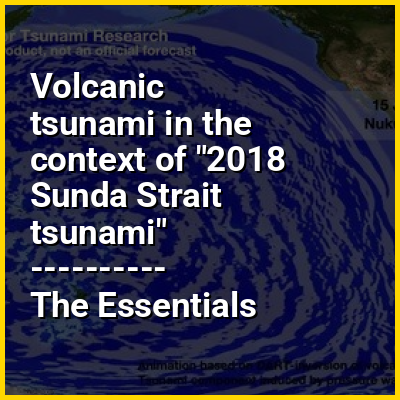
In December 2021, an eruption began on Hunga Tonga–Hunga Haʻapai, a submarine volcano in the Tongan archipelago in the southern Pacific Ocean. The eruption reached a very large and powerful climax nearly four weeks later, on 15 January 2022. Hunga Tonga–Hunga Haʻapai is 65 kilometres (40 mi) north of Tongatapu, the country's main island, and is part of the highly active Tonga–Kermadec Islands volcanic arc, a subduction zone extending from New Zealand to Fiji. On the Volcanic Explosivity Index scale, the eruption was rated at least a VEI-5. Described by scientists as a "magma hammer", the volcano at its height produced a series of four underwater thrusts, displaced 10 cubic kilometres (2.4 cu mi) of rock, ash and sediment, and generated the largest atmospheric explosion recorded by modern instrumentation.
The eruption produced a volcanic tsunami that affected Tonga, Fiji, American Samoa, Samoa, Vanuatu, New Zealand, Japan, the United States, the Russian Far East, Chile and Peru. At least four people were killed, some were injured, and some remain possibly missing in Tonga from tsunami waves up to 20 m (66 ft) high. Tsunami waves with run-up heights up to 45 m (148 ft) struck the uninhabited island of Tofua. Two people drowned in Peru when 2 m (6 ft 7 in) waves struck the coast, while another died of indirect causes in Fiji. It was the largest volcanic eruption since the 1991 eruption of Mount Pinatubo. NASA determined that the eruption was "hundreds of times more powerful" than Little Boy. The eruption was the largest explosion recorded in the atmosphere by modern instrumentation, far larger than any 20th-century volcanic event or nuclear bomb test. It is thought that in recent centuries, only the Krakatoa eruption of 1883 rivalled the atmospheric disturbance produced.