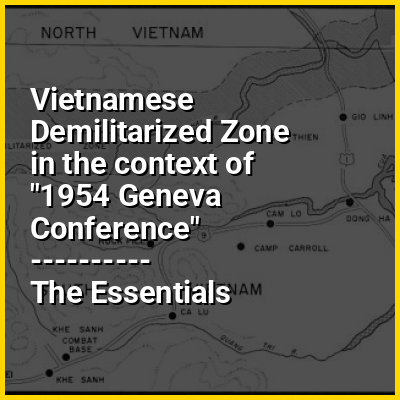
The Geneva Conference was intended to settle outstanding issues resulting from the Korean War and the First Indochina War and involved several nations. It took place in Geneva, Switzerland, from 26 April to 21 July 1954. The part of the conference on the Korean question ended without adopting any declarations or proposals and so is generally considered less relevant. On the other hand, the Geneva Accords that dealt with the dismantling of French Indochina proved to have long-lasting repercussions.
Diplomats from South Korea, North Korea, China, the Soviet Union, and the United States dealt with the Korean side of the conference. On the Indochina issue, the conference involved representatives from France, China, the Soviet Union, the United States, the United Kingdom, the Democratic Republic of Vietnam, the State of Vietnam, the Kingdom of Laos, and the Kingdom of Cambodia. Three binding ceasefire agreements about Indochina ended hostilities in Vietnam, Laos, and Cambodia. The Pathet Lao were confined to two provinces in northern Laos, and Khmer Issarak forces disbanded. Vietnam was provisionally partitioned at the 17th parallel, with troops and personnel of the Democratic Republic of Vietnam regrouping to the North, and those of the State of Vietnam and French Union regrouping to the South. Alongside them, a non‑legally binding Final Declaration called for international supervision (via the International Control Commission), prohibited the introduction of foreign troops and bases in Vietnam, affirmed that the 17th parallel was only a provisional demarcation, and scheduled national elections for 1956. Worsening relations between the communist and anti-communist sides would eventually lead to the Vietnam War. As such, historians generally regard the Geneva Conference as failing to secure lasting peace in Indochina.