Victor Horta in the context of "Skylight"

Play Trivia Questions online!

or

Skip to study material about Victor Horta in the context of "Skylight"

Ad spacer

⭐ Core Definition: Victor Horta

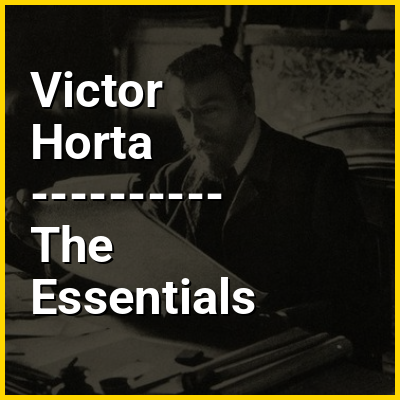
Victor Pierre Horta (French: [viktɔʁ ɔʁta]; Victor, Baron Horta after 1932; 6 January 1861 – 8 September 1947) was a Belgian architect and designer, and one of the founders of the Art Nouveau movement. He was a fervent admirer of the French architectural theorist Eugène Viollet-le-Duc and his Hôtel Tassel in Brussels (1892–93), often considered the first Art Nouveau house, is based on the work of Viollet-le-Duc. The curving stylized vegetal forms that Horta used in turn influenced many others, including the French architect Hector Guimard, who used it in the first Art Nouveau apartment building he designed in Paris and in the entrances he designed for the Paris Metro. He is also considered a precursor of modern architecture for his open floor plans and his innovative use of iron, steel and glass.

Horta's later work moved away from Art Nouveau, and became more geometric and formal, with classical touches, such as columns. He made a highly original use of steel frames and skylights to bring light into the structures, open floor plans, and finely-designed decorative details. His later major works included the Maison du Peuple/Volkshuis (1895–1899), Brussels' Centre for Fine Arts (1923–1929) and Brussels-Central railway station (1913–1952). In 1932, King Albert I conferred on Horta the title of Baron for his services to the field of architecture.
↓ Menu

>>>PUT SHARE BUTTONS HERE<<<
In this Dossier

Victor Horta in the context of Eugène Viollet-le-Duc

Eugène Emmanuel Viollet-le-Duc (French: [øʒɛn vjɔlɛ dyk]; 27 January 1814 – 17 September 1879) was a French architect and author, famous for his restoration of the most prominent medieval landmarks in France. His major restoration projects included Notre-Dame de Paris, the Basilica of Saint Denis, Mont Saint-Michel, Sainte-Chapelle, the medieval walls of the city of Carcassonne, and Château de Roquetaillade in the Bordeaux region.

His writings on decoration and on the relationship between form and function in architecture had a fundamental influence on a whole new generation of architects, including all the major Art Nouveau artists: Antoni Gaudí, Victor Horta, Hector Guimard, Henry van de Velde, Henri Sauvage and the École de Nancy, Paul Hankar, Otto Wagner, Eugène Grasset, Émile Gallé, and Hendrik Petrus Berlage. He also influenced the first modern architects, Frank Lloyd Wright, Mies van der Rohe, Auguste Perret, Louis Sullivan, and Le Corbusier, who considered Viollet-le-Duc as the father of modern architecture. English architect William Burges claimed that "We all cribbed on Viollet-le-Duc even though no one could read French".

↑ Return to Menu

Victor Horta in the context of Whiplash (decorative art)

The whiplash or whiplash line is a motif of decorative art and design that was particularly popular in Art Nouveau. It is an asymmetrical, sinuous line, often in an ornamental S-curve, usually inspired by natural forms such as plants and flowers, which suggests dynamism and movement. It took its name from a woven fabric panel "Cyclamen", by the German artist Hermann Obrist (1895) which depicted the stems and roots of the cyclamen plant, which critics dubbed "Coup de Fouet" ('whiplash'). The panel was later reproduced by the textile workshop of the Darmstadt Artists Colony.

Curling whiplash lines were modelled after natural and vegetal forms, particularly the cyclamen, iris, orchid, thistle, mistletoe, holly, water lily, and from the stylized lines of the swan, peacock, dragonfly, and butterfly.

↑ Return to Menu

Victor Horta in the context of Henry van de Velde

Henry Clemens van de Velde (DutchDutch: [ˈɦɛnri vɑn ˈvɛldə]; 3 April 1863 – 15 October 1957) was a Belgian painter, architect, interior designer, and art theorist. Together with Victor Horta and Paul Hankar, he is considered one of the founders of Art Nouveau in Belgium. He worked in Paris with Siegfried Bing, the founder of the first gallery of Art Nouveau in Paris. Van de Velde spent the most important part of his career in Germany and became a major figure in the German Jugendstil. He had a decisive influence on German architecture and design at the beginning of the 20th century.

↑ Return to Menu

Victor Horta in the context of Hôtel Tassel

The Hôtel Tassel (French: Hôtel Tassel; Dutch: Hotel Tassel), also known as the Tassel House, is a historic town house in Brussels, Belgium. It was designed by Victor Horta for the scientist and professor Emile Tassel, and built between 1892 and 1893, in Art Nouveau style. It is considered one of the first buildings in that style (along with the Hankar House by Paul Hankar, built at the same time) because of its highly innovative plan and its ground-breaking use of materials and decoration. It is located at 6, rue Paul-Emile Janson/Paul-Emile Jansonstraat, a few steps from the Avenue Louise/Louizalaan.

Together with three other town houses of Victor Horta, including Horta's own house and workshop, it was added to the UNESCO World Heritage list in 2000 as the core of epoch-making urban residences that Horta designed before 1900.

↑ Return to Menu