Vibrating structure gyroscope in the context of "Gyroscope"

Play Trivia Questions online!

or

Skip to study material about Vibrating structure gyroscope in the context of "Gyroscope"

Ad spacer

⭐ Core Definition: Vibrating structure gyroscope

A vibrating structure gyroscope (VSG), defined by the IEEE as a Coriolis vibratory gyroscope (CVG), is a gyroscope that uses a vibrating (as opposed to rotating) structure as its orientation reference. A vibrating structure gyroscope functions much like the halteres of flies (insects in the order Diptera).

The underlying physical principle is that a vibrating object tends to continue vibrating in the same plane even if its support rotates. The Coriolis effect causes the object to exert a force on its support, and by measuring this force the rate of rotation can be determined.
↓ Menu

>>>PUT SHARE BUTTONS HERE<<<

👉 Vibrating structure gyroscope in the context of Gyroscope

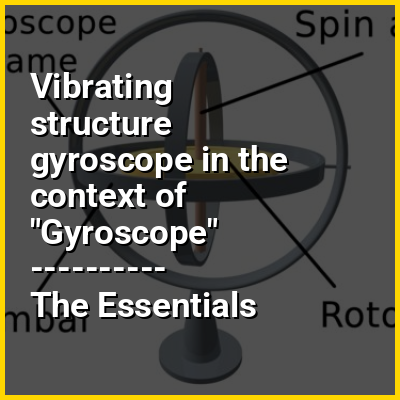
A gyroscope (from Ancient Greek γῦρος gŷros 'round' and σκοπέω skopéō 'to look') is a device used for measuring or maintaining orientation and angular velocity. It is a spinning wheel or disc in which the axis of rotation (spin axis) is free to assume any orientation by itself. When rotating, the orientation of this axis is unaffected by tilting or rotation of the mounting, due to the conservation of angular momentum.

Gyroscopes based on other operating principles also exist, such as the microchip-packaged MEMS gyroscopes found in electronic devices (sometimes called gyrometers), solid-state ring lasers, fibre optic gyroscopes, and the extremely sensitive quantum gyroscope.

↓ Explore More Topics
In this Dossier

Vibrating structure gyroscope in the context of Halteres

Halteres (/hælˈtɪərz/; singular halter or haltere) (from Ancient Greek: ἁλτῆρες, hand-held weights to give an impetus in leaping) are a pair of small club-shaped organs on the body of some flying insects that provide information about body rotations during flight. They are present on flies belonging to two orders, Diptera and Strepsiptera. In dipterans, the halteres evolved from a pair of ancestral hindwings, while males of the much smaller strepsiterans (stylops) have halteres evolved from a pair of ancestral forewings.

Halteres oscillate rapidly along with the wings and operate like vibrating structure gyroscopes: any rotation of the plane of oscillation causes a force on the vibrating halteres by the Coriolis effect. The insect detects this force with sensory organs called campaniform sensilla and chordotonal organs located at the base of the halteres and uses this information to interpret and correct its position in space. Halteres provide rapid feedback to the wing-steering muscles, as well as to the muscles responsible for stabilizing the head.

↑ Return to Menu