ʿUqba ibn Nāfiʿ ibn ʿAbd al-Qays al-Fihrī al-Qurashī (Arabic: عقبة بن نافع بن عبد القيس الفهري القرشي), also simply known as Uqba ibn Nafi (622–683), was an Arab general serving the Rashidun Caliphate since the reign of Umar and later the Umayyad Caliphate during the reigns of Mu'awiya I and Yazid I, leading the Muslim conquest of the Maghreb, including present-day Libya, Tunisia, Algeria and Morocco and a failed attempt in Nubia. He is credited with establishing Umayyad rule in North Africa. Uqba was the nephew of Amr ibn al-As. He is often surnamed al-Fihri in reference to the Banu Fihr, a clan connected to the Quraysh. His descendants would be known as the ʿUqbids or Fihrids.
HINT:
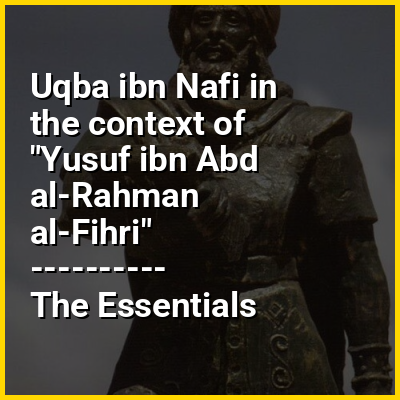
👉 Uqba ibn Nafi in the context of Yusuf ibn Abd al-Rahman al-Fihri
Yusuf ibn Abd al-Rahman al-Fihri (Arabic: يوسف بن عبد الرحمن الفهري) was an Umayyad governor of Narbonne in Septimania and the governor of al-Andalus from 747 to 750, ruling independently following the collapse of the Umayyad Caliphate in 750. He was a descendant of Uqba ibn Nafi, the founder of Kairouan.
In this Dossier
- ⭐ Core Definition: Uqba ibn Nafi
- 👉 Uqba ibn Nafi in the context of Yusuf ibn Abd al-Rahman al-Fihri
- Uqba ibn Nafi in the context of Islam in Chad
- Uqba ibn Nafi in the context of Medieval Muslim Algeria
- Uqba ibn Nafi in the context of Mosque of Uqba
Uqba ibn Nafi in the context of Islam in Chad
The earliest presence of Islam in Chad can be traced back to Uqba ibn Nafi, whose descendants can be found settled in the Lake Chad region to this day. By the time Arab migrants began arriving from the east in the fourteenth century in sizeable numbers, the creed was already well established. Islamization in Chad was gradual, the effect of the slow spread of Islamic civilization beyond its political frontiers. Among Chadian Muslims, 48% professed to be Sunni, 21% Shia, 23% just Muslim and 4% Other.
Islam in Chad was not influenced much by the great mystical movements of the Islamic Middle Ages, nor the fundamentalist upheavals that affected other countries. Consistent contact with West African Muslim traders and pilgrims may be the reason Chadian Muslims identify with the Tijaniyya order. Similarly, in the mid-nineteenth century, the Senusiyya brotherhood was founded in Libya, which benefited from economic and political influence in the Lake Chad Basin around 1900. An Islamic revival movement, feared by some French, led by Sanusi fanatics, Chadian adherents, limited to the Awlad Sulayman Arabs and the Toubou of eastern Tibesti, have never been numerous.
View the full Wikipedia page for Islam in ChadUqba ibn Nafi in the context of Medieval Muslim Algeria
Medieval Muslim Algeria was a period of Muslim dominance in Algeria during the Middle Ages, spanning the millennium from the 7th century to the 17th century. The new faith, in its various forms, would penetrate nearly all segments of society, bringing with it armies, learned men, and fervent mystics; in large part, it would replace tribal practices and loyalties with new social norms and political idioms.
The first Arab military expeditions into the Maghreb, between 642 and 669, resulted in the spread of Islam and migration of Arabs to the Maghreb. These early forays from a base in Egypt occurred under local initiative rather than under orders from the central caliphate. When the seat of the caliphate moved from Medina to Damascus, the Umayyads (a Muslim dynasty ruling from 661 to 750) recognized that the strategic necessity of dominating the Mediterranean dictated a concerted military effort on the North African front. In 670, therefore, an Arab army under Uqba ibn Nafi established the town of Al-Qayrawan about 160 kilometers south of present-day Tunis and used it as a base for further operations.
View the full Wikipedia page for Medieval Muslim AlgeriaUqba ibn Nafi in the context of Mosque of Uqba
The Great Mosque of Kairouan (Arabic: جامع القيروان الأكبر), also known as the Mosque of Uqba (جامع عقبة بن نافع), is a mosque situated in the UNESCO World Heritage town of Kairouan, Tunisia and is one of the largest Islamic monuments in North Africa.
Established by the Arab general Uqba ibn Nafi in 50 AH (670/671 CE) at the founding of the city of Kairouan, the mosque occupies an area of over 9,000 square metres (97,000 sq ft). It is one of the oldest places of worship in the Islamic world, and is a model for all later mosques in the Maghreb. Its perimeter, of about 405 metres (1,329 ft), contains a hypostyle prayer hall, a marble-paved courtyard and a square minaret. In addition to its spiritual prestige, the Mosque of Uqba is one of the masterpieces of Islamic architecture, notable among other things for the first Islamic use of the horseshoe arch.
View the full Wikipedia page for Mosque of Uqba