University of Auckland in the context of University of New Zealand


University of Auckland in the context of University of New Zealand

⭐ Core Definition: University of Auckland

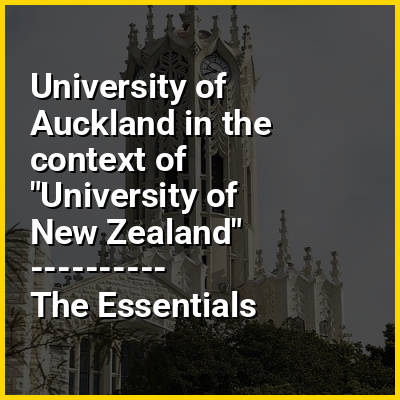
The University of Auckland (UoA; Waipapa Taumata Rau) is a public research university in Auckland, New Zealand. It is the largest and highest ranked University in New Zealand. It was established in 1883 as Auckland University College, a constituent college of the University of New Zealand, following the passage of the Auckland University College Act 1882. In its early years the college operated from a disused courthouse and jail. The University’s Māori name, Waipapa Taumata Rau, was gifted by Ngāti Whātua Ōrākei in 2021.

As of the mid-2020s, the University is widely reported as the largest in New Zealand by enrolment, with a student population of around 44,000. Teaching and research are centred on three main campuses in central Auckland: City (the historic core), Grafton (home to the Faculty of Medical and Health Sciences), and Newmarket (acquired in 2013 on the former Lion Breweries site).

↓ Menu
HINT:

👉 University of Auckland in the context of University of New Zealand

The University of New Zealand was New Zealand's sole degree-granting university from 1874 to 1961. It was a collegiate university embracing several constituent institutions at various locations around New Zealand.

After the University of New Zealand was dissolved in 1961, its constituent colleges became four independent degree-granting universities and two associated agricultural colleges: the University of Otago (Dunedin), University of Canterbury (Christchurch), University of Auckland (Auckland), Victoria University of Wellington (Wellington), Canterbury Agricultural College (Lincoln) and Massey Agricultural College (Palmerston North).

↓ Explore More Topics
In this Dossier

University of Auckland in the context of Edward Zalta

Edward Nouri Zalta (/ˈzɔːltə/; born March 16, 1952) is an American philosopher who is a senior research scholar at the Center for the Study of Language and Information at Stanford University. He received his BA from Rice University in 1975 and his PhD from the University of Massachusetts Amherst in 1981, both in philosophy. Zalta has taught courses at Stanford University, Rice University, the University of Salzburg, and the University of Auckland. Zalta is also the Principal Editor of the Stanford Encyclopedia of Philosophy.

View the full Wikipedia page for Edward Zalta
↑ Return to Menu

University of Auckland in the context of Dylan Horrocks

Dylan Horrocks (born 1966) is a New Zealand cartoonist best known for his graphic novel Hicksville and his scripts for the Batgirl comic book series.

His works are published by the University of Auckland student magazine Craccum, Australia's Fox Comics, the current affairs magazine New Zealand Listener from 1995 to 1997, the Canadian publishers Black Eye Comics and Drawn & Quarterly, and the American publishers Vertigo and Fantagraphics Books. He currently serialises new work online at Hicksville Comics.

View the full Wikipedia page for Dylan Horrocks
↑ Return to Menu

University of Auckland in the context of Learner autonomy

Learner autonomy has been a popular concept in foreign language education in the past decades, specially in relation to lifelong learning skills. It has transformed old practices in the language classroom and has given origin to self access language learning centers around the world such as the SALC at Kanda University of International Studies in Japan, the ASLLC at The Education University of Hong Kong, the SAC at Hong Kong University of Science and Technology and ELSAC at the University of Auckland [1]. As the result of such practices, language teaching is now sometimes seen as the same as language learning, and it has placed the learner in the centre of attention in language learning education in some places.

There is a comprehensive bibliography for learner autonomy.

View the full Wikipedia page for Learner autonomy
↑ Return to Menu

University of Auckland in the context of Dame Cindy Kiro

Dame Alcyion Cynthia Kiro GNZM QSO DStJ (Māori: [kiːɾɔ]) (née Simpson; born 1958) is a New Zealand public-health academic, administrator, and advocate, who has been serving as the 22nd governor-general of New Zealand since 21 October 2021. Kiro is the first Māori woman and the third person of Māori descent to hold the office.

Before she was announced as governor-general designate, Kiro was Chief Executive of the Royal Society Te Apārangi and was previously the Children's Commissioner, head of school of the School of Public Health at Massey University, head of Te Kura Māori at Victoria University of Wellington, and Pro-Vice Chancellor (Māori) of the University of Auckland.

View the full Wikipedia page for Dame Cindy Kiro
↑ Return to Menu

University of Auckland in the context of Paul Feyerabend

Paul Karl Feyerabend (/ˈfərɑːbənd/; FY-ur-ah-bent; German: [ˈfaɪɐˌʔaːbm̩t]; January 13, 1924 – February 11, 1994) was an Austrian philosopher best known for his work in the philosophy of science. He started his academic career as lecturer in the philosophy of science at the University of Bristol (1955–1958); afterward, he moved to the University of California, Berkeley, where he taught for three decades (1958–1989). At various points in his life, he held joint appointments at the University College London (1967–1970), the London School of Economics (1967), the FU Berlin (1968), Yale University (1969), the University of Auckland (1972, 1975), the University of Sussex (1974), and the ETH Zurich (1980–1990). He gave lectures and lecture series at the University of Minnesota (1958–1962), Stanford University (1967), the University of Kassel (1977), and the University of Trento (1992).

Feyerabend's most famous work is Against Method (1975), wherein he argues that there are no universally valid methodological rules for scientific inquiry. He also wrote on topics related to the politics of science in several essays and in his book Science in a Free Society (1978). Feyerabend's later works include Wissenschaft als Kunst (Science as Art) (1984), Farewell to Reason (1987), Three Dialogues on Knowledge (1991), and Conquest of Abundance (released posthumously in 1999), which collect essays from the 1970s until Feyerabend's death. The uncompleted draft of an earlier work was released posthumously in 2009 as Naturphilosophie and translated to English in 2016 as Philosophy of Nature. This work contains Feyerabend's reconstruction of the history of natural philosophy from the Homeric period until the mid-20th century. In these works and others, Feyerabend wrote about numerous issues at the interface between history and philosophy of science and ethics, ancient philosophy, philosophy of art, political philosophy, medicine, and physics. His final work was an autobiography, Killing Time, which he completed on his deathbed. Feyerabend's extensive correspondence and other materials from his Nachlass continue to be published.

View the full Wikipedia page for Paul Feyerabend
↑ Return to Menu

University of Auckland in the context of Brian Boyd

Brian David Boyd (born 30 July 1952) is a professor of literature known primarily as an expert on the life and works of author Vladimir Nabokov and on literature and evolution. He is a University Distinguished Professor in the Department of English at the University of Auckland, New Zealand.

View the full Wikipedia page for Brian Boyd
↑ Return to Menu

University of Auckland in the context of Craccum

Craccum is a student magazine of the University of Auckland, owned and operated by the Auckland University Students' Association (AUSA) in New Zealand. It was founded in 1927 and the name originated from the scrambled acronym of "Auckland University College Men's Common Room Committee". Craccum is a member of the Aotearoa Student Press Association (ASPA).

View the full Wikipedia page for Craccum
↑ Return to Menu