Unitarianism in the context of "Biblical unitarianism"

Play Trivia Questions online!

or

Skip to study material about Unitarianism in the context of "Biblical unitarianism"

Ad spacer

⭐ Core Definition: Unitarianism

Unitarianism is a nontrinitarian sect of Christianity. Unitarians affirm the unitary nature of God as the singular and unique creator of the universe, believe that Jesus Christ was inspired by God in his moral teachings and that he is the savior of mankind, but he is not equal to God himself. Accordingly, Unitarians reject the Ecumenical Councils and ecumenical creeds, and sit outside traditional, mainstream Christianity.

Unitarianism was established in order to restore "primitive Christianity before later corruptions set in". Likewise, Unitarian Christians generally reject the doctrine of original sin. The churchmanship of Unitarianism may include liberal denominations or Unitarian Christian denominations that are more conservative, with the latter being known as biblical Unitarians.
↓ Menu

>>>PUT SHARE BUTTONS HERE<<<

πŸ‘‰ Unitarianism in the context of Biblical unitarianism

Biblical unitarianism (otherwise capitalized as biblical Unitarianism, sometimes abbreviated as BU) is a Unitarian Christian tradition whose adherents affirm the Christian Bible as their sole authority, and from it base their beliefs that God the Father is one singular being, and that Jesus is God's son but not divine. The term "biblical Unitarianism" is connected first with Robert Spears and Samuel Sharpe of the Christian Life magazine in the 1880s. It is a neologism (or retronym) that gained increasing currency in nontrinitarian literature during the 20th century as the Unitarian churches moved away from mainstream church traditions and, in some instances in the United States, towards merger with Universalism. It has been used since the late 19th century by conservative Christian Unitarians, and sometimes by historians, to refer to scripture-fundamentalist Unitarians of the 16th–18th centuries.

A few denominations use this term to describe themselves, clarifying the distinction between them and those churches which, from the late 19th century, evolved into modern British Unitarianism and, primarily in the United States, Unitarian Universalism.

↓ Explore More Topics
In this Dossier

Unitarianism in the context of Christianity in the United Kingdom

Christianity is the largest religion in the United Kingdom. Results of the 2021 Census for England and Wales showed that Christianity is the largest religion (though it makes up less than half of the population at 46.2%), followed by the non-religious (37.2%), Islam (6.5%), Hinduism (1.7%), Sikhism (0.9%), Buddhism (0.5%), Judaism (0.5%), and others (0.6%). Among Christians, Anglicanism is the most common denomination, with 53% of Christian believers in the UK identifying with this denomination as of 2023, followed by Catholicism, Presbyterianism, Methodism, Unitarianism, and Baptists. Results for the 2022 census in Scotland indicated that the majority (51%) had no religion, but that 38.8% of the Scottish population identified as Christian (of which 20% identified with the Church of Scotland and 13% with the Catholic Church). In Northern Ireland, Christianity is the largest religion (79.7%) followed by non-religious (17.4%), other religions (1.3%), and not stated (1.5%), as of 2021.

↑ Return to Menu

Unitarianism in the context of Transcendentalism

Transcendentalism is a philosophical, spiritual, and literary movement that developed in the late 1820s and 1830s in the New England region of the United States. A core belief is in the inherent goodness of people and nature, and while society and its institutions have corrupted the purity of the individual, people are at their best when truly "self-reliant" and independent. Transcendentalists saw divine experience inherent in the everyday. They thought of physical and spiritual phenomena as part of dynamic processes rather than as discrete entities.

Transcendentalism is one of the first philosophical currents that emerged in the United States; it is therefore a key early point in the history of American philosophy. Emphasizing subjective intuition over objective empiricism, its adherents believe that individuals are capable of generating completely original insights with little attention and deference to past transcendentalists. Its rise was a protest against the general state of intellectualism and spirituality at the time. The doctrine of the Unitarian church as taught at Harvard Divinity School was closely related.

↑ Return to Menu

Unitarianism in the context of Geneva gown

The pulpit gown, also called pulpit robe or preaching robe, is a black gown worn by Protestant ministers for preaching. It is particularly associated with Reformed churches, while also used in the Anglican, Baptist, Methodist, Lutheran, and Unitarian traditions.

It is commonly called the Geneva gown, especially in Reformed churches. The garment in Lutheran churches is the talar (talaris vestis), also called priesterrock (priest's robe) or chorrock (choir or chancel robe).

↑ Return to Menu

Unitarianism in the context of David Ricardo

David Ricardo (18 April 1772 – 11 September 1823) was a British economist and politician of Portuguese Jewish descent. He is recognized as one of the most influential classical economists, alongside figures such as Thomas Malthus, Adam Smith and James Mill.

Ricardo was born in London as the third surviving child of a successful stockbroker and his wife. He came from a Sephardic Jewish family of Portuguese origin. At 21, he eloped with a Quaker and converted to Unitarianism, causing estrangement from his family. He made his fortune financing government borrowing and later retired to an estate in Gloucestershire. Ricardo served as High Sheriff of Gloucestershire and bought a seat in Parliament as an earnest reformer. He was friends with prominent figures like James Mill, Jeremy Bentham, and Thomas Malthus, engaging in debates over various topics. Ricardo was also a member of The Geological Society, and his youngest sister was an author.

↑ Return to Menu

Unitarianism in the context of Brook Farm

Brook Farm, also called the Brook Farm Institute of Agriculture and Education or the Brook Farm Association for Industry and Education, was a utopian experiment in communal living in the United States in the 1840s. It was founded by former Unitarian minister George Ripley and his wife Sophia Ripley at the Ellis Farm in West Roxbury, Massachusetts (nine miles outside of downtown Boston), in 1841 and was inspired in part by the ideals of transcendentalism, a religious and cultural philosophy based in New England. Founded as a joint stock company, it promised its participants a portion of the farm's profits in exchange for an equal share of the work. Brook Farmers believed that by sharing the workload, they would have ample time for leisure and intellectual pursuits.

Life on Brook Farm was based on balancing labor and leisure while working together for the community's benefit. Each member could choose whatever work they found most appealing and all were paid equally, including women. Revenue came from farming and from selling handmade products like clothing, as well as fees paid by the farm's many visitors. The main source of income was the school, which was overseen by Mrs. Ripley. A preschool, primary school, and a college preparatory school attracted children internationally and each child was charged for an education. Adult education was also offered.

↑ Return to Menu

Unitarianism in the context of Religious humanism

Religious humanism or ethical humanism is an integration of humanist philosophy with congregational rites and community activity that center on human needs, interests, and abilities. Religious humanists set themselves apart from secular humanists by characterizing the nontheistic humanist life stance as a non-supernatural "religion" and structuring their organization around a congregational model.

Ethical Culture and religious humanist groups first formed in the United States from Unitarian ministers who sought to build a secular religion influenced by the thinking of French philosopher Auguste Comte.

↑ Return to Menu

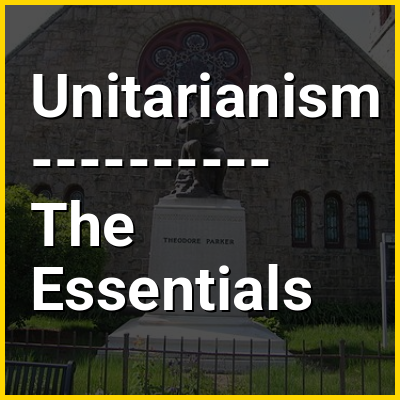
Unitarianism in the context of Theodore Parker

Theodore Parker (August 24, 1810 – May 10, 1860) was an American transcendentalist and reforming minister of the Unitarian church. A reformer and abolitionist, his words and popular quotations would later inspire speeches by Abraham Lincoln and Martin Luther King Jr.

↑ Return to Menu