Unit fraction in the context of Derived unit


Unit fraction in the context of Derived unit

Unit fraction Study page number 1 of 1

Play TriviaQuestions Online!

or

Skip to study material about Unit fraction in the context of "Derived unit"


⭐ Core Definition: Unit fraction

A unit fraction is a positive fraction with one as its numerator, 1/n. It is the multiplicative inverse (reciprocal) of the denominator of the fraction, which must be a positive natural number. Examples are 1/1, 1/2, 1/3, 1/4, 1/5, etc. When an object is divided into equal parts, each part is a unit fraction of the whole.

Multiplying two unit fractions produces another unit fraction, but other arithmetic operations do not preserve unit fractions. In modular arithmetic, unit fractions can be converted into equivalent whole numbers, allowing modular division to be transformed into multiplication. Every rational number can be represented as a sum of distinct unit fractions; these representations are called Egyptian fractions based on their use in ancient Egyptian mathematics. Many infinite sums of unit fractions are meaningful mathematically.

↓ Menu
HINT:

In this Dossier

Unit fraction in the context of Base unit (measurement)

A base unit of measurement (also referred to as a base unit or fundamental unit) is a unit of measurement adopted for a base quantity. A base quantity is one of a conventionally chosen subset of physical quantities, where no quantity in the subset can be expressed in terms of the others. The SI base units, or Systéme International d'unités, consists of the metre, kilogram, second, ampere, kelvin, mole and candela.

A unit multiple (or multiple of a unit) is an integer multiple of a given unit; likewise a unit submultiple (or submultiple of a unit) is a submultiple or a unit fraction of a given unit. Unit prefixes are common base-10 or base-2 powers multiples and submultiples of units.

View the full Wikipedia page for Base unit (measurement)
↑ Return to Menu

Unit fraction in the context of Egyptian fractions

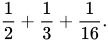
An Egyptian fraction is a finite sum of distinct unit fractions, such asThat is, each fraction in the expression has a numerator equal to 1 and a denominator that is a positive integer, and all the denominators differ from each other. The value of an expression of this type is a positive rational number ; for instance the Egyptian fraction above sums to . Every positive rational number can be represented by an Egyptian fraction. Sums of this type, and similar sums also including and as summands, were used as a serious notation for rational numbers by the ancient Egyptians, and continued to be used by other civilizations into medieval times. In modern mathematical notation, Egyptian fractions have been superseded by vulgar fractions and decimal notation. However, Egyptian fractions continue to be an object of study in modern number theory and recreational mathematics, as well as in modern historical studies of ancient mathematics.

View the full Wikipedia page for Egyptian fractions
↑ Return to Menu

Unit fraction in the context of Harmonic series (mathematics)

In mathematics, the harmonic series is the infinite series formed by summing all positive unit fractions:

The first terms of the series sum to approximately , where is the natural logarithm and is the Euler–Mascheroni constant. Because the logarithm has arbitrarily large values, the harmonic series does not have a finite limit: it is a divergent series. Its divergence was proven in the 14th century by Nicole Oresme using a precursor to the Cauchy condensation test for the convergence of infinite series. It can also be proven to diverge by comparing the sum to an integral, according to the integral test for convergence.

View the full Wikipedia page for Harmonic series (mathematics)
↑ Return to Menu
