Unification of Saudi Arabia in the context of "Walled town of Riyadh"

Play Trivia Questions online!

or

Skip to study material about Unification of Saudi Arabia in the context of "Walled town of Riyadh"

Ad spacer

⭐ Core Definition: Unification of Saudi Arabia

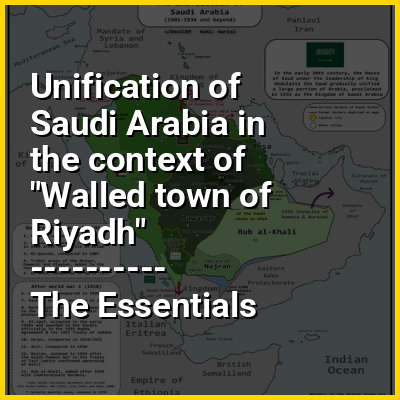
The unification of Saudi Arabia was a military and political campaign in which the various tribes, sheikhdoms, city-states, emirates, and kingdoms of most of the central Arabian Peninsula were conquered by the House of Saud, Unification started in 1902 and continued until 1932, when the Kingdom of Saudi Arabia was proclaimed under the leadership of Abdulaziz, known in the West as Ibn Saud, creating what is sometimes referred to as the Third Saudi state, to differentiate it from the First Saudi state, and the Second Saudi State.

The House of Saud had been in exile in the British-protected Emirate of Kuwait since 1893, following their second removal from power and the dissolution of their polity by the Rashidi dynasty rulers of the Emirate of Jabal Shammar, allies of the Ottoman Empire.
↓ Menu

>>>PUT SHARE BUTTONS HERE<<<

👉 Unification of Saudi Arabia in the context of Walled town of Riyadh

The walled town of Riyadh was the original core of Riyadh, the modern-day capital of Saudi Arabia, located on the western edge of Wadi al-Batʼha in present-day districts of ad-Dirah and ad-Doho. It emerged from the city-state of Migrin around 1746 when Dahham ibn Dawwas built a wall and a Al Hukm Palace within it, and ruled as the settlement's chieftain until his overthrow by the First Saudi State in 1773. It was later the center of power of the Second Saudi State for most of 19th century following brief Ottoman presence in the Najd. Abdulaziz ibn Saud recaptured the town in 1902 and made it the base for his 30-year long unification wars that led to the establishment of Saudi Arabia in 1932. The town served as the administrative center of the Saudi government before King Abdulaziz ibn Saud moved his workplace and residence to the Murabba Palace in 1944. In 1950, he instructed the dismantling of the fortifications in order to expand the settlement into a metropolis and the walled town eventually ceased to exist. The area covering the perimeters of the erstwhile town was renamed as the Qasr al-Hukm District in 1973 with the aim of preserving its historical and architectural significance.

↓ Explore More Topics
In this Dossier

Unification of Saudi Arabia in the context of Ibn Saud

Abdulaziz bin Abdul Rahman Al Saud (Arabic: عبد العزيز بن عبد الرحمن آل سعود; 15 January 1876 – 9 November 1953), known in the Western world as Ibn Saud (Arabic: ابن سعود; Ibn Suʿūd), was a Najdi statesman and tribal leader who became the founder and first king of Saudi Arabia, reigning from 23 September 1932 until his death in 1953. He had ruled parts of the kingdom since 1902, having previously been Emir, Sultan, King of Nejd, and King of Hejaz.

Ibn Saud was the son of Abdul Rahman bin Faisal, Emir of Nejd, and Sara bint Ahmed Al Sudairi. The family were exiled from their residence in the city of Riyadh in 1890. Ibn Saud reconquered Riyadh in 1902, starting three decades of conquests that made him the ruler of nearly all of central and north Arabia. He consolidated his control over Najd in 1921, then conquered the Hejaz in 1925. He extended his dominions into what later became the Kingdom of Saudi Arabia in 1932. Ibn Saud's victory and his support for Islamic revivalists would greatly bolster pan-Islamism across the Islamic world. Concording with Wahhabi beliefs, he ordered the demolition of several shrines, the Al-Baqi Cemetery and the Jannat al-Mu'alla. As King, he presided over the discovery of petroleum in Saudi Arabia in 1938 and the beginning of large-scale oil production after World War II. He fathered many children, including 45 sons, and all of the subsequent kings of Saudi Arabia as of 2025.

↑ Return to Menu

Unification of Saudi Arabia in the context of Kingdom of Hejaz and Nejd

The Kingdom of Hejaz and Nejd (Arabic: مملكة الحجاز ونجد, Mamlakat al-Ḥijāz wa-Najd), initially the Kingdom of Hejaz and Sultanate of Nejd (Arabic: مملكة الحجاز وسلطنة نجد, Mamlakat al-Ḥijāz wa-Salṭanat Najd), was a dual monarchy ruled by Abdulaziz (Ibn Saud) following the Saudi conquest of Hejaz by the Sultanate of Nejd in 1925. It was the fourth iteration of the Third Saudi State.

In 1932, the two kingdoms were unified as the Kingdom of Saudi Arabia.

↑ Return to Menu

Unification of Saudi Arabia in the context of St John Philby

Harry St John Bridger Philby, CIE (3 April 1885 – 30 September 1960), also known as Jack Philby or Sheikh Abdullah (Arabic: الشيخ عبدالله), was a British Arabist, advisor, explorer, writer, and a colonial intelligence officer who served as an advisor to King Abdulaziz ibn Saud, the founder of Saudi Arabia.

As he states in his autobiography, he "became something of a fanatic" and in 1908 "the first Socialist to join the Indian Civil Service". After studying Oriental languages at the University of Cambridge, he was posted to Lahore in the Punjab in 1908, acquiring fluency in Urdu, Punjabi, Baluchi, Persian and eventually Arabic. He converted to Islam in 1930 and later became an adviser to Ibn Saud, urging him to unite the Arabian Peninsula under Saudi rule, and helping him to negotiate with the United Kingdom and the United States when petroleum was discovered in 1938. His second marriage was to a Saudi Arabian woman, Rozy al-Abdul Aziz.

↑ Return to Menu

Unification of Saudi Arabia in the context of Salman of Saudi Arabia

Salman bin Abdulaziz Al Saud (Arabic: سلمان بن عبد العزيز آل سعود; born 31 December 1935) is King of Saudi Arabia, a position he has held since 2015. He was also Prime Minister of Saudi Arabia from 2015 to 2022. He is the 25th son of King Abdulaziz, the founder of Saudi Arabia. He assumed the throne on 23 January 2015. Prior to his accession, he was Crown Prince of Saudi Arabia from 18 June 2012 to 23 January 2015. Salman is the third oldest living head of state, the oldest living monarch, and Saudi Arabia's first head of state born after the unification of Saudi Arabia. He has a reported personal wealth of at least US$18 billion, which makes him the third wealthiest royal in the world.

Salman is a son of King Abdulaziz and Hassa bint Ahmed Al Sudairi, making him one of the Sudairi Seven. He was the deputy governor of Riyadh and later the governor of Riyadh for 48 years from 1963 to 2011. He was then appointed minister of defense. He was named crown prince in 2012. Salman became king in 2015 upon the death of his half-brother, King Abdullah.

↑ Return to Menu

Unification of Saudi Arabia in the context of Battle of Riyadh

The Battle of Riyadh was a minor battle in Riyadh, then part of the Emirate of Ha'il, fought between the Rashidi dynasty and the House of Saud in January 1902 that resulted in the latter's takeover of walled town by Abdul-Aziz Ibn Saud. The battle is considered a prelude to the 30-year old unification war, culminating in the establishment of Saudi Arabia in 1932.

In late 1901, following the end of the Second Saudi State, the Al Saud clan was forced to move to Kuwait after Riyadh had fallen to the Al Rashid family. Ibn Saud, the head of the clan, requested supplies and men from the Kuwaiti Emir to retake his hometown. The Kuwaiti prince, who was also involved in several wars with the Rashidis, acceded to Ibn Saud's request and gave him horses and arms.

↑ Return to Menu