Uganda–Tanzania War in the context of "Idi Amin"

Play Trivia Questions online!

or

Skip to study material about Uganda–Tanzania War in the context of "Idi Amin"

Ad spacer

⭐ Core Definition: Uganda–Tanzania War

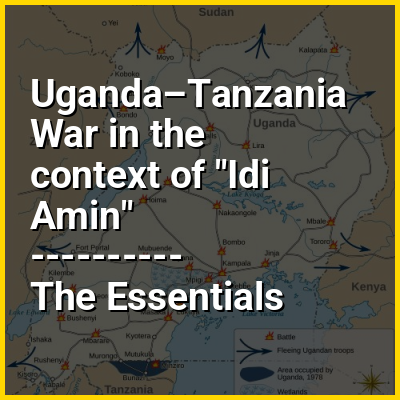
The Uganda–Tanzania War, known in Tanzania as the Kagera War (Swahili: Vita vya Kagera) and in Uganda as the 1979 Liberation War, was fought between Uganda and Tanzania from October 1978 until June 1979 and led to the overthrow of Ugandan President Idi Amin. The war was preceded by a deterioration of relations between Uganda and Tanzania following Amin's 1971 overthrow of President Milton Obote, who was close to the President of Tanzania, Julius Nyerere. Over the following years, Amin's regime was destabilised by violent purges, economic problems, and dissatisfaction in the Uganda Army.

The circumstances surrounding the outbreak of the war are not clear, and differing accounts of the events exist. In October 1978, Ugandan forces began making incursions into Tanzania. Later that month, the Uganda Army launched an invasion, looting property and killing civilians. Ugandan official media declared the annexation of the Kagera Salient. On 2 November, Nyerere declared war on Uganda and mobilised the Tanzania People's Defence Force (TPDF) to retake the salient. Nyerere also mobilised Ugandan rebels loyal to Obote and Yoweri Museveni to weaken Amin's regime. After Amin failed to renounce his claims to Kagera and the Organisation of African Unity (OAU) failed to condemn the Ugandan invasion, the TPDF occupied the towns of Masaka and Mbarara in southern Uganda.
↓ Menu

>>>PUT SHARE BUTTONS HERE<<<

👉 Uganda–Tanzania War in the context of Idi Amin

Idi Amin Dada Oumee (30 May 1928 – 16 August 2003) was a Ugandan military officer and politician who served as the third president of Uganda from 1971 until his overthrow in 1979. An admirer of Adolf Hitler, he ruled as a military dictator and is considered one of the most brutal despots in modern world history. He is often called "Hitler of Africa" and his ideology draws similarity to National Socialism.

Amin was born to a Kakwa father and Lugbara mother. In 1946, he joined the King's African Rifles (KAR) of the British Colonial Army as a cook. He rose to the rank of lieutenant, taking part in British actions against Somali rebels and then the Mau Mau Uprising in Kenya. Uganda gained independence from the United Kingdom in 1962, and Amin remained in the army, rising to the position of deputy army commander in 1964 and being appointed commander two years later. He became aware that Ugandan president Milton Obote was planning to arrest him for misappropriating army funds, so he launched the 1971 Ugandan coup d'état and declared himself president.

↓ Explore More Topics
In this Dossier

Uganda–Tanzania War in the context of Uganda Army (1962–1971)

The Uganda Army (abbreviated UA), also known as the Uganda Rifles, served as the national armed forces of Uganda during the presidencies of Mutesa II and Milton Obote (known as Obote I). As time went on, the military was gradually expanded and increasingly interfered in Uganda's national politics. It played a prominent role in defeating local insurgencies, suppressing opposition to Obote, and intervened in conflicts in the Congo as well as Sudan. Dissatisfied soldiers overthrew Obote in 1971, resulting in the establishment of the Second Republic of Uganda under the dictatorship of army commander Idi Amin. The Uganda Army was purged, with thousands of suspected pro-Obote troops killed or fleeing the country. The military was consequently split into an army serving under Amin – the Uganda Army (1971–1980) – and exiled rebel factions. The latter helped to overthrow Amin's regime during the Uganda–Tanzania War of 1978–79, and became the core of the Uganda National Liberation Army which would serve as Uganda's national military from 1980 to 1986.

↑ Return to Menu