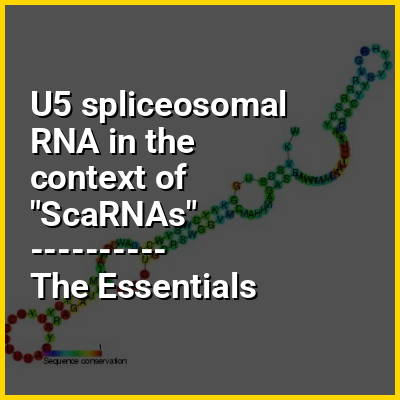
U5 spliceosomal RNA in the context of "ScaRNAs"

Play Trivia Questions online!

or

Skip to study material about U5 spliceosomal RNA in the context of "ScaRNAs"

Ad spacer

>>>PUT SHARE BUTTONS HERE<<<

👉 U5 spliceosomal RNA in the context of ScaRNAs

Small Cajal body-specific RNAs (scaRNAs) are a class of small nucleolar RNAs (snoRNAs) that specifically localise to the Cajal body, a nuclear organelle (cellular sub-organelle) involved in the biogenesis of small nuclear ribonucleoproteins (snRNPs or snurps). ScaRNAs guide the modification (methylation and pseudouridylation) of RNA polymerase II transcribed spliceosomal RNAs U1, U2, U4, U5 and U12.

The first scaRNA identified was U85. It is unlike typical snoRNAs in that it is a composite C/D box and H/ACA box snoRNAs and can guide both pseudouridylation and 2′-O-methylation. Not all scaRNAs are composite C/D and H/ACA box snoRNA and most scaRNAs are structurally and functionally indistinguishable from snoRNAs, directing ribosomal RNA (rRNA) modification in the nucleolus.

↓ Explore More Topics
In this Dossier

U5 spliceosomal RNA in the context of SnRNA

Small nuclear RNA (snRNA) is a class of small RNA molecules that are found within the splicing speckles and Cajal bodies of the cell nucleus in eukaryotic cells. The length of an average snRNA is approximately 150 nucleotides. They are transcribed by either RNA polymerase II or RNA polymerase III. Their primary function is in the processing of pre-messenger RNA (hnRNA) in the nucleus. They have also been shown to aid in the regulation of transcription factors (7SK RNA) or RNA polymerase II (B2 RNA), and in the maintenance of telomeres.

snRNA are always associated with a set of specific proteins, and the complexes are referred to as small nuclear ribonucleoproteins (snRNP, often pronounced "snurps"). Each snRNP particle is composed of an snRNA component and several snRNP-specific proteins (including Sm proteins, a family of nuclear proteins). The most common human snRNA components of these complexes are known, respectively, as: U1 spliceosomal RNA, U2 spliceosomal RNA, U4 spliceosomal RNA, U5 spliceosomal RNA, and U6 spliceosomal RNA. Their nomenclature derives from their high uridine content.

↑ Return to Menu