
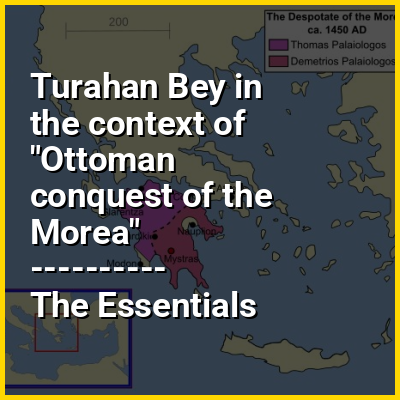
The Ottoman conquest of the Morea occurred in two phases, in 1458 and 1460, and marked the end of the Despotate of the Morea, one of the last remnants of the Byzantine Empire, which had been extinguished in the Fall of Constantinople in 1453.
The Despotate of the Morea had been founded as an autonomous appanage ruled by members of the Byzantine imperial Palaiologos dynasty. During the 14th and 15th centuries, it was the scene of the last flourishing of Byzantine culture, but in the 1420s it was repeatedly attacked by Ottoman raiders under Turahan Bey, and was reduced to a tributary vassal by Sultan Murad II in 1446. From 1449, it was ruled by the brothers Demetrios Palaiologos and Thomas Palaiologos, who were engaged in a constant rivalry with one another: they divided the Morea peninsula among themselves, and neglected the payment of tribute to the Sultan. Having lost his patience with the quarreling brothers, and determined to avoid the Morea being used as a springboard for a Western crusade against him following his capture of Constantinople, Sultan Mehmed II invaded the peninsula in May 1458. While part of his forces besieged the Acrocorinth, the rest ravaged the peninsula. After the fall of the Acrocorinth, the two Palaiologoi brothers capitulated. Acrocorinth, Thomas' capital, Patras, and much of the northern part of the peninsula came under direct Ottoman rule; the Palaiologoi were left as tributary rulers in the southern half, which included the Despotate's capital, Mystras.