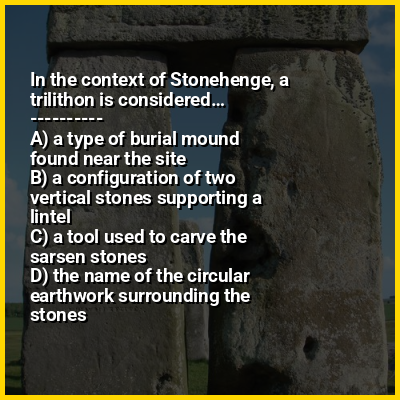
Stonehenge is a prehistoric megalithic structure on Salisbury Plain in Wiltshire, England, two miles (3 km) west of Amesbury. It consists of an outer ring of vertical sarsen standing stones, each around 13 feet (4.0 m) high, seven feet (2.1 m) wide, and weighing around 25 tons, topped by connecting horizontal lintel stones which are held in place with mortise and tenon joints—a feature unique among contemporary monuments. Inside is a ring of smaller bluestones. Inside, these are free-standing trilithons, two bulkier vertical sarsens joined by a single lintel. The whole monument, now in ruins, is aligned towards the sunrise on the summer solstice and sunset on the winter solstice. The stones are set within earthworks in the middle of the densest complex of Neolithic and Bronze Age monuments in England, including several hundred tumuli (burial mounds).
Stonehenge was constructed in several phases beginning about 3100 BC and continuing until about 1600 BC. The famous circle of large sarsen stones was placed between 2600 BC and 2400 BC. The surrounding circular earth bank and ditch, which constitute the earliest phase of the monument, have been dated to about 3100 BC. Radiocarbon dating suggests that the bluestones were given their current positions between 2400 and 2200 BC, although they may have been at the site as early as 3000 BC.