Transient ischemic attack in the context of "Brain ischemia"

Play Trivia Questions online!

or

Skip to study material about Transient ischemic attack in the context of "Brain ischemia"

Ad spacer

⭐ Core Definition: Transient ischemic attack

A transient ischemic attack (TIA), commonly known as a mini-stroke, is a temporary (transient) stroke with noticeable symptoms that end within 24 hours. A TIA causes the same symptoms associated with a stroke, such as weakness or numbness on one side of the body, sudden dimming or loss of vision, difficulty speaking or understanding language or slurred speech.

All forms of stroke, including a TIA, result from a disruption in blood flow to the central nervous system. A TIA is caused by a temporary disruption in blood flow to the brain, or cerebral blood flow (CBF). The primary difference between a major stroke and a TIA's minor stroke is how much tissue death (infarction) can be detected afterwards through medical imaging. While a TIA must by definition be associated with symptoms, strokes can also be asymptomatic or silent. In a silent stroke, also known as a silent cerebral infarct (SCI), there is permanent infarction detectable on imaging, but there are no immediately observable symptoms. The same person can have major strokes, minor strokes, and silent strokes, in any order.
↓ Menu

>>>PUT SHARE BUTTONS HERE<<<

👉 Transient ischemic attack in the context of Brain ischemia

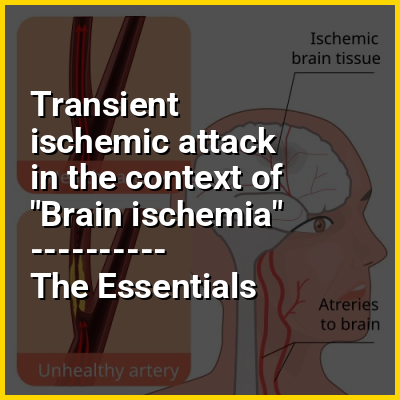
Brain ischemia is a condition in which there is insufficient bloodflow to the brain to meet metabolic demand. This leads to poor oxygen supply in the brain and may be temporary such as in transient ischemic attack or permanent in which there is death of brain tissue such as in cerebral infarction (ischemic stroke).

The symptoms of brain ischemia reflect the anatomical region undergoing blood and oxygen deprivation, and may involve impairments in vision, body movement, and speaking.

↓ Explore More Topics
In this Dossier

Transient ischemic attack in the context of Stroke

Stroke is a medical condition in which poor blood flow to a part of the brain causes cell death. There are two main types of stroke: ischemic, due to lack of blood flow, and hemorrhagic, due to bleeding. Both cause parts of the brain to stop functioning properly.

Signs and symptoms of stroke may include an facial drooping, inability to walk, move or feel on one side of the body, problems understanding or speaking, dizziness, or loss of vision to one side. Signs and symptoms often appear soon after the stroke has occurred. If symptoms last less than 24 hours, the stroke is a transient ischemic attack (TIA), also called a mini-stroke. Hemorrhagic stroke may also be associated with a severe headache. The symptoms of stroke can be permanent. Long-term complications may include pneumonia and loss of bladder control.

↑ Return to Menu

Transient ischemic attack in the context of Cerebrovascular disease

Cerebrovascular disease includes a variety of medical conditions that affect the blood vessels of the brain and the cerebral circulation. Arteries supplying oxygen and nutrients to the brain are often damaged or deformed in these disorders. The most common presentation of cerebrovascular disease is an ischemic stroke or mini-stroke and sometimes a hemorrhagic stroke. Hypertension (high blood pressure) is the most important contributing risk factor for stroke and cerebrovascular diseases as it can change the structure of blood vessels and result in atherosclerosis. Atherosclerosis narrows blood vessels in the brain, resulting in decreased cerebral perfusion. Other risk factors that contribute to stroke include smoking and diabetes. Narrowed cerebral arteries can lead to ischemic stroke, but continually elevated blood pressure can also cause tearing of vessels, leading to a hemorrhagic stroke.

A stroke usually presents with an abrupt onset of a neurologic deficit – such as hemiplegia (one-sided weakness), numbness, aphasia (language impairment), or ataxia (loss of coordination) – attributable to a focal vascular lesion. The neurologic symptoms manifest within seconds because neurons need a continual supply of nutrients, including glucose and oxygen, that are provided by the blood. Therefore, if blood supply to the brain is impeded, injury and energy failure is rapid.

↑ Return to Menu

Transient ischemic attack in the context of Ménière's disease

Ménière's disease (MD) is a disease of the inner ear characterized by potentially severe and incapacitating episodes of vertigo, tinnitus, hearing loss, and a feeling of fullness in the ear. Typically, only one ear is affected initially, but over time, both ears may become involved. Episodes generally last from 20 minutes to a few hours, with varying time between episodes. The hearing loss and ringing in the ears can become constant over time. Ménière's disease was identified in the early 1800s by Prosper Menière.

The cause of Ménière's disease is unclear, but likely involves both genetic and environmental factors. A number of theories exist for why it occurs, including constrictions in blood vessels, viral infections, and autoimmune reactions. About 10% of cases run in families. Symptoms are believed to occur as the result of increased fluid buildup in the labyrinth of the inner ear. Diagnosis is based on the symptoms and a hearing test. Other conditions that may produce similar symptoms include vestibular migraine and transient ischemic attack.

↑ Return to Menu