Touring car racing in the context of "Motorsports"

Play Trivia Questions online!

or

Skip to study material about Touring car racing in the context of "Motorsports"

Ad spacer

⭐ Core Definition: Touring car racing

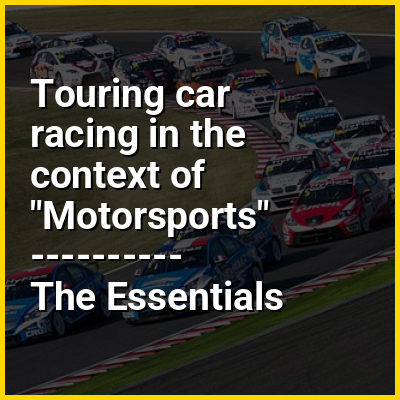
Touring car racing is a form of motorsport racing featuring production-based cars that are modified for competition. The discipline emphasizes close racing, balanced performance, and manufacturer diversity, with cars that still resemble their road-going counterparts. Originating in Europe in the mid-20th century, touring car racing has since expanded globally through rule sets such as Group A, Super Touring, and the FIA TCR formula. Major championships include the British Touring Car Championship (BTCC), German Touring Car Masters (DTM), and Supercars Championship. It has both similarities to and significant differences from stock car racing, which is popular in the United States.

Modern touring car championships increasingly rely on Balance of Performance (BoP) and cost-control regulations to ensure close competition among manufacturers and private teams. The adoption of hybrid technology and the introduction of electric touring car series, such as the ETCR (now FIA E-Touring Car World Cup), mark the category’s adaptation to sustainability trends in motorsport. While the cars do not move as fast as those in formula or sports car races, their similarity both to one another and to fans' own vehicles makes for well-supported racing. The lesser use of aerodynamics means following cars have a much easier time passing than in open-wheel racing, and the more substantial bodies of the cars makes the subtle bumping and nudging for overtaking much more acceptable as part of racing.
↓ Menu

>>>PUT SHARE BUTTONS HERE<<<

👉 Touring car racing in the context of Motorsports

Motorsport or motor sport or motor sports are sporting events, competitions and related activities that primarily involve the use of automobiles, motorcycles, motorboats and powered aircraft. For each of these vehicle types, the more specific terms automobile sport, motorcycle sport, power boating and air sports may be used commonly, or officially by organisers and governing bodies.

Different manifestations of motorsport with their own objectives and specific rules are called disciplines. Examples include circuit racing, rallying and trials. Governing bodies, also called sanctioning bodies, often have general rules for each discipline, but allow supplementary rules to define the character of a particular competition, series or championship. Groups of these are often categorised informally, such as by vehicle type, surface type or propulsion method. Examples of categories within a discipline are formula racing, stock car racing, touring car racing, sports car racing, etc.

↓ Explore More Topics
In this Dossier

Touring car racing in the context of Sports car racing

Sports car racing is a form of motorsport road racing that uses sports cars with two seats and enclosed wheels. The cars in question may be either purpose-built sports prototypes, which are the highest level in sports car racing; or grand tourers (GT cars) which, being based on road-going models, are considerably more common, but not as fast. Sports car races are often endurance races run over particularly long distances or large amounts of time (generally between 6 and 24 hours), resulting in an emphasis on reliability and efficiency of the car and its drivers over outright car performance or driver skills. The FIA World Endurance Championship and IMSA SportsCar Championship are some of the best-known sports car racing series, and so is the GT World Challenge. Sports car racing is one of the main types of circuit auto racing, alongside open-wheel racing (such as Formula One and Indycar), touring car racing (such as BTCC and V8 Supercars, which is based on 'saloon cars' as opposed to the 'exotics' seen in sports cars) and stock car racing (such as NASCAR).

A hybrid of the purism of open-wheelers and the familiarity of touring car racing, sports car racing is commonly associated with the annual 24 Hours of Le Mans endurance race. First run in 1923, Le Mans is one of the longest-running motor races. Well-known defunct sports car races include the Italian classics, the Targa Florio (1906–1977) and Mille Miglia (1927–1957), and the Mexican Carrera Panamericana (1950–1954). Most top-class sports car races focus more on endurance and strategy than pure speed or skills, and longer races usually involve complex pit strategies and regular driver changes. As a result, sports car racing is seen more as a team endeavour than an individual sport, with team managers such as John Wyer, Tom Walkinshaw, driver-turned-constructor Henri Pescarolo, Peter Sauber and Reinhold Joest becoming almost as famous as some of their drivers.

↑ Return to Menu

Touring car racing in the context of BMW

Bayerische Motoren Werke Aktiengesellschaft (BMW AG), trading as BMW Group (commonly abbreviated to BMW (German pronunciation: [ˌbeːʔɛmˈveː] ), sometimes anglicised as Bavarian Motor Works), is a German multinational conglomerate manufacturer of luxury vehicles and motorcycles headquartered in Munich, Germany. The moniker, "BMW ", first came into use when the German firm Rapp Motorenwerke changed its name to Bayerische Motoren Werke GmbH (BMW GmbH) in 1917. Thereafter, in 1922, the name and assets of BMW GmbH were transferred to the aircraft manufacturer Bayerische Flugzeugwerke AG (formerly Otto Flugmaschinenfabrik), thereby giving rise to the company known today as BMW AG.

BMW AG's automobiles are marketed under the BMW, Mini, and Rolls-Royce brands while its motorcycles are marketed under the BMW Motorrad brand. In 2023, BMW became the world's ninth-largest producer of motor vehicles (with 2,555,341 vehicles made in that year alone) as well as the 6th largest automaker by revenue. In 2023, it was ranked 46th in the Forbes Global 2000. The company also has significant motor-sport history, especially in touring cars, sports cars, and the Isle of Man TT.

↑ Return to Menu

Touring car racing in the context of TCR International Series

The TCR International Series was an international touring car championship. The championship was promoted by World Sporting Consulting (WSC), founded by former World Touring Car Championship manager Marcello Lotti. It was marketed as a cost-effective spin-off of the WTCC, targeted at C-segment hatchbacks production-based touring cars. The title TCR follows the naming convention now used by the FIA to classify the cars that compete in touring car racing, with TC1 referring to the top tier as used by the FIA WTCC and TC2 referring to the legacy cars which principally compete in the FIA ETCC.

On 6th December 2017, FIA's World Motorsport Council announced that the series will merge with World Touring Car Championship and European Touring Car Cup starting in 2018.

↑ Return to Menu

Touring car racing in the context of Open-wheel

An open-wheel car is a car with the wheels outside the car's main body, and usually having only one seat. Open-wheel cars contrast with street cars, sports cars, stock cars, and touring cars, which have their wheels below the body or inside fenders. Open-wheel cars are built both for road racing and oval track racing. Open-wheel cars licensed for use on public roads (street legal), such as the Ariel Atom, are uncommon, as they are often impractical for everyday use.

↑ Return to Menu