Torres Strait Islands in the context of "Austronesian vessels"

Play Trivia Questions online!

or

Skip to study material about Torres Strait Islands in the context of "Austronesian vessels"

Ad spacer

⭐ Core Definition: Torres Strait Islands

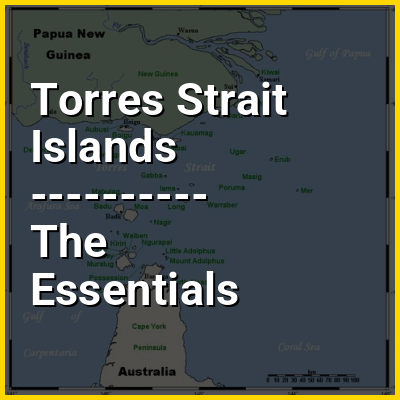
The Torres Strait Islands are an archipelago of at least 274 small islands in the Torres Strait, a waterway separating far northern continental Australia's Cape York Peninsula and the island of New Guinea. They span an area of 48,000 km (19,000 sq mi), but their total land area is 566 km (219 sq mi).

The Islands are inhabited by the indigenous Torres Strait Islanders. Lieutenant James Cook first claimed British sovereignty over the eastern part of Australia at Possession Island in 1770, but British administrative control only began in the Torres Strait Islands in 1862. The islands are now mostly part of Queensland, a constituent State of the Commonwealth of Australia, but are administered by the Torres Strait Regional Authority, a statutory authority of the Australian federal government. A few islands very close to the coast of mainland New Guinea belong to the Western Province of Papua New Guinea, most importantly Daru Island and its provincial capital, Daru.
↓ Menu

>>>PUT SHARE BUTTONS HERE<<<

👉 Torres Strait Islands in the context of Austronesian vessels

Austronesian vessels are the traditional seafaring vessels of the Austronesian peoples of Taiwan, Maritime Southeast Asia, Micronesia, coastal New Guinea, Island Melanesia, Polynesia, and Madagascar. They also include indigenous ethnic minorities in Vietnam, Cambodia, Myanmar, Thailand, Hainan, the Comoros, and the Torres Strait Islands.

They range from small dugout canoes to large lashed-lug plank-built vessels. Their hull configurations include monohulls as well as catamarans and outrigger boats (single-outrigger boats and trimarans). Traditional sail types include a variety of distinctively Austronesian crab-claw and tanja configurations, though modern vessels are typically motorized. These vessels allowed the migrations of the Austronesian peoples during the Austronesian expansion (starting at around 3000 to 1500 BC from Taiwan and Island Southeast Asia) throughout the islands of the Indo-Pacific, reaching as far as Madagascar, New Zealand, and Easter Island. They were also used to establish trading routes, including the Austronesian maritime trade network which formed the maritime leg of the spice trade and later, the maritime silk road.

↓ Explore More Topics
In this Dossier

Torres Strait Islands in the context of Austronesian peoples

The Austronesian people, sometimes referred to as Austronesian-speaking peoples, are a large group of peoples who have settled in Taiwan, maritime Southeast Asia, parts of mainland Southeast Asia, Micronesia, coastal New Guinea, Island Melanesia, Polynesia, and Madagascar that speak Austronesian languages. They also include indigenous ethnic minorities in Vietnam, Cambodia, Myanmar, Thailand, Hainan, the Comoros, and the Torres Strait Islands. The nations and territories predominantly populated by Austronesian-speaking peoples are sometimes known collectively as Austronesia.

The group originated from a prehistoric seaborne migration, known as the Austronesian expansion, from Taiwan, circa 3000 to 1500 BCE. Austronesians reached the Batanes Islands in the northernmost Philippines by around 2200 BCE. They used sails some time before 2000 BCE. In conjunction with their use of other maritime technologies (notably catamarans, outrigger boats, lashed-lug boats, and the crab claw sail), this enabled phases of rapid dispersal into the islands of the Indo-Pacific, culminating in the settlement of New Zealand c. 1250 CE. During the initial part of the migrations, they encountered and assimilated (or were assimilated by) the Paleolithic populations that had migrated earlier into Maritime Southeast Asia and New Guinea. They reached as far as Easter Island to the east, Madagascar to the west, and New Zealand to the south. At the furthest extent, they might have also reached the Americas.

↑ Return to Menu

Torres Strait Islands in the context of Torres Strait

The Torres Strait (/ˈtɒrɪs/), also known as Zenadh Kes (pronounced [ˈzen̪ad̪ kes]), is a strait between Australia and the Melanesian island of New Guinea. It is 150 km (93 mi) wide at its narrowest extent. To the south is Cape York Peninsula, the northernmost extremity of the Australian mainland. To the north is the Western Province of Papua New Guinea. It is named after the Spanish navigator Luís Vaz de Torres, who sailed through the strait in 1606.

↑ Return to Menu

Torres Strait Islands in the context of Pearl fisheries

Pearl hunting, also known as pearl fishing or pearling, is the activity of recovering or attempting to recover pearls from wild molluscs, usually oysters or mussels, in the sea or freshwater. Pearl hunting was prevalent in India and Japan for thousands of years. On the northern and north-western coast of Western Australia pearl diving began in the 1850s, and started in the Torres Strait Islands in the 1860s, where the term also covers diving for nacre or mother of pearl found in what were known as pearl shells.

In most cases the pearl-bearing molluscs live at depths where they are not manually accessible from the surface, and diving or the use of some form of tool is needed to reach them. Historically the molluscs were retrieved by freediving, a technique where the diver descends to the bottom, collects what they can, and surfaces on a single breath. The diving mask improved the ability of the diver to see while underwater. When the surface-supplied diving helmet became available for underwater work, it was also applied to the task of pearl hunting, and the associated activity of collecting pearl shell as a raw material for the manufacture of buttons, inlays and other decorative work. The surface supplied diving helmet greatly extended the time the diver could stay at depth, and introduced the previously unfamiliar hazards of barotrauma of ascent and decompression sickness.

↑ Return to Menu

Torres Strait Islands in the context of Aboriginal Australians

Aboriginal Australians are the various indigenous peoples of the Australian mainland and many of its islands, excluding the ethnically distinct people of the Torres Strait Islands.

Humans first migrated to Australia 50,000 to 65,000 years ago, and over time formed as many as 500 linguistic and territorial groups. In the past, Aboriginal people lived over large sections of the continental shelf. They were isolated on many of the smaller offshore islands and Tasmania when the land was inundated at the start of the Holocene inter-glacial period, about 11,700 years ago. Despite this, Aboriginal people maintained extensive networks within the continent and certain groups maintained relationships with Torres Strait Islanders and the Makassar people of modern-day Indonesia.

↑ Return to Menu

Torres Strait Islands in the context of Torres Strait Islanders

Torresians (/ˈtɒrɪs/ TORR-iss) are the Indigenous Melanesian people of the Torres Strait Islands, which are part of the state of Queensland, Australia. Ethnically distinct from the Aboriginal peoples of the rest of Australia, they are often grouped with them as Indigenous Australians. Today, many more Torresian people live in mainland Australia than on the Islands.

Five distinct peoples exist within the broader designation of Torresian people, based partly on geographical and cultural divisions. Kalaw Lagaw Ya and Meriam Mir comprise the two main Indigenous language groups; Torresian Creole is also widely spoken as a language of trade and commerce. The core of Island culture is Papuan, and the people are traditionally a seafaring nation. The Torres Islanders exhibit a strong artistic culture, particularly in sculpture, printmaking, and mask-making.

↑ Return to Menu

Torres Strait Islands in the context of Indigenous Australians

Indigenous Australians are the various Aboriginal Australian peoples of Australia, and the ethnically distinct people of the Torres Strait Islands. The terms Aboriginal and Torres Strait Islander peoples, First Nations of Australia, First Peoples of Australia and First Australians are also common. Many Indigenous Australians prefer to identify with their specific cultural group.

Estimates from the 2021 census show there were 983,700 Indigenous Australians, representing 3.8% of the Australian populations. Of these Indigenous Australians, 92% identified as Aboriginal, 4% identified as Torres Strait Islander, and 4% identified with both groups. About 84% spoke English at home and 9% spoke an Australian Indigenous language at home. Just over half hold secular or other spiritual beliefs or no religious affiliation; about 40% are Christian; and about 1% adhere to a traditional Aboriginal religion.

↑ Return to Menu