Many topological vector spaces are spaces of functions, or linear operators acting on topological vector spaces, and the topology is often defined so as to capture a particular notion of convergence of sequences of functions.

HINT:
👉 Topological vector space in the context of Seminorm
In mathematics, particularly in functional analysis, a seminorm is like a norm but need not be positive definite. Seminorms are intimately connected with convex sets: every seminorm is the Minkowski functional of some absorbing disk and, conversely, the Minkowski functional of any such set is a seminorm.
A topological vector space is locally convex if and only if its topology is induced by a family of seminorms.
In this Dossier
- ⭐ Core Definition: Topological vector space
- 👉 Topological vector space in the context of Seminorm
- Topological vector space in the context of Complex coordinate space
- Topological vector space in the context of Sequence space
- Topological vector space in the context of Lp space
- Topological vector space in the context of Infinite-dimensional-vector-valued function
Topological vector space in the context of Complex coordinate space
In mathematics, the n-dimensional complex coordinate space (or complex n-space) is the set of all ordered n-tuples of complex numbers, also known as complex vectors. The space is denoted , and is the n-fold Cartesian product of the complex line with itself. Symbolically,orThe variables are the (complex) coordinates on the complex n-space. The special case , called the complex coordinate plane, is not to be confused with the complex plane, a graphical representation of the complex line.



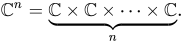


Complex coordinate space is a vector space over the complex numbers, with componentwise addition and scalar multiplication. The real and imaginary parts of the coordinates set up a bijection of with the 2n-dimensional real coordinate space, . With the standard Euclidean topology, is a topological vector space over the complex numbers.
View the full Wikipedia page for Complex coordinate space
Topological vector space in the context of Sequence space
In functional analysis and related areas of mathematics, a sequence space is a vector space whose elements are infinite sequences of real or complex numbers. Equivalently, it is a function space whose elements are functions from the natural numbers to the field of real or complex numbers. The set of all such functions is naturally identified with the set of all possible infinite sequences with elements in , and can be turned into a vector space under the operations of pointwise addition of functions and pointwise scalar multiplication. All sequence spaces are linear subspaces of this space. Sequence spaces are typically equipped with a norm, or at least the structure of a topological vector space.

The most important sequence spaces in analysis are the spaces, consisting of the -power summable sequences, with the -norm. These are special cases of spaces for the counting measure on the set of natural numbers. Other important classes of sequences like convergent sequences or null sequences form sequence spaces, respectively denoted and , with the sup norm. Any sequence space can also be equipped with the topology of pointwise convergence, under which it becomes a special kind of Fréchet space called FK-space.
View the full Wikipedia page for Sequence space


Topological vector space in the context of Lp space
In mathematics, the L spaces are function spaces defined using a natural generalization of the p-norm for finite-dimensional vector spaces. They are sometimes called Lebesgue spaces, named after Henri Lebesgue (Dunford & Schwartz 1958, III.3), although according to the Bourbaki group (Bourbaki 1987) they were first introduced by Frigyes Riesz (Riesz 1910).
L spaces form an important class of Banach spaces in functional analysis, and of topological vector spaces. Because of their key role in the mathematical analysis of measure and probability spaces, Lebesgue spaces are used also in the theoretical discussion of problems in physics, statistics, economics, finance, engineering, and other disciplines.
View the full Wikipedia page for Lp spaceTopological vector space in the context of Infinite-dimensional-vector-valued function
An infinite-dimensional vector function is a function whose values lie in an infinite-dimensional topological vector space, such as a Hilbert space or a Banach space.
Such functions are applied in most sciences including physics.
View the full Wikipedia page for Infinite-dimensional-vector-valued function