Toṇḍaimaṇḍalam, also known as Toṇḍai Nāḍu, is a historical region located in the northernmost part of Tamil Nadu and southernmost part of Andhra Pradesh. Toṇḍaimaṇḍalam was divided into 24 kottams — smaller districts by kurumbar king and also build a royal fort (pulhal). The kottams are subdivided into smaller agricultural districts called nadus, which were groupings of several agricultural villages. At the beginning of the historical period, the kottams were mostly pastoral. The region comprises the districts which formed a part of the legendary kingdom of Athondai Chakravarti. The boundaries of Tondaimandalam are ambiguous – between the river basins of Penna River and Ponnaiyar River. During the reign of Rajaraja I, this region was called as Jayankonda Cholamandalam.
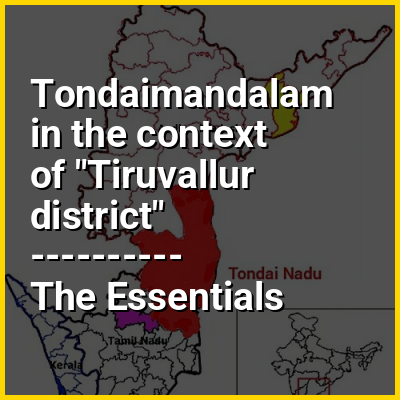
Tondaimandalam in the context of Pallava dynasty
The Pallava dynasty existed from 275 to 897, ruling a significant portion of the Deccan, also known as Tondaimandalam. The Pallavas played a crucial role in shaping in particular southern Indian history and heritage. The dynasty rose to prominence after the downfall of the Satavahana Empire, whom they had formerly served as feudatories.
The Pallavas became a major southern Indian power during the reign of Mahendravarman I (600–630) and Narasimhavarman I (630–668), and dominated the southern Telugu region and the northern parts of the Tamil region for about 600 years, until the end of the 9th century. Throughout their reign, they remained in constant conflict with both the Chalukyas of Vatapi to the north, and the Tamil kingdoms of Chola and Pandyas to their south. The Pallavas were finally defeated by the Chola ruler Aditya I in the 9th century.
View the full Wikipedia page for Pallava dynasty