Tipping points in the climate system in the context of North Atlantic Deep Water


Tipping points in the climate system in the context of North Atlantic Deep Water

⭐ Core Definition: Tipping points in the climate system

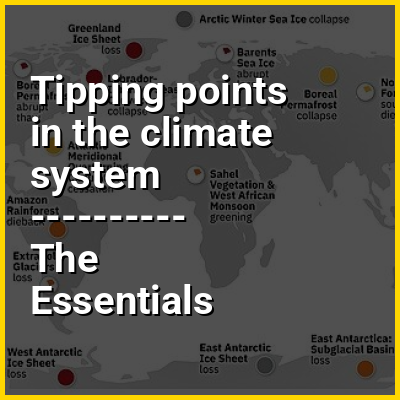
In climate science, a tipping point is a critical threshold that, when crossed, leads to large, accelerating and often irreversible changes in the climate system. If tipping points are crossed, they are likely to have severe impacts on human society and may accelerate global warming. Tipping behavior is found across the climate system, for example in ice sheets, mountain glaciers, circulation patterns in the ocean, in ecosystems, and the atmosphere. Examples of tipping points include thawing permafrost, which will release methane, a powerful greenhouse gas, or melting ice sheets and glaciers reducing Earth's albedo, which would warm the planet faster. Thawing permafrost is a threat multiplier because it holds roughly twice as much carbon as the amount currently circulating in the atmosphere.

Tipping points are often, but not necessarily, abrupt. For example, with average global warming somewhere between 0.8 °C (1.4 °F) and 3 °C (5.4 °F), the Greenland ice sheet passes a tipping point and is doomed, but its melt would take place over millennia. Tipping points are possible at today's global warming of just over 1 °C (1.8 °F) above preindustrial times, and highly probable above 2 °C (3.6 °F) of global warming. It is possible that some tipping points are close to being crossed or have already been crossed, like those of the West Antarctic and Greenland ice sheets, the Amazon rainforest and warm-water coral reefs. A 2022 study published in Science found that exceeding 1.5 °C of global warming could trigger multiple tipping points, including the collapse of major ice sheets, abrupt thawing of permafrost, and coral reef die-off, with potential for cascading system effects.
↓ Menu
HINT:

👉 Tipping points in the climate system in the context of North Atlantic Deep Water

North Atlantic Deep Water (NADW) is a deep water mass formed in the North Atlantic Ocean. Thermohaline circulation (properly described as meridional overturning circulation) of the world's oceans involves the flow of warm surface waters from the southern hemisphere into the North Atlantic. Water flowing northward becomes modified through evaporation and mixing with other water masses, leading to increased salinity. When this water reaches the North Atlantic, it cools and sinks through convection, due to its decreased temperature and increased salinity resulting in increased density. NADW is the outflow of this thick deep layer, which can be detected by its high salinity, high oxygen content, nutrient minima, high C/C, and chlorofluorocarbons (CFCs).

CFCs are anthropogenic substances that enter the surface of the ocean from gas exchange with the atmosphere. This distinct composition allows its path to be traced as it mixes with Circumpolar Deep Water (CDW), which in turn fills the deep Indian Ocean and part of the South Pacific. NADW and its formation is essential to the Atlantic meridional overturning circulation (AMOC), which is responsible for transporting large amounts of water, heat, salt, carbon, nutrients and other substances from the Tropical Atlantic to the Mid and High Latitude Atlantic.

↓ Explore More Topics
In this Dossier

Tipping points in the climate system in the context of Effects of climate change

Effects of climate change are well documented and growing for Earth's natural environment and human societies. Changes to the climate system include an overall warming trend, changes to precipitation patterns, and more extreme weather. As the climate changes it impacts the natural environment with effects such as more intense forest fires, thawing permafrost, and desertification. These changes impact ecosystems and societies, and can become irreversible once tipping points are crossed. Climate activists are engaged in a range of activities around the world that seek to ameliorate these issues or prevent them from happening.

The effects of climate change vary in timing and location. Up until now the Arctic has warmed faster than most other regions due to climate change feedbacks. Surface air temperatures over land have also increased at about twice the rate they do over the ocean, causing intense heat waves. These temperatures would stabilize if greenhouse gas emissions were brought under control. Ice sheets and oceans absorb the vast majority of excess heat in the atmosphere, delaying effects there but causing them to accelerate and then continue after surface temperatures stabilize. Sea level rise is a particular long term concern as a result. The effects of ocean warming also include marine heatwaves, ocean stratification, deoxygenation, and changes to ocean currents. The ocean is also acidifying as it absorbs carbon dioxide from the atmosphere.

View the full Wikipedia page for Effects of climate change
↑ Return to Menu

Tipping points in the climate system in the context of Abrupt climate change

An abrupt climate change occurs when the climate system is forced to transition at a rate that is determined by the climate system energy-balance. The transition rate is more rapid than the rate of change of the external forcing, though it may include sudden forcing events such as meteorite impacts. Abrupt climate change therefore is a variation beyond the variability of a climate. Past events include the end of the Carboniferous Rainforest Collapse, Younger Dryas, Dansgaard–Oeschger events, Heinrich events and possibly also the Paleocene–Eocene Thermal Maximum. The term is also used within the context of climate change to describe sudden climate change that is detectable over the time-scale of a human lifetime. Such a sudden climate change can be the result of feedback loops within the climate system or tipping points in the climate system.

Scientists may use different timescales when speaking of abrupt events. For example, the duration of the onset of the Paleocene–Eocene Thermal Maximum may have been anywhere between a few decades and several thousand years. In comparison, climate models predict that under ongoing greenhouse gas emissions, the Earth's near surface temperature could depart from the usual range of variability in the last 150 years as early as 2047.

View the full Wikipedia page for Abrupt climate change
↑ Return to Menu