Climate system in the context of "Abrupt climate change"

Play Trivia Questions online!

or

Skip to study material about Climate system in the context of "Abrupt climate change"

Ad spacer

⭐ Core Definition: Climate system

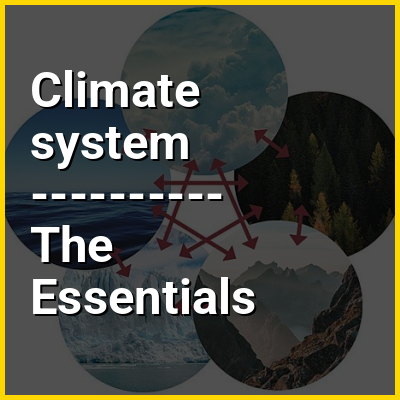
Earth's climate system is a complex system with five interacting components: the atmosphere (air), the hydrosphere (water), the cryosphere (ice and permafrost), the lithosphere (earth's upper rocky layer) and the biosphere (living things). Climate is the statistical characterization of the climate system. It represents the average weather, typically over a period of 30 years, and is determined by a combination of processes, such as ocean currents and wind patterns. Circulation in the atmosphere and oceans transports heat from the tropical regions to regions that receive less energy from the Sun. Solar radiation is the main driving force for this circulation. The water cycle also moves energy throughout the climate system. In addition, certain chemical elements are constantly moving between the components of the climate system. Two examples for these biochemical cycles are the carbon and nitrogen cycles.

The climate system can change due to internal variability and external forcings. These external forcings can be natural, such as variations in solar intensity and volcanic eruptions, or caused by humans. Accumulation of greenhouse gases in the atmosphere, mainly being emitted by people burning fossil fuels, is causing climate change. Human activity also releases cooling aerosols, but their net effect is far less than that of greenhouse gases. Changes can be amplified by feedback processes in the different climate system components.
↓ Menu

>>>PUT SHARE BUTTONS HERE<<<
In this Dossier

Climate system in the context of Earth

Earth is the third planet from the Sun and the only astronomical object known to harbor life. This is enabled by Earth being an ocean world, the only one in the Solar System sustaining liquid surface water. Almost all of Earth's water is contained in its global ocean, covering 70.8% of Earth's crust. The remaining 29.2% of Earth's crust is land, most of which is located in the form of continental landmasses within Earth's land hemisphere. Most of Earth's land is at least somewhat humid and covered by vegetation, while large ice sheets at Earth's polar deserts retain more water than Earth's groundwater, lakes, rivers, and atmospheric water combined. Earth's crust consists of slowly moving tectonic plates, which interact to produce mountain ranges, volcanoes, and earthquakes. Earth has a liquid outer core that generates a magnetosphere capable of deflecting most of the destructive solar winds and cosmic radiation.

Earth has a dynamic atmosphere, which sustains Earth's surface conditions and protects it from most meteoroids and UV-light at entry. It is composed primarily of nitrogen and oxygen. Water vapor is widely present in the atmosphere, forming clouds that cover most of the planet. The water vapor acts as a greenhouse gas and, together with other greenhouse gases in the atmosphere, particularly carbon dioxide (CO2), creates the conditions for both liquid surface water and water vapor to persist via the capturing of energy from the Sun's light. This process maintains the current average surface temperature of 14.76 °C (58.57 °F), at which water is liquid under normal atmospheric pressure. Differences in the amount of captured energy between geographic regions (as with the equatorial region receiving more sunlight than the polar regions) drive atmospheric and ocean currents, producing a global climate system with different climate regions, and a range of weather phenomena such as precipitation, allowing components such as carbon and nitrogen to cycle.

↑ Return to Menu

Climate system in the context of Climate change

Present-day climate change includes both global warming—the ongoing increase in global average temperature—and its wider effects on Earth's climate system. Climate change in a broader sense also includes previous long-term changes to Earth's climate. The modern-day rise in global temperatures is driven by human activities, especially fossil fuel (coal, oil and natural gas) burning since the Industrial Revolution. Fossil fuel use, deforestation, and some agricultural and industrial practices release greenhouse gases. These gases absorb some of the heat that the Earth radiates after it warms from sunlight, warming the lower atmosphere. Carbon dioxide, the primary gas driving global warming, has increased in concentration by about 50% since the pre-industrial era to levels not seen for millions of years.

Climate change has an increasingly large impact on the environment. Deserts are expanding, while heat waves and wildfires are becoming more common. Amplified warming in the Arctic has contributed to thawing permafrost, retreat of glaciers and sea ice decline. Higher temperatures are also causing more intense storms, droughts, and other weather extremes. Rapid environmental change in mountains, coral reefs, and the Arctic is forcing many species to relocate or become extinct. Even if efforts to minimize future warming are successful, some effects will continue for centuries. These include ocean heating, ocean acidification and sea level rise.

↑ Return to Menu

Climate system in the context of Climate

Climate is the long-term weather pattern in a region, typically averaged over 30 years. More rigorously, it is the mean and variability of meteorological variables over a time spanning from months to millions of years. Some of the meteorological variables that are commonly measured are temperature, humidity, atmospheric pressure, wind, and precipitation. In a broader sense, climate is the state of the components of the climate system, including the atmosphere, hydrosphere, cryosphere, lithosphere and biosphere and the interactions between them. The climate of a location is affected by its latitude, longitude, terrain, altitude, land use and nearby water bodies and their currents.

Climates can be classified according to the average and typical variables, most commonly temperature and precipitation. The most widely used classification scheme is the Köppen climate classification. The Thornthwaite system, in use since 1948, incorporates evapotranspiration along with temperature and precipitation information and is used in studying biological diversity and how climate change affects it. The major classifications in Thornthwaite's climate classification are microthermal, mesothermal, and megathermal. Finally, the Bergeron and Spatial Synoptic Classification systems focus on the origin of air masses that define the climate of a region.

↑ Return to Menu

Climate system in the context of Climate variability and change

Climate variability includes all the variations in the climate that last longer than individual weather events, whereas the term climate change only refers to those variations that persist for a longer period of time, typically decades or more. Climate change may refer to any time in Earth's history, but the term is now commonly used to describe contemporary climate change, often popularly referred to as global warming. Since the Industrial Revolution, the climate has increasingly been affected by human activities.

The climate system receives nearly all of its energy from the sun and radiates energy to outer space. The balance of incoming and outgoing energy and the passage of the energy through the climate system is Earth's energy budget. When the incoming energy is greater than the outgoing energy, Earth's energy budget is positive and the climate system is warming. If more energy goes out, the energy budget is negative and Earth experiences cooling.

↑ Return to Menu

Climate system in the context of Land


Land, also known as dry land, ground, or earth, is the solid terrestrial surface of Earth not submerged by the ocean or another body of water. It makes up 29.2% of Earth's surface and includes all continents and islands. Earth's land surface is almost entirely covered by regolith, a layer of rock, soil, and minerals that forms the outer part of the crust. Land plays an important role in Earth's climate system, being involved in the carbon cycle, nitrogen cycle, and water cycle. One-third of land is covered in trees, another third is used for agriculture, and one-tenth is covered in permanent snow and glaciers. The remainder consists of desert, savannah, and prairie.

Land terrain varies greatly, consisting of mountains, deserts, plains, plateaus, glaciers, and other landforms. In physical geology, the land is divided into two major categories: Mountain ranges and relatively flat interiors called cratons. Both form over millions of years through plate tectonics. Streams – a major part of Earth's water cycle – shape the landscape, carve rocks, transport sediments, and replenish groundwater. At high elevations or latitudes, snow is compacted and recrystallized over hundreds or thousands of years to form glaciers, which can be so heavy that they warp the Earth's crust. About 30 percent of land has a dry climate, due to losing more water through evaporation than it gains from precipitation. Since warm air rises, this generates winds, though Earth's rotation and uneven sun distribution also play a part.

↑ Return to Menu

Climate system in the context of Effects of climate change

Effects of climate change are well documented and growing for Earth's natural environment and human societies. Changes to the climate system include an overall warming trend, changes to precipitation patterns, and more extreme weather. As the climate changes it impacts the natural environment with effects such as more intense forest fires, thawing permafrost, and desertification. These changes impact ecosystems and societies, and can become irreversible once tipping points are crossed. Climate activists are engaged in a range of activities around the world that seek to ameliorate these issues or prevent them from happening.

The effects of climate change vary in timing and location. Up until now the Arctic has warmed faster than most other regions due to climate change feedbacks. Surface air temperatures over land have also increased at about twice the rate they do over the ocean, causing intense heat waves. These temperatures would stabilize if greenhouse gas emissions were brought under control. Ice sheets and oceans absorb the vast majority of excess heat in the atmosphere, delaying effects there but causing them to accelerate and then continue after surface temperatures stabilize. Sea level rise is a particular long term concern as a result. The effects of ocean warming also include marine heatwaves, ocean stratification, deoxygenation, and changes to ocean currents. The ocean is also acidifying as it absorbs carbon dioxide from the atmosphere.

↑ Return to Menu

Climate system in the context of Earth's energy budget

Earth's energy budget (or Earth's energy balance) is the balance between the energy that Earth receives from the Sun and the energy the Earth loses back into outer space. Smaller energy sources, such as Earth's internal heat, are taken into consideration, but make a tiny contribution compared to solar energy. The energy budget also takes into account how energy moves through the climate system. The Sun heats the equatorial tropics more than the polar regions. Therefore, the amount of solar irradiance received by a certain region is unevenly distributed. As the energy seeks equilibrium across the planet, it drives interactions in Earth's climate system, i.e., Earth's water, ice, atmosphere, rocky crust, and all living things. The result is Earth's climate.

Earth's energy budget depends on many factors, such as atmospheric aerosols, greenhouse gases, surface albedo, clouds, and land use patterns. When the incoming and outgoing energy fluxes are in balance, Earth is in radiative equilibrium and the climate system will be relatively stable. Global warming occurs when earth receives more energy than it gives back to space, and global cooling takes place when the outgoing energy is greater.

↑ Return to Menu