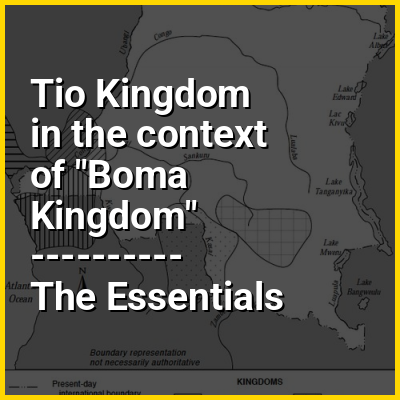
Tio Kingdom in the context of "Boma Kingdom"

Play Trivia Questions online!

or

Skip to study material about Tio Kingdom in the context of "Boma Kingdom"

Ad spacer

⭐ Core Definition: Tio Kingdom

The Tio Kingdom was a West Central African state in modern-day Republic of Congo and DR Congo, belonging to the Tio people (Eastern Teke). With its capital on the Mbe plains (where modern-day Mbe is) and its commercial capital at Pool Malebo, the kingdom extended over 200 mi (320 km) north to south, and over 150 mi (240 km) east to west.

Founded around the 14th century, it rivalled the Kingdom of Kongo for much of its early existence. During the 18th century, nkobi (boxes containing charms which legitimised power) were introduced among Tio lords, diminishing the authority of the õkoo (king) and empowering a lord in the north titled Nzã Mbã. In the early-19th century after the death of Nzã Mbã, Õkoo Opontaba captured the nkobi, causing an internal conflict against northern lords which ended inconclusively, yet saw royal prestige strengthened. The kingdom soon entered another period of decline amid the Bobangi wars and a revolt, and became a French protectorate in 1880. The kingdom continued to exist as a non-sovereign monarchy, and the current monarch is Michel Ganari Nsalou II [fr], ruling since 2021.

↓ Menu

>>>PUT SHARE BUTTONS HERE<<<

👉 Tio Kingdom in the context of Boma Kingdom

The Boma Kingdom, Ibar, or Giribuma was a polity in the Congo Basin of the Boma people, around Lake Mai-Ndombe. It split from Mwene Muji in the early-17th century, with tradition holding its founder as Maluma Bieme. It maintained close relations with the Tio Kingdom. In the 1640s, the Boma Kingdom was said to control fifteen "kings" and to be one of the "mightiest kingdoms in Africa". By the end of the 19th century, Boma surpassed Mwene Muji to become the major power in the Lower Kasai region.

According to tradition, the Ngeliboma (Boma king) was elected by the spirits. The Ngeliboma embodied divine virtues and surrounded himself with a royal court. He had to be a mage to become the chief of the community, however he could not remove any village chiefs. Villages north of Lake Mai-Ndombe were run by councils of elders. The Ngeli became the dominant class of the kingdom. They could only marry the Nkumu class, also located in the elite of the kingdom. Free men could also marry the Nkumu, but never the Ngeli. They traded ivory, wood and slaves.

↓ Explore More Topics
In this Dossier

Tio Kingdom in the context of Republic of the Congo

The Republic of the Congo, also known as Congo-Brazzaville, the Congo Republic or simply the Congo (its name from 1971 to 1997; the last ambiguously also referring to the neighbouring Democratic Republic of the Congo), is a country located on the western coast of Central Africa to the west of the Congo River. It is bordered to the west by Gabon, to the northwest by Cameroon, to the northeast by the Central African Republic, to the southeast by the Democratic Republic of the Congo, to the south by the Angolan exclave of Cabinda, and to the southwest by the Atlantic Ocean.

The region was dominated by Bantu-speaking tribes at least 3,000 years ago, who built trade links leading into the Congo River basin. From the 13th century, the present-day territory was dominated by a confederation led by Vungu which included Kakongo and Ngoyo. The Tio Kingdom emerged in the 14th century, and Loango in the 16th century. In the late 19th century France colonised the region and incorporated it into French Equatorial Africa. The Republic of the Congo was established on 28 November 1958 and gained independence from France in 1960. It was a Marxist–Leninist state from 1969 to 1992, under the name People's Republic of the Congo (PRC). The country has had multi-party elections since 1992, but a democratically elected government was ousted in the 1997 Republic of the Congo Civil War. Denis Sassou Nguesso has been president since 1979, except for the period from 1992 to 1997.

↑ Return to Menu

Tio Kingdom in the context of Mwene Muji

Mwene Muji was a polity proposed by John Thornton, located around Lake Mai-Ndombe in the Congo Basin, likely stretching south to Idiofa. It bordered the Tio Kingdom among others to its southwest. Mwene Muji dominated the region of the Lower Kasai. It was ruled by the BaNunu, holding the titles of Ntote. Its unity crumbled in the early-17th century, with the Boma Kingdom, Yaka Kingdom, and Bozanga breaking away. Mwene Muji entered a further severe decline in the 19th century and was surpassed by the Boma Kingdom, on the eve of Belgian conquest in the early-20th century. Its 'empire' status is pending on further archaeological research.

The first written record of Mwene Muji came in 1591 by Italian humanist Filippo Pigafetta. The name Monemugi was erroneously applied to Unyamwezi in modern-day Tanzania near Lake Malawi.

↑ Return to Menu

Tio Kingdom in the context of Republic of Congo

The Republic of the Congo, also known as Congo-Brazzaville, the Congo Republic or simply the Congo (its name from 1971 to 1997; the last ambiguously also referring to the neighbouring Democratic Republic of the Congo), is a country located on the western coast of Central Africa to the west of the Congo River. It is bordered to the west by Gabon, to the northwest by Cameroon, to the northeast by the Central African Republic, to the southeast by the Democratic Republic of the Congo, to the south by the Angolan exclave of Cabinda, and to the southwest by the Atlantic Ocean.

The region was dominated by Bantu-speaking tribes at least 3,000 years ago, who built trade links leading into the Congo River basin. From the 13th century, the present-day territory was dominated by a confederation led by Vungu which included Kakongo and Ngoyo. The Tio Kingdom emerged in the 14th century, and Loango in the 16th century. In the late 19th century France colonised the region and incorporated it into French Equatorial Africa. The Republic of the Congo was established on 28 November 1958 and gained independence from France in 1960. It was a Marxist–Leninist state from 1969 to 1992, under the name People's Republic of the Congo (PRC). After the introduction of multi-party elections in 1992, the democratically elected government was overthrown during the civil war, after which Denis Sassou Nguesso, who had previously served as president from 1979 to 1992, returned to office in 1997. He has remained president since then.

↑ Return to Menu