Tin Pan Alley in the context of "Thirty-two-bar form"

Play Trivia Questions online!

or

Skip to study material about Tin Pan Alley in the context of "Thirty-two-bar form"

Ad spacer

⭐ Core Definition: Tin Pan Alley

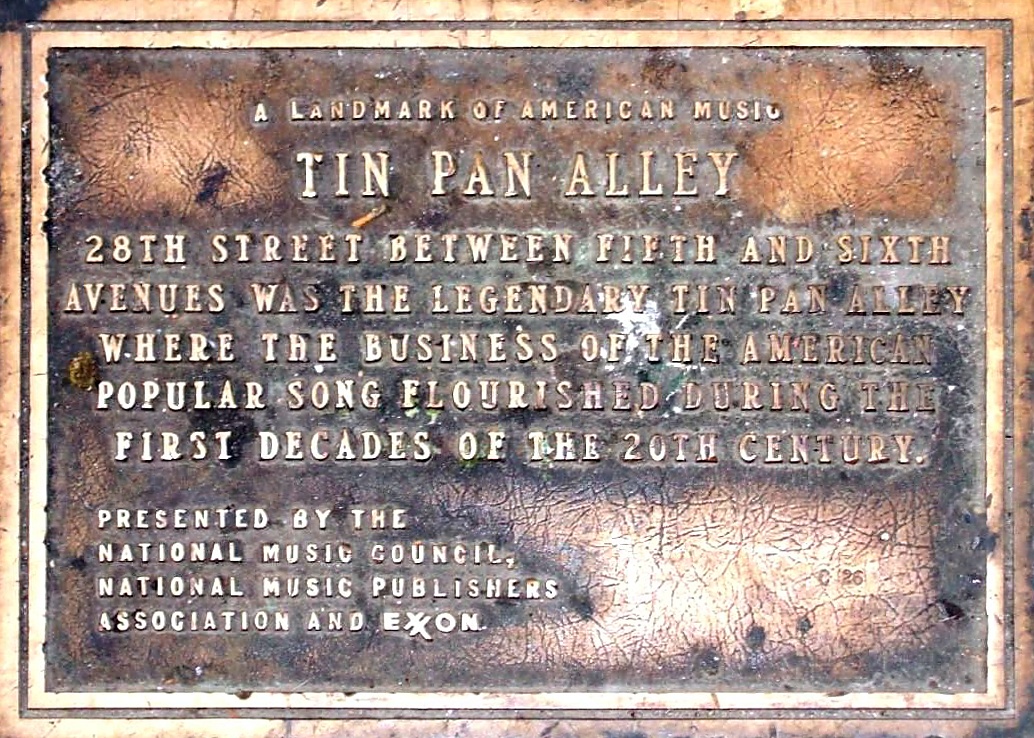
Tin Pan Alley was a collection of music publishers and songwriters in New York City that dominated the popular music of the United States in the late 19th and early 20th centuries. Originally, it referred to a specific location on West 28th Street, between Fifth and Sixth Avenues in the Flower District of Manhattan, as commemorated by a plaque on 28th Street between Broadway and Sixth. Several buildings on Tin Pan Alley are protected as New York City designated landmarks, and the section of 28th Street from Fifth to Sixth Avenue is also officially co-named Tin Pan Alley.

The start of Tin Pan Alley is usually dated to about 1885, when a number of music publishers set up shop in the same district of Manhattan. The end of Tin Pan Alley is less clear cut. Some date it to the start of the Great Depression in the 1930s when the phonograph, radio, and motion pictures supplanted sheet music as the driving force of American popular music, while others consider Tin Pan Alley to have continued into the 1950s when earlier styles of music were upstaged by the rise of rock and roll, which was centered on the Brill Building. Brill Building songwriter Neil Sedaka described his employer as being a natural outgrowth of Tin Pan Alley, in that the older songwriters were still employed in Tin Pan Alley firms while younger songwriters such as Sedaka found work at the Brill Building.

↓ Menu

>>>PUT SHARE BUTTONS HERE<<<

👉 Tin Pan Alley in the context of Thirty-two-bar form

The 32-bar form, also known as the AABA song form, American popular song form and the ballad form, is a song structure commonly found in Tin Pan Alley songs and other American popular music, especially in the first half of the 20th century.

The song form consists of four sections: an eight-bar A section; a second eight-bar A section (which may have slight changes from the first A section); an eight-bar B section, often with contrasting harmony or "feel"; and a final eight-bar A section. The core melody line is generally retained in each A section, although variations may be added, particularly for the last A section.

↓ Explore More Topics
In this Dossier

Tin Pan Alley in the context of Culture of New York City

New York City has been described as the cultural capital of the world. Its urban culture is reflected in its size and ethnic diversity. As many as 800 languages are spoken in New York, making it the most linguistically diverse city in the world. Many American cultural movements first emerged in the city. Large numbers of Irish, Italian, Jewish, Russian, and eventually African, Latino, and Asian Americans also migrated to New York throughout the 20th century and continuing into the 21st century, significantly influencing the city's culture and image. The city became the center of stand-up comedy in the early 20th century. The city was the top venue for jazz in the 1940s, expressionism in the 1950s and home to hip hop, punk rock, and the Beat Generation. Along with London's West End, New York City is the global center of musical theatre, often referred to as "Broadway" after the major thoroughfare in Manhattan. The Stonewall Inn in Greenwich Village, Lower Manhattan, is a designated U.S. National Historic Landmark and National Monument, as the site of the June 1969 Stonewall riots and the cradle of the modern gay rights movement.

The city is the birthplace of many cultural movements, including the Harlem Renaissance in literature and visual art; abstract expressionism (also known as the New York School) in painting; and hip hop, punk, salsa, freestyle, Tin Pan Alley, certain forms of jazz, and (along with Philadelphia) disco in music. New York has been considered the dance capital of the world. The city is also frequently the setting for novels, movies (see List of films set in New York City), and television programs. New York Fashion Week is one of the world's preeminent fashion events and is afforded extensive coverage by the media.New York has also frequently been ranked the top fashion capital of the world on the annual list compiled by the Global Language Monitor. Artists have been drawn into the city by opportunity, as the city government funds the arts with a larger annual budget than the National Endowment for the Arts, and New York is the center of the global art market, which grew up along with national and international media centers.

↑ Return to Menu

Tin Pan Alley in the context of Popular music

Popular music is music with wide appeal that is typically distributed to large audiences through the music industry. These forms and styles can be enjoyed and performed by people with little or no musical training. As a kind of popular art, it stands in contrast to art music. Art music was historically disseminated through the performances of written music, although since the beginning of the recording industry, it is also disseminated through recordings. Traditional music forms such as early blues songs or hymns were passed along orally, or to smaller, local audiences.

The original application of the term is to music of the 1880s Tin Pan Alley period in the United States. Although popular music sometimes is known as "pop music", the two terms are not interchangeable. Popular music is a generic term for a wide variety of genres of music that appeal to the tastes of a large segment of the population, whereas pop music usually refers to a specific musical genre within popular music. Popular music songs and pieces typically have easily singable melodies. The song structure of popular music commonly involves repetition of sections, with the verse and chorus or refrain repeating throughout the song and the bridge providing a contrasting and transitional section within a piece. From the 1960s through the mid-2000s, albums collecting songs were the dominant form for recording and consuming English-language popular music, in a period known as the album era.

↑ Return to Menu

Tin Pan Alley in the context of Verse (popular music)

Verse–chorus form is a musical form going back to the 1840s, in such songs as "Oh! Susanna", "The Daring Young Man on the Flying Trapeze", and many others. It became passé in the early 1900s, with advent of the AABA (with verse) form in the Tin Pan Alley days. It became commonly used in blues and rock and roll in the 1950s, and predominant in rock music since the 1960s. In contrast to 32-bar form, which is focused on the refrain (contrasted and prepared by the B section), in verse–chorus form the chorus is highlighted (prepared and contrasted with the verse).

The chorus often sharply contrasts the verse melodically, rhythmically, and harmonically, and assumes a higher level of dynamics and activity, often with added instrumentation. This is referred to as a "breakout chorus". See: arrangement.

↑ Return to Menu

Tin Pan Alley in the context of Jazz standard

Jazz standards are musical compositions that are an important part of the musical repertoire of jazz musicians, in that they are widely known, performed, and recorded by jazz musicians, and widely known by listeners. There is no definitive list of jazz standards, and the list of songs deemed to be standards changes over time. Songs included in major fake book publications (lead sheet collections of popular tunes) and jazz reference works offer a rough guide to which songs are considered standards.

Not all jazz standards were written by jazz composers. Many are originally Tin Pan Alley popular songs, Broadway show tunes or songs from Hollywood musicals – the Great American Songbook. In Europe, jazz standards and "fake books" may even include some traditional folk songs (such as in Scandinavia) or pieces of a minority ethnic group's music (such as Romani music) that have been played with a jazz feel by well known jazz players. A commonly played song can only be considered a jazz standard if it is widely played among jazz musicians. The jazz standard repertoire has some overlap with blues and pop standards.

↑ Return to Menu

Tin Pan Alley in the context of Brill Building

The Brill Building is an office building at 1619 Broadway on 49th Street in the New York City borough of Manhattan, just north of Times Square and farther uptown from the historic musical Tin Pan Alley neighborhood. The Brill Building housed music industry offices and studios where some of the most popular American songs were written. It is considered to have been the center of the American music industry that dominated the pop charts in the early 1960s.

It was built in 1931 as the Alan E. Lefcourt Building, after the son of its builder Abraham E. Lefcourt, and designed by Victor Bark Jr. The building is 11 stories high and has about 175,000 square feet (16,300 m) of rentable area.

↑ Return to Menu