Tin-glazed pottery in the context of "Samarra"

Play Trivia Questions online!

or

Skip to study material about Tin-glazed pottery in the context of "Samarra"

Ad spacer

⭐ Core Definition: Tin-glazed pottery

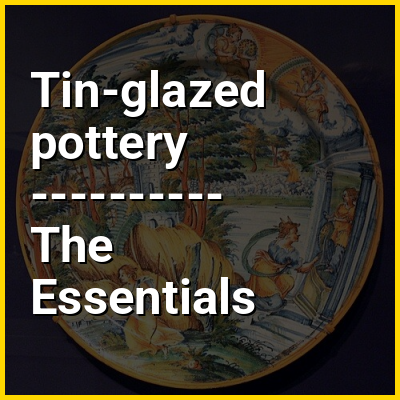
Tin-glazed pottery is earthenware covered in lead glaze with added tin oxide which is white, shiny and opaque (see tin-glazing for the chemistry); usually this provides a background for brightly painted decoration. It has been important in Islamic and European pottery, but very little used in East Asia. The pottery body is usually made of red or buff-colored earthenware and the white glaze imitated Chinese porcelain. The decoration on tin-glazed pottery is usually applied to the unfired glaze surface by brush with metallic oxides, commonly cobalt oxide, copper oxide, iron oxide, manganese dioxide and antimony oxide. The makers of Italian tin-glazed pottery from the late Renaissance blended oxides to produce detailed and realistic polychrome paintings.

The earliest tin-glazed pottery appears to have been made in Iraq in the 9th century, the oldest fragments having been excavated during the First World War from the palace of Samarra about fifty miles north of Baghdad. From there it spread to Egypt, Persia and Spain before reaching Italy in mid-15th century, early Renaissance, Holland in the 16th century and England, France and other European countries shortly after.
↓ Menu

>>>PUT SHARE BUTTONS HERE<<<
In this Dossier

Tin-glazed pottery in the context of Faience

Faience or faïence (/fˈɑːns, fˈ-, -ˈɒ̃s/; French: [fajɑ̃s] ) is the general English language term for fine tin-glazed pottery. The invention of a white pottery glaze suitable for painted decoration, by the addition of an oxide of tin to the slip of a lead glaze, was a major advance in the history of pottery. The invention seems to have been made in Iran or the Middle East before the ninth century. A kiln capable of producing temperatures exceeding 1,000 °C (1,830 °F) was required to achieve this result, after millennia of refined pottery-making traditions. The term is now used for a wide variety of pottery from several parts of the world, including many types of European painted wares, often produced as cheaper versions of porcelain styles.

English generally uses various other terms for well-known sub-types of faience. Italian tin-glazed earthenware, at least the early forms, is called maiolica in English, Dutch wares are called Delftware, and their English equivalents English delftware, leaving "faience" as the normal term in English for French, German, Spanish, Portuguese wares and those of other countries not mentioned (it is also the usual French term, and fayence in German). The name faience is simply the French name for Faenza, in the Romagna near Ravenna, Italy, where a painted majolica ware on a clean, opaque pure-white ground, was produced for export as early as the fifteenth century.

↑ Return to Menu

Tin-glazed pottery in the context of Delftware

Delftware or Delft pottery, also known as Delft Blue (Dutch: Delfts blauw) or as delf, is a general term now used for Dutch tin-glazed earthenware, a form of faience. Most of it is blue and white pottery, and the city of Delft in the Netherlands was the major centre of production, but the term covers wares with other colours, and made elsewhere. It is also used for similar pottery, English delftware.

Delftware is one of the types of tin-glazed pottery in which a white glaze is applied and usually decorated with metal oxides. In particular, the cobalt oxide is used for its ability to withstand high firing temperatures, allowing it to be applied under this glaze. Cobalt Oxide is also what gives Delftware its trademark blue designs.

↑ Return to Menu

Tin-glazed pottery in the context of Luca della Robbia

Luca della Robbia (/ˌdɛlə ˈrɒbiə/, also US: /- ˈrb-/, Italian: [ˈluːka della ˈrobbja, - ˈrɔb-]; 1399/1400–1482) was an Italian Renaissance sculptor from Florence. Della Robbia is noted for his colorful, tin-glazed terracotta statuary, a technique that he invented and passed on to his nephew Andrea della Robbia and great-nephews Giovanni della Robbia and Girolamo della Robbia. Although a leading sculptor in stone, after developing his technique in the early 1440s he worked primarily in terracotta. His large workshop produced both less expensive works cast from molds in multiple versions, and more expensive one-off individually modeled pieces.

The vibrant, polychrome glazes made his creations both more expressive and more durable. His work is noted for its charm rather than the drama of the work of some of his contemporaries. Two of his famous works are The Nativity (c. 1460) and Madonna and Child (c. 1475). In stone, his most famous work is also his first major commission, the choir gallery, Cantoria in the Florence Cathedral (1431–1438).

↑ Return to Menu

Tin-glazed pottery in the context of Maiolica

Maiolica /mˈɒlɪkə/ is tin-glazed pottery decorated in colours on a white background. The most renowned maiolica is from the Renaissance period. These works were known as istoriato wares ("painted with stories") when depicting historical and mythical scenes. Its origins date from painted Hispano-Moresque ware from Spain, developing the styles of Al-Andalus. By the late 15th century, multiple locations were producing sophisticated pieces for a luxury market. In Italy, the production arose in the northern and central regions. In France, maiolica developed as faience, in the Netherlands and England as delftware, and in Spain as talavera. In English, the spelling was anglicised to majolica (/mˈɒlɪkə/).

↑ Return to Menu

Tin-glazed pottery in the context of English delftware

English delftware is tin-glazed pottery made in Britain and Ireland between about 1550 and the late 18th century. The main centres of production were London, Bristol and Liverpool with smaller centres at Lancaster, Wincanton, Glasgow and Dublin. English tin-glazed pottery was called "galleyware" or "galliware" and its makers "gallypotters" until the early 18th century; it was given the name delftware after the tin-glazed pottery from the Netherlands.

Many everyday wares were made: tiles, mugs, drug jars, dishes, wine bottles, posset pots, salt pots, candlesticks, fuddling cups (that is, ale mugs joined in groups of three, four or five with connecting holes to confuse the drinker), puzzle jugs (similar to fuddling cups), barber's bowls, pill slabs, bleeding bowls, porringers and flower bricks. Humble undecorated items included chamberpots, colanders and small disposable ointment pots (gallipots), dispensed by apothecaries. Large decorative dishes, often called chargers, were popular, and included much of the most ambitious painting, often stretching the artists to the edge of their capabilities, and beyond.

↑ Return to Menu

Tin-glazed pottery in the context of Tin-glazing

Tin-glazing is the process of giving tin-glazed pottery items a ceramic glaze that is white, glossy and opaque, which is normally applied to red or buff earthenware. Tin-glaze is plain lead glaze with a small amount of tin oxide added. The opacity and whiteness of tin glaze encourage its frequent decoration. Historically this has mostly been done before the single firing, when the colours blend into the glaze, but since the 17th century also using overglaze enamels, with a light second firing, allowing a wider range of colours. Majolica, maiolica, delftware and faience are among the terms used for common types of tin-glazed pottery.

An alternative is lead-glazing, where the basic glaze is transparent; some types of pottery use both. However, when pieces are glazed only with lead, the glaze becomes fluid during firing, and may run or pool. Colours painted on the glaze may also run or blur. Tin-glazing avoids these problems.

↑ Return to Menu