Timok Valley in the context of "Vlachs of Serbia"

Play Trivia Questions online!

or

Skip to study material about Timok Valley in the context of "Vlachs of Serbia"


⭐ Core Definition: Timok Valley

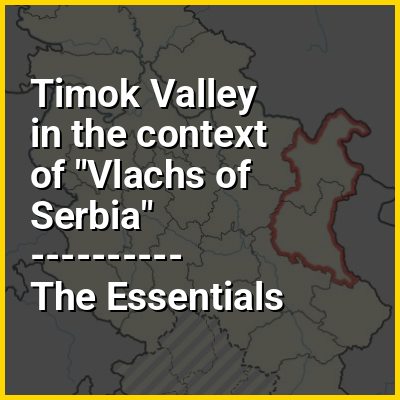
The Timočka Krajina (Serbian: Тимочка Крајина, lit.'Timok Frontier') or Timok Valley (Romanian: Valea Timocului), is a geographical region in eastern Serbia around the Timok River. It roughly corresponds to two administrative districts, Bor and Zaječar, which have a combined population of 197,815.

↓ Menu

👉 Timok Valley in the context of Vlachs of Serbia

The Vlachs (Romanian: rumâń; Serbian: Власи, romanizedVlasi) are a Romanian-speaking recognized ethnic minority in Serbia. According to data from the 2022 census, there were 21,013 Vlachs living in Serbia (constituting 0.3% of the total population), although unofficial estimates by members of the community put the number of Vlachs or speakers of Romanian in eastern Serbia to be between 150,000 and 300,000. They are concentrated in eastern Serbia, mainly within the Timok Valley.

The Vlachs are characterized by a culture that has preserved archaic and ancient elements in matters such as language or customs. Although ethnographically and linguistically related to the Romanians, within the Vlach community there are divergences on whether or not they belong to the Romanian ethnicity and whether or not their minority should be amalgamated with the Romanian ethnic minority in Serbia.

↓ Explore More Topics
In this Dossier

Timok Valley in the context of Timok River

The Timok (Serbian and Bulgarian: Тимок, Romanian: Timoc), sometimes also known as Great Timok (Serbian: Велики Тимок / Veliki Timok, Romanian: Timocul Mare), is a river in eastern Serbia, a right tributary of the Danube. For the last 15 km of its run it forms a border between eastern Serbia and western Bulgaria.

It is a branchy system of many shorter rivers, many of them having the same name (Timok), only clarified with adjectives. From the farthest source in the system, that of the Svrljiški Timok, until its confluence (as Veliki Timok), the Timok is 202 km long. The area of the river basin is 4,626 km (1,786 sq mi). Its average discharge at the mouth is 31 m/s (1,100 cu ft/s). The Timok Valley is known for the most important Vlach population in Eastern Serbia.

↑ Return to Menu

Timok Valley in the context of Romanians in Bulgaria

The Romanians in Bulgaria (Romanian: români or rumâni; Bulgarian: румънци, rumŭntsi, or власи, vlasi), are a small ethnic minority in Bulgaria. In the country, Romanians live in several northern regions, mostly along the Danube. This includes a region between the city of Vidin and the Timok river; these Romanians form a continuous community with the Romanian community in the Timok Valley of Serbia. Another region with a high density of Romanians is located between the towns of Oryahovo and Svishtov. Another goes from Tutrakan to the Bulgaria–Romania border at Northern Dobruja. There also are scattered groups of Romanians within the interior of Bulgaria, such as in Pleven or around Vratsa. The Romanians in Bulgaria are not recognized as a national minority, and they lack minority rights such as schools or churches in their own Romanian language. Many are subject to assimilation.

In Bulgaria, the local Romanians are commonly referred to as "Vlachs". This term is also applied to the Aromanians of the country, as well as to Romanian-speaking Boyash Gypsies. The German linguist Gustav Weigand dealt in the most detailed and concrete way with the Vlach population south of the Danube. In 1905 he undertook a special trip through Bulgaria to establish where the Vlach settlements are located and to characterize their language. According to Weigand, the largest group of Vlach population moved to the Bulgarian lands in the 1830s, when the so-called Organic statute (1831), was introduced in Walachia, by virtue of which men were subject to mandatory military service. Using the data from the population census in the Principality of Bulgaria in 1900, he pointed out that, at the end of the 19th century, 86,000 Vlachs were registered in Bulgaria, of which 11,708 (about 15%) were born north of the river, which means that they moved south of the Danube in the second half of the 19th century.

↑ Return to Menu

Timok Valley in the context of Baba Vida

Baba Vida (Bulgarian: Баба Вида) is a medieval castle in Vidin in northwestern Bulgaria and the town's primary landmark. It consists of two concentric curtain walls and about nine towers of which three are preserved to their full medieval height, including the original battlements, and is the only entirely preserved medieval castle in the country. Baba Vida is 39 metres (128 ft) above sea level.

The construction of the castle began in the 10th century at the place of the ancient Roman castell Bononia. The building of Baba Vida is tied to a legend, according to which a Danubian Bulgarian king who ruled at Vidin had three daughters: Vida, Kula, and Gamza. Prior to his death, he divided his realm among the three. Vida, the eldest, was given Vidin and the lands north to the Carpathians, Kula was awarded Zaječar and the Timok Valley, and Gamza was to rule the lands west up to the Morava. Although Gamza and Kula married to drunkard and warlike nobles, Vida remained unmarried and built the castle in her city. The name of the castle means "Granny Vida".

↑ Return to Menu