Thurlow Weed in the context of "War of 1812"

Play Trivia Questions online!

or

Skip to study material about Thurlow Weed in the context of "War of 1812"

Ad spacer

⭐ Core Definition: Thurlow Weed

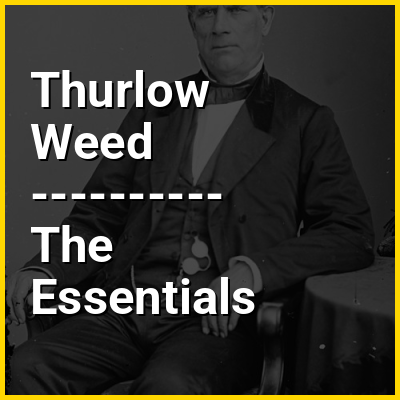
Edward Thurlow Weed (November 15, 1797 – November 22, 1882) was an American printer, newspaper publisher, and Whig and Republican politician. He was the principal political advisor to prominent New York politician William H. Seward and was instrumental in the presidential nominations of William Henry Harrison (1840), Zachary Taylor (1848), and John C. Frémont (1856).

Born in Cairo, New York, Weed apprenticed as a printer under William Williams and served with him in the War of 1812 before winning election to the New York State Assembly. He met Seward in the assembly, and they formed a close political alliance that lasted for several decades. Weed and Seward became leaders of the New York Anti-Masonic Party, and Weed established the Albany Evening Journal as the party's main newspaper. Weed supported the American System of Henry Clay and helped establish the Whig Party in the 1830s. He helped Seward win election as Governor of New York and supported the successful presidential candidacies of Harrison and Taylor.
↓ Menu

>>>PUT SHARE BUTTONS HERE<<<
In this Dossier

Thurlow Weed in the context of Millard Fillmore

Millard Fillmore (January 7, 1800 – March 8, 1874) was the 13th president of the United States, serving from 1850 to 1853. He was the last president to be a member of the Whig Party while in the White House, and the last to be neither a Democrat nor a Republican. A former member of the U.S. House of Representatives, Fillmore was elected vice president in 1848, and succeeded to the presidency when Zachary Taylor died in 1850. Fillmore was instrumental in passing the Compromise of 1850, which led to a brief truce in the battle over the expansion of slavery.

Fillmore was born into poverty in the Finger Lakes area of upstate New York. He had little formal schooling, but studied to become a lawyer. Fillmore became prominent in the Buffalo area as an attorney and politician, and was elected to the New York Assembly in 1828 and the House of Representatives in 1832. Fillmore initially belonged to the Anti-Masonic Party, but became a member of the Whig Party as it formed in the mid-1830s. He was a rival for the state party leadership with Thurlow Weed and his protégé William H. Seward. Throughout his career, Fillmore declared slavery evil but said it was beyond the federal government's power to end it. Conversely, Seward argued that the federal government had a role to play. Fillmore was an unsuccessful candidate for Speaker of the U.S. House of Representatives when the Whigs took control of the chamber in 1841, but was made chairman of the Ways and Means Committee. Defeated in bids for the Whig nomination for vice president and for New York governor in 1844, Fillmore was elected Comptroller of New York in 1847, the first to hold that post by election.

↑ Return to Menu

Thurlow Weed in the context of William Morgan (anti-Mason)

William Morgan (1774 – disappeared c. 1826) was a resident of Batavia, New York, whose disappearance and presumed murder in 1826 ignited a powerful movement against the Freemasons, a fraternal society that had become influential in the United States. After Morgan announced his intention to publish a book exposing Freemasonry's secrets, he was arrested on trumped-up charges. He disappeared soon after and was believed to have been kidnapped and killed by Masons from western New York.

The allegations surrounding Morgan's disappearance and presumed death sparked a public outcry and inspired Thurlow Weed and others to harness the discontent by founding the new Anti-Masonic Party in opposition to President Andrew Jackson's Democrats. It ran a presidential candidate in 1832 but was nearly defunct by 1835.

↑ Return to Menu

Thurlow Weed in the context of Conservative Republicans (Reconstruction era)

Conservative Republicans was a designation applied in reference to a faction of the early Republican Party during the American Civil War and Reconstruction era which advocated a lenient, conciliatory policy towards the South in contrast to the harsher attitudes emphasized by Radical Republicans. "Conservatives" such as Pennsylvania senator Edgar Cowan generally opposed efforts by Radical Republicans to rebuild the Southern U.S. under an economically mobile, free-market system.

Members of the faction primarily thrived politically on antipathy towards civil rights and black suffrage. In states outside New England, Republicans such as Thurlow Weed, Oliver P. Morton, Jacob Dolson Cox, and James R. Doolittle touted their alliance with President Andrew Johnson and/or exploited racist opposition towards suffrage for political gains and to drastically reduce influence by Radical Republicans. In such states, amendments and referendums to enfranchise blacks would fail due to small fractions of Republican voters voting with Democrats to defeat them. Both Radicals and Conservatives in the Republican Party were firm and unwavering in their viewpoints. Senator William E. Chandler of New Hampshire observed: "I notice, that everyone who goes South, whether Radical or Conservative, comes back confirmed in his previous opinion."

↑ Return to Menu