Three Bards in the context of Polish Romanticism


Three Bards in the context of Polish Romanticism

⭐ Core Definition: Three Bards

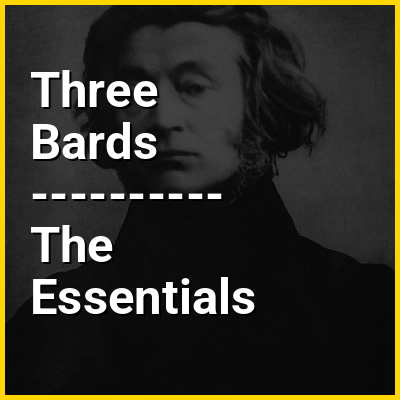
The Three Bards (Polish: trzej wieszcze, IPA: [ˈtʂɛj ˈvjɛʂt͡ʂɛ]) are the national poets of Polish Romantic literature. The term is almost exclusively used to denote Adam Mickiewicz (1798–1855), Juliusz Słowacki (1809–1849) and Zygmunt Krasiński (1812–1859). Of the three, Mickiewicz is considered the most influential and Krasiński the least.

The Three Bards were thought not only to voice Polish national sentiments but to foresee their nation's future. They lived and worked in exile following the partitions of Poland, which had ended the existence of the independent Polish state. Their tragic poetical plays and epic poetry, written in the aftermath of the 1830 Uprising against Russian rule, revolved around the Polish struggle for independence from the three occupying foreign empires.
↓ Menu
HINT:

In this Dossier

Three Bards in the context of Adam Mickiewicz

Adam Bernard Mickiewicz (24 December 1798 – 26 November 1855) was a Polish poet, dramatist, essayist, publicist, translator and political activist. He is regarded as national poet in Poland, Lithuania and Belarus. He also largely influenced Ukrainian literature and affected Russian literature. A principal figure in Polish Romanticism, he is one of Poland's "Three Bards" (Polish: trzej wieszcze) and is widely regarded as Poland's greatest poet. He is also considered one of the greatest Slavic and European poets and has been dubbed a "Slavic bard". A leading Romantic dramatist, he has been compared in Poland and Europe to Byron and Goethe.

He is known chiefly for the poetic drama Dziady (Forefathers' Eve) and the national epic poem Pan Tadeusz. His other influential works include Konrad Wallenrod and Grażyna. All these served as inspiration for uprisings against the three imperial powers that had partitioned the Polish–Lithuanian Commonwealth out of existence.

View the full Wikipedia page for Adam Mickiewicz
↑ Return to Menu

Three Bards in the context of Juliusz Słowacki

Juliusz Słowacki (/slˈvɑːtski/; Polish: [ˈjuljuʂ swɔˈvat͡skʲi]; French: Jules Slowacki; 4 September 1809 – 3 April 1849) was a Polish Romantic poet. He is considered one of the "Three Bards" of Polish literature — a major figure in the Polish Romantic period, and the father of modern Polish drama. His works often feature elements of Slavic paganism, Polish history, mysticism and orientalism. His style includes the employment of neologisms and irony. His primary genre was the drama, but he also wrote lyric poetry. His most popular works include the dramas Kordian and Balladyna and the poems Beniowski, Testament mój and Anhelli.

Słowacki spent his youth in the so-called "Stolen Lands" within the Russian Empire, in Kremenets (Polish: Krzemieniec, now in Ukraine) and in Vilnius (now Lithuania). He briefly worked for the government of the Kingdom of Poland. During the November 1830 Uprising, he was a courier for the Polish revolutionary government. When the uprising ended in defeat, he found himself abroad and thereafter, like many compatriots, lived the life of an émigré. He settled briefly in Paris, France, and later in Geneva, Switzerland. He also traveled through Italy, Greece and the Middle East. Eventually he returned to Paris, where he spent the last decade of his life. He briefly returned to Poland when another uprising broke out during the Spring of Nations (1848).

View the full Wikipedia page for Juliusz Słowacki
↑ Return to Menu

Three Bards in the context of Zygmunt Krasiński

Count Napoleon Stanisław Adam Feliks Zygmunt Krasiński (Polish: [ˈzɨɡmunt kraˈɕij̃skʲi]; 19 February 1812 – 23 February 1859) was a Polish poet traditionally ranked after Adam Mickiewicz and Juliusz Słowacki as one of Poland's Three Bards – the Romantic poets who influenced national consciousness in the period of Partitions of Poland.

Krasiński was the most famous member of the noble Krasiński family. He was born in Paris to Count Wincenty Krasiński and Princess Maria Urszula Radziwiłł, a member of the aristocratic Radziwiłł family, and became the close companion of his father after his mother's early death from tuberculosis. He was educated by tutors prior to attending the Warsaw Lyceum, where he graduated in 1827. He then started to study law and administration at the Royal University of Warsaw, but was expelled from the university in 1829.

View the full Wikipedia page for Zygmunt Krasiński
↑ Return to Menu

Three Bards in the context of Kordian

Kordian: First Part of a Trilogy: The Coronation Plot (Polish: Kordian: Część pierwsza trylogii. Spisek koronacyjny), simply known as Kordian, is a drama written in 1833, and published in 1834, by Juliusz Słowacki, one of the "Three Bards" of Polish literature.

Kordian is one of the most notable works of Polish Romanticism and drama, and is considered one of Słowacki's best works.

View the full Wikipedia page for Kordian
↑ Return to Menu

Three Bards in the context of Beniowski

Beniowski is a poem written and composed by one of Poland's "Three National Bards", Juliusz Słowacki. The first section was published in 1841, however the remaining parts were written by Antoni Malecki after Słowacki's death in 1849.

The content of the poem summarizes the events that occurred during the infamous Bar Confederation; the fight against the Russians and rebellious Ruthenian peasants, which took place in the Eastern borderlands (Polish: Kresy) of the Polish-Lithuanian Commonwealth. It tells the story of Maurycy Beniowski, an impoverished nobleman and aristocrat in the region of Podolia, and his love to a wealthy lady living in a nearby castle with her intolerant family.

View the full Wikipedia page for Beniowski
↑ Return to Menu

Three Bards in the context of Testament mój

Testament mój (variously translated as My Testament, My Last Will, The Testament of Mine, My Will and Testament and likewise) is a poem written by Juliusz Słowacki, one of the Three Bards of Polish poetry, in Paris around 1839 and 1840. This poem has been described as one of Słowacki's most famous works.

View the full Wikipedia page for Testament mój
↑ Return to Menu

Three Bards in the context of Krasiński family

The House of Krasiński (plural: Krasińscy) is an old Polish noble family, whose members held the title of Count in the Austro-Hungarian Empire, granted to them on 29 June 1856 by Franz Joseph I. The name is derived from the village of Krasne in Masovia. The family traces its origins to the 14th century. Its members have been landowners and politically active in Masovia, Lithuania, and Galicia, now in Poland. The Krasiński family has produced officers, politicians (including voivodes of Poland and members of the Senate of Poland), and bishops. One of the most renowned members of the Krasiński family is the 19th-century poet Zygmunt Krasiński, one of Poland's Three Bards.

View the full Wikipedia page for Krasiński family
↑ Return to Menu

Three Bards in the context of Wincenty Krasiński

Count Wincenty Krasiński (5 April 1782 – 24 November 1858) was a Polish nobleman (szlachcic), political activist and military leader.

He was the father of Zygmunt Krasiński, one of Poland's Three Bards—Poland's greatest romantic poets.

View the full Wikipedia page for Wincenty Krasiński
↑ Return to Menu