Theory in the context of "Rationalism"

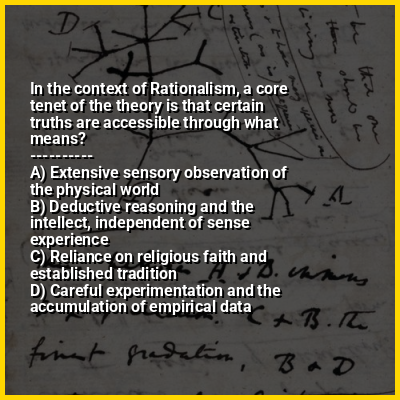
⭐ In the context of Rationalism, a core tenet of the theory is that certain truths are accessible through what means?

Ad spacer

⭐ Core Definition: Theory

A theory is in general any hypothesis or set of ideas about something, formed in any number of ways through any sort of reasoning for any sort of reason.

When applied to intellectual or academic situations, it is considered a systematic and rational form of abstract thinking about a phenomenon, or the conclusions derived from such thinking. It involves contemplative and logical reasoning, often supported by processes such as observation, experimentation, and research. Theories can be scientific, falling within the realm of empirical and testable knowledge, or they may belong to non-scientific disciplines, such as philosophy, art, or sociology. In some cases, theories may exist independently of any formal discipline.
↓ Menu

>>>PUT SHARE BUTTONS HERE<<<

👉 Theory in the context of Rationalism

In philosophy, rationalism is the epistemological view that "regards reason as the chief source and test of knowledge" or "the position that reason has precedence over other ways of acquiring knowledge", often in contrast to other possible sources of knowledge such as faith, tradition, or sensory experience. More formally, rationalism is defined as a methodology or a theory "in which the criterion of truth is not sensory but intellectual and deductive".

In a major philosophical debate during the Enlightenment, rationalism (sometimes here equated with innatism) was opposed to empiricism. On the one hand, rationalists like René Descartes emphasized that knowledge is primarily innate and the intellect, the inner faculty of the human mind, can therefore directly grasp or derive logical truths; on the other hand, empiricists like John Locke emphasized that knowledge is not primarily innate and is best gained by careful observation of the physical world outside the mind, namely through sensory experiences. Rationalists asserted that certain principles exist in logic, mathematics, ethics, and metaphysics that are so fundamentally true that denying them causes one to fall into contradiction. The rationalists had such a high confidence in reason that empirical proof and physical evidence were regarded as unnecessary to ascertain certain truths – in other words, "there are significant ways in which our concepts and knowledge are gained independently of sense experience".

↓ Explore More Topics
In this Dossier

Theory in the context of Cosmology

Cosmology (from Ancient Greek κόσμος (cosmos) 'the universe, the world' and λογία (logia) 'study of') is a branch of physics and metaphysics dealing with the nature of the universe, the cosmos. The term cosmology was first used in English in 1656 in Thomas Blount's Glossographia, with the meaning of "a speaking of the world". In 1731, German philosopher Christian Wolff used the term cosmology in Latin (cosmologia) to denote a branch of metaphysics that deals with the general nature of the physical world. Religious or mythological cosmology is a body of beliefs based on mythological, religious, and esoteric literature and traditions of creation myths and eschatology. In the science of astronomy, cosmology is concerned with the study of the chronology of the universe.

Physical cosmology is the study of the observable universe's origin, its large-scale structures and dynamics, and the ultimate fate of the universe, including the laws of science that govern these areas. It is investigated by scientists, including astronomers and physicists, as well as philosophers, such as metaphysicians, philosophers of physics, and philosophers of space and time. Because of this shared scope with philosophy, theories in physical cosmology may include both scientific and non-scientific propositions and may depend upon assumptions that cannot be tested. Physical cosmology is a sub-branch of astronomy that is concerned with the universe as a whole. Modern physical cosmology is dominated by the Big Bang Theory which attempts to bring together observational astronomy and particle physics; more specifically, a standard parameterization of the Big Bang with dark matter and dark energy, known as the Lambda-CDM model.

↑ Return to Menu

Theory in the context of Master's degree

A master's degree (from Latin magister) is a postgraduate academic degree awarded by universities or colleges upon completion of a course of study demonstrating mastery or a high-order overview of a specific field of study or area of professional practice. A master's degree normally requires previous study at the bachelor's level, either as a separate degree or as part of an integrated course. Within the area studied, master's graduates are expected to possess advanced knowledge of a specialized body of theoretical and applied topics; high order skills in analysis, critical evaluation, or professional application; and the ability to solve complex problems and think rigorously and independently.

↑ Return to Menu

Theory in the context of Realism (international relations)

Realism, in international relations theory, is a theoretical framework that views world politics as an enduring competition among self-interested states vying for power and positioning within an anarchic global system devoid of a centralized authority. It centers on states as rational primary actors navigating a system shaped by power politics, national interest, and a pursuit of security and self-preservation.

Realism involves the strategic use of military force and alliances to boost global influence while maintaining a balance of power. War is seen as inevitably inherent in the anarchic conditions of world politics. Realism also emphasizes the complex dynamics of the security dilemma, where actions taken for security reasons can unintentionally lead to tensions between states.

↑ Return to Menu

Theory in the context of Life stance

A person's life stance, or lifestance, is their relation with what they accept as being of ultimate importance. It involves presuppositions and commitment to exercise it in theory and practice in one's life.

It can connote an integrated perspective on reality as a whole and how to assign valuations, thus being a concept similar or equivalent to that of a worldview; with the latter word (derived from the German Weltanschauung) being generally a more common and comprehensive term. Like the term worldview, the term life stance is a shared label encompassing both religious perspectives (for instance: "a Buddhist life stance" or "a Christian life stance" or "a Pagan life stance"), as well as non-religious spiritual or philosophical alternatives (for instance: "a humanist life stance" or "a personist life stance" or "a Deep Ecology life stance"), without discrimination in favour of any.

↑ Return to Menu

Theory in the context of Sociology

Sociology is the scientific study of human society that focuses on society, human social behavior, patterns of social relationships, social interaction, and aspects of culture associated with everyday life. The term sociology was coined in the late 18th century to describe the scientific study of society. Regarded as a part of both the social sciences and humanities, sociology uses various methods of empirical investigation and critical analysis to develop a body of knowledge about social order and social change. Sociological subject matter ranges from micro-level analyses of individual interaction and agency to macro-level analyses of social systems and social structure. Applied sociological research may be applied directly to social policy and welfare, whereas theoretical approaches may focus on the understanding of social processes and phenomenological method.

Traditional focuses of sociology include social stratification, social class, social mobility, religion, secularization, law, sexuality, gender, and deviance. Recent studies have added socio-technical aspects of the digital divide as a new focus. Digital sociology examines the impact of digital technologies on social behavior and institutions, encompassing professional, analytical, critical, and public dimensions. The internet has reshaped social networks and power relations, illustrating the growing importance of digital sociology. As all spheres of human activity are affected by the interplay between social structure and individual agency, sociology has gradually expanded its focus to other subjects and institutions, such as health and the institution of medicine; economy; military; punishment and systems of control; the Internet; sociology of education; social capital; and the role of social activity in the development of scientific knowledge.

↑ Return to Menu

Theory in the context of Interdependence theory

Interdependence theory is a social exchange theory developed in social psychology that examines how interpersonal relationships are defined through interpersonal interdependence, which is "the process by which interacting people influence one another's experiences". Originally proposed by Harold H. Kelley and John Thibaut in 1959, the theory provides a conceptual framework for analyzing the structure of interpersonal situations and how individuals' outcomes depend not only on their own actions but also on the actions of others.

The most basic principle of the theory is encapsulated in the equation I = ƒ[A, B, S], which states that all interpersonal interactions (I) are a function (ƒ) of the given situation (S), plus the actions and characteristics of the individuals (A & B) in the interaction. This equation represents how people's behaviors, thoughts, and emotions in relationships are influenced by both situational structures and psychological processes.

↑ Return to Menu

Theory in the context of Great man theory

The great man theory is an approach to the study of history popularised in the 19th century according to which history can be largely explained by the impact of great men, or heroes: highly influential and unique individuals who, due to their natural attributes, such as superior intellect, heroic courage, extraordinary leadership abilities, or divine inspiration, have a decisive historical effect. The theory is primarily attributed to the Scottish essayist, historian, and philosopher Thomas Carlyle, who gave a series of lectures on heroism in 1840, later published as On Heroes, Hero-Worship, & the Heroic in History, in which he states:

This theory is usually contrasted with people's history, which emphasizes the life of the masses creating overwhelming waves of smaller events which carry leaders along with them. Another contrasting school is historical materialism.

↑ Return to Menu