The Yankee Doodle Boy in the context of "Little Johnny Jones"

Play Trivia Questions online!

or

Skip to study material about The Yankee Doodle Boy in the context of "Little Johnny Jones"


⭐ Core Definition: The Yankee Doodle Boy

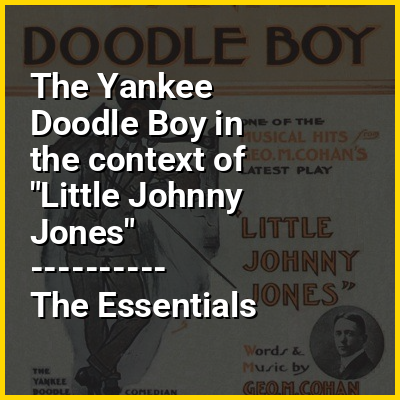
"The Yankee Doodle Boy", also known as "(I'm a) Yankee Doodle Dandy" is a patriotic song from the Broadway musical Little Johnny Jones, written by George M. Cohan. The play opened at the Liberty Theater on November 7, 1904. The play concerns the trials and tribulations of a fictional American jockey, Johnny Jones (based on the real-life jockey Tod Sloan), who rides a horse named Yankee Doodle in the English Derby. Cohan incorporates snippets of several popular traditional American songs into his lyrics of this song, as he often did with his songs. The song was performed by James Cagney in the 1942 film Yankee Doodle Dandy, in which he played Cohan.

↓ Menu

👉 The Yankee Doodle Boy in the context of Little Johnny Jones

Little Johnny Jones is a musical by George M. Cohan. The show introduced Cohan's tunes "Give My Regards to Broadway" and "The Yankee Doodle Boy." The Johnny Jones character was inspired by real-life Hall of Fame jockey Tod Sloan.

↓ Explore More Topics
In this Dossier

The Yankee Doodle Boy in the context of George M. Cohan

George Michael Cohan (July 3, 1878 – November 5, 1942) was an American entertainer, playwright, composer, lyricist, actor, singer, dancer and theatrical producer.

Cohan began his career as a child, performing with his parents and sister in a vaudeville act known as "The Four Cohans". Beginning with Little Johnny Jones in 1904, he wrote, composed, produced, and appeared in more than three dozen musicals on Broadway. Cohan wrote more than 50 shows and published more than 300 songs during his lifetime, including the standards "Over There", "Give My Regards to Broadway", "The Yankee Doodle Boy" and "You're a Grand Old Flag". As a composer, he was one of the early members of the American Society of Composers, Authors, and Publishers (ASCAP). He displayed remarkable theatrical longevity, appearing in films until the 1930s and continuing to perform as a headline artist until 1940.

↑ Return to Menu