Tharsis Montes in the context of "Tharsis"

Play Trivia Questions online!

or

Skip to study material about Tharsis Montes in the context of "Tharsis"


👉 Tharsis Montes in the context of Tharsis

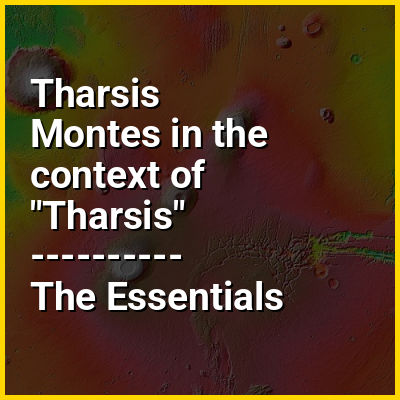
Tharsis (/ˈθɑːrsɪs/) is a vast volcanic plateau centered near the equator in the western hemisphere of Mars. The region is home to the largest volcanoes in the Solar System, including the three enormous shield volcanoes Arsia Mons, Pavonis Mons, and Ascraeus Mons, which are collectively known as the Tharsis Montes. The tallest volcano on the planet, Olympus Mons, is often associated with the Tharsis region but is actually located off the western edge of the plateau. The name Tharsis is the Greco-Latin transliteration of the biblical Tarshish, the land at the western extremity of the known world.

↓ Explore More Topics
In this Dossier

Tharsis Montes in the context of Marsquake

A marsquake is a quake which, much like an earthquake, is a shaking of the surface or interior of the planet Mars. Such quakes may occur with a shift in the planet's interior, such as the result of plate tectonics, from which most quakes on Earth originate, or possibly from hotspots such as Olympus Mons or the Tharsis Montes. The detection and analysis of marsquakes are informative to probing the interior structure of Mars, as well as potentially identifying whether any of Mars's many volcanoes continue to be volcanically active.

Quakes have been observed and well-documented on the Moon, and there is evidence of past quakes on Venus. Marsquakes were first detected but not confirmed by the Viking mission in 1976. Marsquakes were detected and confirmed by the InSight mission in 2019. Using InSight data and analysis, the Viking marsquakes were confirmed in 2023. Compelling evidence has been found that Mars has in the past been seismically more active, with clear magnetic striping over a large region of southern Mars. Magnetic striping on Earth is often a sign of a region of particularly thin crust splitting and spreading, forming new land in the slowly separating rifts; a prime example of this being the Mid-Atlantic Ridge. However, no clear spreading ridge has been found in this region, suggesting that another, possibly non-seismic explanation may be needed.

↑ Return to Menu

Tharsis Montes in the context of Olympus Mons

Olympus Mons (/əˌlɪmpəs ˈmɒnz, -/; Latin for 'Mount Olympus') is a large shield volcano on Mars. It is over 21.9 km (13.6 mi; 72,000 ft) high as measured by the Mars Orbiter Laser Altimeter (MOLA), about 2.5 times the elevation of Mount Everest above sea level. It is Mars's tallest volcano, its tallest planetary mountain, and is approximately tied with Rheasilvia on Vesta as the tallest mountain currently discovered in the Solar System. It is associated with the volcanic region of Tharsis Montes. It last erupted 25 million years ago.

Olympus Mons is the youngest of the large volcanoes on Mars, having formed during the Martian Hesperian Period with eruptions continuing well into the Amazonian Period. It has been known to astronomers since the late 19th century as the albedo feature Nix Olympica (Latin for "Olympic Snow"), and its mountainous nature was suspected well before space probes confirmed it as a mountain.

↑ Return to Menu

Tharsis Montes in the context of Alba Patera

Alba Mons (formerly and still occasionally known as Alba Patera, a term that has since been restricted to the volcano's summit caldera; also initially known as the Arcadia ring) is a volcano located in the northern Tharsis region of the planet Mars. It is the biggest volcano on Mars in terms of surface area, with volcanic flow fields that extend for at least 1,350 km (840 mi) from its summit. Although the volcano has a span comparable to that of the United States, it reaches an elevation of only 6.8 km (22,000 ft) at its highest point. This is about one-third the height of Olympus Mons, the tallest volcano on the planet. The flanks of Alba Mons have very gentle slopes. The average slope along the volcano's northern (and steepest) flank is 0.5°, which is over five times lower than the slopes on the other large Tharsis volcanoes. In broad profile, Alba Mons resembles a vast but barely raised welt on the planet's surface. It is a unique volcanic structure with no counterpart on Earth or elsewhere on Mars.

In addition to its great size and low relief, Alba Mons has a number of other distinguishing features. The central portion of the volcano is surrounded by an incomplete ring of faults (graben) and fractures, called Alba Fossae on the volcano's western flank and Tantalus Fossae on the eastern flank. The volcano also has very long, well preserved lava flows that form a radiating pattern from the volcano's central region. The enormous lengths of some individual flows (>300 km (190 mi)) implies that the lavas were very fluid (low viscosity) and of high volume. Many of the flows have distinctive morphologies, consisting of long, sinuous ridges with discontinuous central lava channels. The low areas between the ridges (particularly along the volcano's northern flank) show a branching pattern of shallow gullies and channels (valley networks) that likely formed by water runoff.
↑ Return to Menu

Tharsis Montes in the context of Arsia Mons

Arsia Mons /ˈɑːrsiə ˈmɒnz/ is the southernmost of three volcanoes (collectively known as Tharsis Montes) on the Tharsis bulge near the equator of the planet Mars. To its north is Pavonis Mons, and north of that is Ascraeus Mons. The tallest volcano in the Solar System, Olympus Mons, is to its northwest. Its name comes from a corresponding albedo feature on a map by Giovanni Schiaparelli, which he named in turn after the legendary Roman forest of Arsia Silva. Historically, it was known as Nodus Gordii ("Gordian knot") before being renamed.

↑ Return to Menu