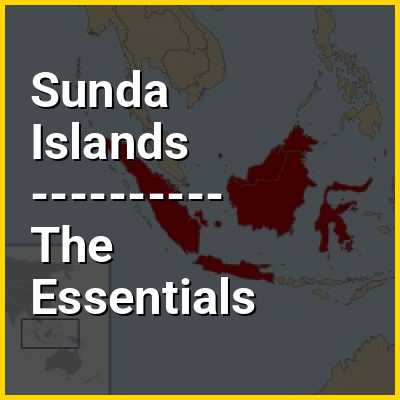
The Sunda Islands (Indonesian: Kepulauan Sunda; Tetun: Illa Sunda) are a group of islands in the Nusantara (Indonesian Archipelago). They consist of the Greater Sunda Islands and the Lesser Sunda Islands.
>>>PUT SHARE BUTTONS HERE<<<
👉 Sunda Islands in the context of Lesser Sunda Islands
The Lesser Sunda Islands (Indonesian: Kepulauan Sunda Kecil, Tetum: Illá Sunda ki'ik sirá, Balinese: ᬓᬧᬸᬮᭀᬯᬦ᭄ᬲᬸᬦ᭄ᬤᬘᬾᬦᬶᬓ᭄, romanized: Kapuloan Sunda cénik), now known as Nusa Tenggara Islands (Indonesian: Kepulauan Nusa Tenggara, or "Southeast Islands"), are an archipelago in the Indonesian archipelago. Most of the Lesser Sunda Islands are located within the Wallacea region, except for the Bali province which is west of the Wallace Line and is within the Sunda Shelf. Together with the Greater Sunda Islands to the west, they make up the Sunda Islands. The islands are part of a volcanic arc, the Sunda Arc, formed by subduction along the Sunda Trench in the Java Sea. In 1930 the population was 3,460,059; today over 17 million people live on the islands. Etymologically, Nusa Tenggara means "Southeast Islands" from the words of nusa which means 'island' from Old Javanese language and tenggara means 'southeast'.
The main Lesser Sunda Islands are, from west to east: Bali, Lombok, Sumbawa, Flores, Sumba, Savu, Rote, Timor, Atauro, Alor archipelago, Barat Daya Islands, and Tanimbar Islands. Apart from the eastern half of Timor island and Atauro island which constitute the nation of Timor Leste, all the other islands are part of Indonesia.
In this Dossier
- ⭐ Core Definition: Sunda Islands
- 👉 Sunda Islands in the context of Lesser Sunda Islands
- Sunda Islands in the context of Greater Sunda Islands
- Sunda Islands in the context of Sumatra
- Sunda Islands in the context of Tiger
- Sunda Islands in the context of Malagasy language
- Sunda Islands in the context of Sumatran tiger
- Sunda Islands in the context of History of Indian influence on Southeast Asia
- Sunda Islands in the context of Flores Sea
- Sunda Islands in the context of Gili Motang
Sunda Islands in the context of Greater Sunda Islands
The Greater Sunda Islands (Indonesian and Malay: Kepulauan Sunda Besar) are four tropical islands situated within the Indonesian Archipelago, in the Pacific Ocean. The islands, Borneo, Java, Sulawesi and Sumatra, are internationally recognised for their ecological diversity and rich culture. Together with the Lesser Sunda Islands to their southeast, they comprise the archipelago known as the Sunda Islands.
Mainly part of Indonesia, each island is diverse in its ethnicity, culture and biological attributes. The islands have a long and rich history which has shaped their cultural backgrounds.
Sunda Islands in the context of Sumatra
Sumatra (/sʊˈmɑːtrə/) is one of the Sunda Islands of western Indonesia. It is the largest island that is fully within Indonesian territory, as well as the sixth-largest island in the world at 482,286.55 km (182,812 mi.), including adjacent islands such as the Simeulue, Nias, Mentawai, Enggano, Riau Islands, Bangka Belitung and Krakatoa archipelago.
Sumatra is an elongated landmass spanning a diagonal northwest–southeast axis. The Indian Ocean borders the northwest, west, and southwest coasts of Sumatra, with the island chain of Simeulue, Nias, Mentawai, and Enggano off the western coast. In the northeast, the narrow Strait of Malacca separates the island from the Malay Peninsula, which is an extension of the Eurasian continent. In the southeast, the narrow Sunda Strait, containing the Krakatoa archipelago, separates Sumatra from Java. The northern tip of Sumatra is near the Andaman Islands, while off the southeastern coast lie the islands of Bangka and Belitung, Karimata Strait and the Java Sea. The Bukit Barisan mountains, which contain several active volcanoes, form the backbone of the island, while the northeastern area contains large plains and lowlands with swamps, mangrove forest and complex river systems. The equator crosses the island at its centre in West Sumatra and Riau provinces. The climate of the island is tropical, hot, and humid. Lush tropical rain forest once dominated the landscape.
Sunda Islands in the context of Tiger
The tiger (Panthera tigris) is a large cat and a member of the genus Panthera native to Asia. It has a powerful, muscular body with a large head and paws, a long tail and orange fur with black, mostly vertical stripes. It is traditionally classified into nine recent subspecies, though some recognise only two subspecies, mainland Asian tigers and the island tigers of the Sunda Islands.
Throughout the tiger's range, it inhabits mainly forests, from coniferous and temperate broadleaf and mixed forests in the Russian Far East and Northeast China to tropical and subtropical moist broadleaf forests on the Indian subcontinent and Southeast Asia. The tiger is an apex predator and preys mainly on ungulates, which it takes by ambush. It lives a mostly solitary life and occupies home ranges, defending these from individuals of the same sex. The range of a male tiger overlaps with that of multiple females with whom he mates. Females give birth to usually two or three cubs that stay with their mother for about two years. When becoming independent, they leave their mother's home range and establish their own.
Sunda Islands in the context of Malagasy language
Malagasy (/ˌmæləˈɡæsi/ MAL-ə-GASS-ee; Malagasy pronunciation: [malaˈɡasʲ]; Sorabe: مَلَغَسِ) is an Austronesian language and dialect continuum spoken in Madagascar. The standard variety, called Official Malagasy, is one of the official languages of Madagascar, alongside French.
Malagasy is the westernmost Austronesian language, brought to Madagascar with the settlement of Austronesian speakers from the Sunda Islands (about 7,300 kilometres or 4,500 miles away) around the 5th century AD or perhaps between the 7th and 13th centuries. The Malagasy language is one of the Barito languages and is most closely related to the Maʼanyan language, still spoken on Borneo. Malagasy also includes numerous Malay loanwords, from the time of the early Austronesian settlement and trading between Madagascar and the Sunda Islands. After c. 1000 AD, Malagasy incorporated numerous Bantu and Arabic loanwords brought over by traders and new settlers.
Sunda Islands in the context of Sumatran tiger
The Sumatran tiger is a population of Panthera tigris sondaica on the Indonesian island of Sumatra. It is the only surviving tiger population in the Sunda Islands, as the other Bali and Javan tigers went extinct during the 20th century.
Sequences from complete mitochondrial genes of 34 tigers support the hypothesis that Sumatran tigers are diagnostically distinct from existing mainland subspecies. In 2017, the Cat Classification Task Force of the Cat Specialist Group revised felid taxonomy and recognizes the living and extinct tiger populations in Indonesia as P. t. sondaica.
Sunda Islands in the context of History of Indian influence on Southeast Asia
Southeast Asia was in the Indian sphere of cultural influence from 290 BCE to the 15th century CE, when Hindu-Buddhist influences were incorporated into local political systems. Kingdoms in the southeast coast of the Indian subcontinent had established trade, cultural and political relations with Southeast Asian kingdoms in Burma, Bhutan, Thailand, the Sunda Islands, Malay Peninsula, Philippines, Cambodia, Laos, and Champa. This led to the Indianisation and Sanskritisation of Southeast Asia within the Indosphere, Southeast Asian polities were the Indianised Hindu-Buddhist Mandala (polities, city states and confederacies).
Indian culture itself arose from various distinct cultures and peoples, also including Austroasiatic lingusitic influence onto early Indians. However some scholars, such as Professor Przyluski, Jules Bloch, and Lévi, concluded that not only linguistic but there are also some cultural, and even political Austroasiatic influence on early Indian culture and traditions. India is seen as a melting pot of western, eastern and indigenous traditions. This distinctly Indian cultural system was later adopted and assimilated into the indigenous social construct and statehood of Southeast Asian regional polity, which rulers gained power and stability, transforming small chieftains into regional powers.
Sunda Islands in the context of Flores Sea
The Flores Sea is a body of water bounded on the north by the Indonesian island of Sulawesi and on the south by the Sunda Islands of Flores and Sumbawa. It covers an area of 121,000 square kilometres (47,000 sq mi).
Sunda Islands in the context of Gili Motang
Gili Motang is a small island in Eastern Indonesia. It is part of the Lesser Sunda Islands chain, which together with the Greater Sunda Islands to the west make up the Sunda Islands.
The island, volcanic in origin, is approximately 30 km (12 mi) in area.