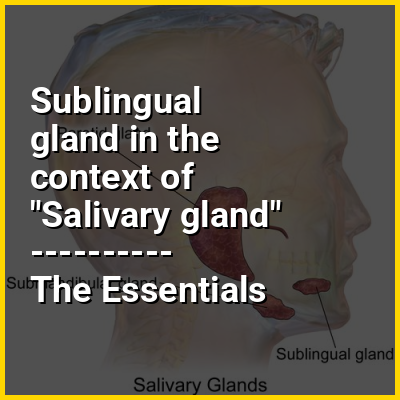
Sublingual gland in the context of "Salivary gland"

Play Trivia Questions online!

or

Skip to study material about Sublingual gland in the context of "Salivary gland"

Ad spacer

>>>PUT SHARE BUTTONS HERE<<<

👉 Sublingual gland in the context of Salivary gland

The salivary glands in many vertebrates including mammals are exocrine glands that produce saliva through a system of ducts. Humans have three paired major salivary glands (parotid, submandibular, and sublingual), as well as hundreds of minor salivary glands. Salivary glands can be classified as serous, mucous, or seromucous (mixed).

In serous secretions, the main type of protein secreted is alpha-amylase, an enzyme that breaks down starch into maltose and glucose, whereas in mucous secretions, the main protein secreted is mucin, which acts as a lubricant.

↓ Explore More Topics
In this Dossier

Sublingual gland in the context of Serous glands

Serous glands secrete serous fluid. They contain serous acini, a grouping of serous cells that secrete serous fluid, isotonic with blood plasma, that contains enzymes such as alpha-amylase.

Serous glands are most common in the parotid gland and lacrimal gland but are also present in the submandibular gland and, to a far lesser extent, the sublingual gland.

↑ Return to Menu