Stratum spinosum in the context of "Stratum lucidum"

Play Trivia Questions online!

or

Skip to study material about Stratum spinosum in the context of "Stratum lucidum"


⭐ Core Definition: Stratum spinosum

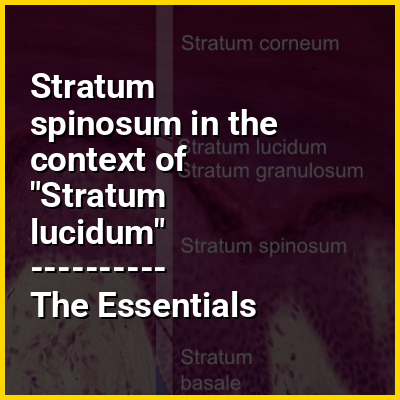
The stratum spinosum (or spinous layer/prickle cell layer) is a layer of the epidermis found between the stratum granulosum and stratum basale. This layer is composed of polyhedral keratinocytes. These are joined with desmosomes. Their spiny (Latin, spinosum) appearance is due to shrinking of the microfilaments between desmosomes that occurs when stained with H&E. Keratinization begins in the stratum spinosum, although the actual keratinocytes begin in the stratum basale. They have large pale-staining nuclei as they are active in synthesizing fibrillar proteins, known as cytokeratin, which build up within the cells aggregating together forming tonofibrils. The tonofibrils go on to form the desmosomes, which allow for strong connections to form between adjacent keratinocytes. The stratum spinosum also contains Langerhans cells, which functions as a macrophage by engulfing bacteria, foreign particles, and damaged cells that occur in this layer.

↓ Menu

πŸ‘‰ Stratum spinosum in the context of Stratum lucidum

The stratum lucidum (Latin, 'clear layer') is a thin, clear layer of dead skin cells in the epidermis named for its translucent appearance under a microscope. It is readily visible by light microscopy only in areas of thick skin, which are found on the palms of the hands and the soles of the feet.

Located between the stratum granulosum and stratum corneum layers, it is composed of three to five layers of dead, flattened keratinocytes. The keratinocytes of the stratum lucidum do not feature distinct boundaries and are filled with eleidin, an intermediate form of keratin. They are surrounded by an oily substance that is the result of the exocytosis of lamellar bodies accumulated while the keratinocytes are moving through the stratum spinosum and stratum granulosum.

↓ Explore More Topics
In this Dossier

Stratum spinosum in the context of Integumentary

The integumentary system is the set of organs forming the outermost layer of an animal's body, comprising the skin, hair, scales, feathers, hooves, claws, and nails. It acts as a protective physical barrier between the external environment and the internal environment. Additionally, it maintains water balance, protects the deeper tissues, excretes waste, regulates body temperature, and contains the sensory receptors that detect pain, sensation, pressure, and temperature.

The skin (integument) is a composite organ, made up of at least two major layers of tissue: the outermost epidermis and the inner dermis, which are separated by a basement membrane (comprising basal lamina and reticular lamina). The epidermis comprises five layers: the stratum corneum, stratum granulosum, stratum spinosum and stratum basale. Where the skin is thicker, such as in the palms and soles, there is an extra layer of skin between the stratum corneum and the stratum granulosum known as the stratum lucidum. The dermis comprises two sections, the papillary and reticular layers, and contains connective tissues, blood vessels, glands, follicles, hair roots, sensory nerve endings, and muscular tissue. Between the integument and the deep body musculature there is a transitional subcutaneous zone, the hypodermis.

↑ Return to Menu

Stratum spinosum in the context of Stratum granulosum

The stratum granulosum (or granular layer) is a thin layer of cells in the epidermis lying above the stratum spinosum and below the stratum corneum (stratum lucidum on the soles and palms). Keratinocytes migrating from the underlying stratum spinosum become known as granular cells in this layer. These cells contain keratohyalin granules, which are filled with histidine- and cysteine-rich proteins that appear to bind the keratin filaments together.Therefore, the main function of keratohyalin granules is to bind intermediate keratin filaments together.

At the transition between this layer and the stratum corneum, cells secrete lamellar bodies (containing lipids and proteins) into the extracellular space. This results in the formation of the hydrophobic lipid envelope responsible for the skin's barrier properties. Concomitantly, cells lose their nuclei and organelles.

↑ Return to Menu

Stratum spinosum in the context of Stratum basale

The stratum basale (basal layer, sometimes referred to as stratum germinativum) is the deepest layer of the five layers of the epidermis, the external covering of skin in mammals.

The stratum basale is a single layer of columnar or cuboidal basal cells. The cells are attached to each other and to the overlying stratum spinosum cells by desmosomes and hemidesmosomes. The nucleus is large, ovoid and occupies most of the cell. Some basal cells can act like stem cells with the ability to divide and produce new cells, and these are sometimes called basal keratinocyte stem cells. Others serve to anchor the epidermis glabrous skin (hairless), and hyper-proliferative epidermis (from a skin disease).

↑ Return to Menu

Stratum spinosum in the context of List of cutaneous conditions

Many skin conditions affect the human integumentary systemβ€”the organ system covering the entire surface of the body and composed of skin, hair, nails, and related muscles and glands. The major function of this system is as a barrier against the external environment. The skin weighs an average of four kilograms, covers an area of two square metres, and is made of three distinct layers: the epidermis, dermis, and subcutaneous tissue. The two main types of human skin are: glabrous skin, the hairless skin on the palms and soles (also referred to as the "palmoplantar" surfaces), and hair-bearing skin. Within the latter type, the hairs occur in structures called pilosebaceous units, each with hair follicle, sebaceous gland, and associated arrector pili muscle. In the embryo, the epidermis, hair, and glands form from the ectoderm, which is chemically influenced by the underlying mesoderm that forms the dermis and subcutaneous tissues.

The epidermis is the most superficial layer of skin, a squamous epithelium with several strata: the stratum corneum, stratum lucidum, stratum granulosum, stratum spinosum, and stratum basale. Nourishment is provided to these layers by diffusion from the dermis since the epidermis is without direct blood supply. The epidermis contains four cell types: keratinocytes, melanocytes, Langerhans cells, and Merkel cells. Of these, keratinocytes are the major component, constituting roughly 95 percent of the epidermis. This stratified squamous epithelium is maintained by cell division within the stratum basale, in which differentiating cells slowly displace outwards through the stratum spinosum to the stratum corneum, where cells are continually shed from the surface. In normal skin, the rate of production equals the rate of loss; about two weeks are needed for a cell to migrate from the basal cell layer to the top of the granular cell layer, and an additional two weeks to cross the stratum corneum.

↑ Return to Menu