Stratified sampling in the context of Statistical sample


Stratified sampling in the context of Statistical sample

Stratified sampling Study page number 1 of 1

Play TriviaQuestions Online!

or

Skip to study material about Stratified sampling in the context of "Statistical sample"


⭐ Core Definition: Stratified sampling

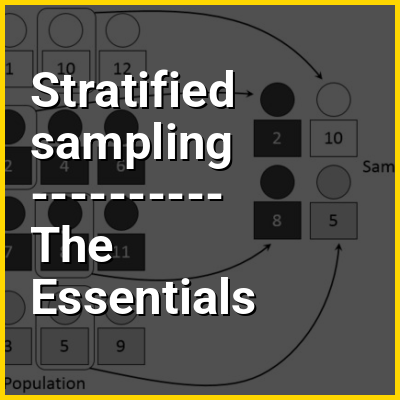
In statistics, stratified sampling is a method of sampling from a population which can be partitioned into subpopulations.

In statistical surveys, when subpopulations within an overall population vary, it could be advantageous to sample each subpopulation (stratum) independently.

↓ Menu
HINT:

In this Dossier

Stratified sampling in the context of Sample (statistics)

In statistics, quality assurance, and survey methodology, sampling is the selection of a subset or a statistical sample (termed sample for short) of individuals from within a statistical population to estimate characteristics of the whole population. The subset is meant to reflect the whole population, and statisticians attempt to collect samples that are representative of the population. Sampling has lower costs and faster data collection compared to recording data from the entire population (in many cases, collecting the whole population is impossible, like getting sizes of all stars in the universe), and thus, it can provide insights in cases where it is infeasible to measure an entire population.

Each observation measures one or more properties (such as weight, location, colour or mass) of independent objects or individuals. In survey sampling, weights can be applied to the data to adjust for the sample design, particularly in stratified sampling. Results from probability theory and statistical theory are employed to guide the practice. In business and medical research, sampling is widely used for gathering information about a population. Acceptance sampling is used to determine if a production lot of material meets the governing specifications.

View the full Wikipedia page for Sample (statistics)
↑ Return to Menu

Stratified sampling in the context of Sampling fraction

In sampling theory, the sampling fraction is the ratio of sample size to population size or, in the context of stratified sampling, the ratio of the sample size to the size of the stratum.The formula for the sampling fraction is

where n is the sample size and N is the population size. A sampling fraction value close to 1 will occur if the sample size is relatively close to the population size. When sampling from a finite population without replacement, this may cause dependence between individual samples. To correct for this dependence when calculating the sample variance, a finite population correction (or finite population multiplier) of may be used. If the sampling fraction is small, less than 0.05, then the sample variance is not appreciably affected by dependence, and the finite population correction may be ignored.

View the full Wikipedia page for Sampling fraction
↑ Return to Menu