Stirlingshire in the context of "Loch Lomond"

Play Trivia Questions online!

or

Skip to study material about Stirlingshire in the context of "Loch Lomond"

Ad spacer

⭐ Core Definition: Stirlingshire

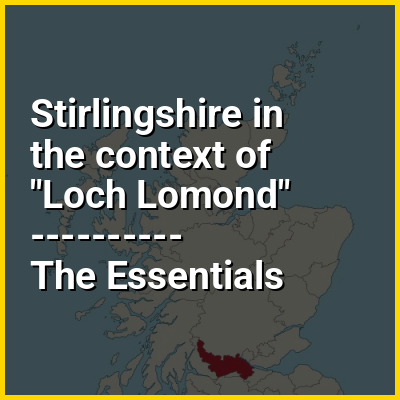
Stirlingshire or the County of Stirling (Scottish Gaelic: Siorrachd Sruighlea [ˈʃirˠəxk ˈs̪t̪ɾuʝlə]) is a historic county and registration county of Scotland. Its county town is Stirling.

It borders Perthshire to the north, Clackmannanshire to the east, West Lothian to the south-east, Lanarkshire to the south, and Dunbartonshire to the south and south-west (this latter boundary is split in two owing to Dunbartonshire's Cumbernauld exclave).

↓ Menu

>>>PUT SHARE BUTTONS HERE<<<

👉 Stirlingshire in the context of Loch Lomond

Loch Lomond (/ˈlɒx ˈlmənd/; Scottish Gaelic: Loch Laomainn) is a freshwater Scottish loch which crosses the Highland Boundary Fault (HBF), often considered the boundary between the lowlands of Central Scotland and the Highlands. Traditionally forming part of the boundary between the counties of Stirlingshire and Dunbartonshire, Loch Lomond is split between the council areas of Stirling, Argyll and Bute and West Dunbartonshire. Its southern shores are about 23 kilometres (14 mi) northwest of the centre of Glasgow, Scotland's largest city. The Loch forms part of the Loch Lomond and The Trossachs National Park which was established in 2002. From a limnological perspective, Loch Lomond is classified as a dimictic lake, meaning it typically undergoes two mixing periods each year. This occurs in the spring and autumn when the water column becomes uniformly mixed due to temperature-driven density changes

Loch Lomond is 36.4 kilometres (22.6 mi) long and between one and eight kilometres (12–5 miles) wide, with a surface area of 71 km (27.5 sq mi). It is the largest lake in Great Britain by surface area; in the United Kingdom, it is surpassed only by Lough Neagh and Lough Erne in Northern Ireland. In the British Isles as a whole there are several larger loughs in the Republic of Ireland. The loch has a maximum depth of about 190 metres (620 ft) in the deeper northern portion, although the southern part of the loch rarely exceeds 30 metres (98 ft) in depth. The total volume of Loch Lomond is 2.6 km (0.62 cu mi), making it the second largest lake in Great Britain, after Loch Ness, by water volume.Due to its considerable depth and latitudinal location, Loch Lomond exhibits thermal stratification during the summer months, with a distinct epilimnion, metalimnion, and hypolimnion forming in deeper areas. These stratification patterns have important implications for nutrient cycling and aquatic ecology within the loch. During periods of stratification, a decrease in hypolimnetic oxygen can occur in the deeper northern basin, which can affect the species distribution patterns.
↓ Explore More Topics
In this Dossier

Stirlingshire in the context of Dunmore Pineapple

The Dunmore Pineapple is a folly in Dunmore Park, near Airth in Stirlingshire, Scotland. In 1995, it was ranked "as the most bizarre building in Scotland".

↑ Return to Menu

Stirlingshire in the context of River Forth

The River Forth is a major river in central Scotland, 47 km (29 mi) long, which drains into the North Sea on the east coast of the country. Its drainage basin covers much of Stirlingshire in Scotland's Central Belt. The Gaelic name for the upper reach of the river, above Stirling, is Abhainn Dubh, meaning "black river". The name for the river below the tidal reach (just past where it is crossed by the M9 motorway) is Uisge For.

↑ Return to Menu

Stirlingshire in the context of North Lanarkshire

North Lanarkshire (Scots: North Lanrikshire; Scottish Gaelic: Siorrachd Lannraig a Tuath) is one of the 32 council areas of Scotland. It borders the north-east of the Glasgow City council area and contains many of Glasgow's suburbs, commuter towns, and villages. It also borders East Dunbartonshire, Falkirk, Stirling, South Lanarkshire, and West Lothian. The council area covers parts of the historic counties of Dunbartonshire, Lanarkshire, and Stirlingshire. The council is based in Motherwell.

The area was formed in 1996, covering the districts of Cumbernauld and Kilsyth, Motherwell, and Monklands, plus the Chryston and Auchinloch areas from Strathkelvin district, all of which had been in the Strathclyde region between 1975 and 1996. As a new single-tier authority, North Lanarkshire became responsible for all functions previously performed by both the regional council and the district councils, which were abolished.

↑ Return to Menu

Stirlingshire in the context of Grangemouth

Grangemouth (Scots: Grangemooth; Scottish Gaelic: Inbhir Ghrainnse, pronounced [ˈiɲɪɾʲ ˈɣɾaiɲʃə]) is a town in the Falkirk council area in the central belt of Scotland. Historically part of the county of Stirlingshire, the town lies in the Forth Valley, on the banks of the Firth of Forth, three miles (five kilometres) east of Falkirk, five miles (eight kilometres) west of Bo'ness and 13 miles (21 km) south-east of Stirling. Grangemouth had a resident population of 17,906 according to the 2001 Census. Preliminary figures from the 2011 census reported the number as 17,373.

Grangemouth's original growth as a town relied mainly on its geographical location. Originally a bustling port, trade flowed through the town with the construction of the Forth and Clyde Canal in the 18th century. Nowadays, the economy of Grangemouth is focused primarily on the large petrochemical industry of the area which includes the oil refinery, owned by Ineos, one of the largest of its kind in Europe. The town is twinned with La Porte, Indiana, U.S..

↑ Return to Menu

Stirlingshire in the context of Perthshire

Perthshire or the County of Perth, is a historic county and registration county in central Scotland.

Geographically Perthshire extends from Strathmore in the east, to the Pass of Drumochter in the north, Rannoch Moor and Ben Lui in the west, and Aberfoyle in the south; it borders the counties of Inverness-shire and Aberdeenshire to the north, Angus to the east, Fife, Kinross-shire, Clackmannanshire, Stirlingshire and Dunbartonshire to the south and Argyllshire to the west.

↑ Return to Menu

Stirlingshire in the context of Clackmannanshire

Clackmannanshire (/klækˈmænənˌʃɪər, -ʃər/ ; Scots: Clackmannanshire; Scottish Gaelic: Siorrachd Chlach Mhanann), or the County of Clackmannan, is a historic county, council area, registration county and lieutenancy area in Scotland, bordering the council areas of Stirling, Fife, and Perth and Kinross. To the south, it is separated from Falkirk by the Firth of Forth. In terms of historic counties it borders Perthshire, Stirlingshire and Fife.

The name consists of elements from three languages. The first element is from Scottish Gaelic: Clach meaning "Stone". Mannan is a derivative of the Brythonic name of the Manaw, the Iron Age tribe who inhabited the area. The final element is the English word shire. As Britain's smallest historic county, it is often nicknamed "The Wee County". When written, Clackmannanshire is commonly abbreviated to Clacks.

↑ Return to Menu

Stirlingshire in the context of Stirling

Stirling (/ˈstɜːrlɪŋ/; Scots: Stirlin; Scottish Gaelic: Sruighlea [ˈs̪t̪ɾuʝlə]) is a city in central Scotland, 26 miles (42 km) northeast of Glasgow and 37 miles (60 km) north-west of Edinburgh. The city is surrounded by rich farmland and had a royal citadel, the medieval old town with its merchants and tradesmen, the Old Bridge and the port are all linked in to its history. Situated on the River Forth, Stirling is the administrative centre for the Stirling council area, and is traditionally the county town and historic county of Stirlingshire. Stirling's key position as the lowest bridging point of the River Forth before it broadens towards the Firth of Forth made it a focal point for travel north or south. It has been said that "Stirling, like a huge brooch clasps Highlands and Lowlands together". The city's status as "Gateway to the Highlands" also historically lent it great strategic importance—the credo "he who holds Stirling, holds Scotland" is sometimes attributed to Robert the Bruce.

When Stirling was temporarily under Anglo-Saxon sway, according to a 9th-century legend, it was attacked by Danish invaders. The sound of a wolf roused a sentry, however, who alerted his garrison, which forced a Viking retreat. This led to the wolf being adopted as a symbol of the town as is shown on the 1511 Stirling Jug. The area is today known as Wolfcraig. Even today the wolf appears with a goshawk on the council's coat of arms along with the recently chosen motto: "Steadfast as the Rock".

↑ Return to Menu